Author: admin

  • Valuable Security Certifications for 2019

    Valuable Security Certifications for 2019

    Valuable Security Certifications for 2019

    This year, we witnessed the scariest cybersecurity threats with major breaches suffered by global entities like Facebook (breached 87 million records). The immense scale of these breaches of information security is equated not only with greater damage and media coverage but also with more IT and programming professionals employment opportunities.

    Yes, you hear me right! Over the past few years, the demand for cybersecurity experts has continued to rise. Gaining training in this region is, therefore, an ideal way to build up your career potential. You will achieve your career goals easily and rapidly with the right certification. And as an IT professional seeking the next step in your career, you should start caring about how to make your professional life more satisfying. One possible way you can grow an outstanding career is by continuing to invest your time and money to validate your skills set, knowledge and experience, and there’s no better method to do this than to earn an IT certificate.

    So what are the most valuable cybersecurity certifications? Well, It depends on who you are asking, and how you look at it. While some training courses or certifications pay more than others, the only differences among all of them are negligible and all of them are valuable. Want to know why? Continue reading to grasp and learn more about it.

    So here is the list of the Valuable Security Certifications for IT Professionals:

    CISSP Certified Information Systems Security Professional

    CISSP is a specialized-level IT certification. It is tailored for people who are serious about seeking an information security career. ISC2 or the International Security Certification Consortium for Information Systems offers this certification. It is a vendor-neutral certification and is known internationally for its high standards. CISSP practitioners are in their organizations’ decision-makers. They possess the technical knowledge and expert skills needed within their companies to develop, manage and guide security standards, procedures and policies. There’s no doubt that this credential remains one of IT professionals highly sought after.

    Accelerate your CISSP qualification cybersecurity work. Earning the CISSP shows that you have what it takes to plan, execute and maintain a best-in-class cybersecurity system effectively. To obtain CISSP, applicants must have at least five years of experience working in at least two of eight common knowledge fields. Another option is having 4-year work experience with a college degree or other relevant credential in at least two of the Common Body of Knowledge domains.

    CBK domains of the International Information Systems Security Certification Consortium are as follows:

    • Security and Risk Management
    • Security Architecture and Engineering
    • Asset Security
    • Identity and Access Management
    • Security Operations
    • Security Assessment and Testing
    • Software Development Security
    • Communications and Network Security are the CBK domains of the International Information Systems Security Certification Consortium.

    CompTIA Security+

    CompTIA Security+ is the first and highly recommended certification an IT practitioners should have. It defines the key knowledge necessary for any position in cybersecurity and offers a springboard to cybersecurity positions at the intermediate level.

    Although Security+ is an entry-level training course, potential participants should have at least 2 years of network security training and consider gaining Network+ certification first. IT professionals who receive this certification have expertise in areas such as threat management, identity management, cryptography, security systems, identification and mitigation of security risks, security infrastructure, and control of network access.

    The certificate of CompTIA Security+ is also recognized by the United States. Defense Department to conform with requirements of Directive 8140/8570.01-M. The Security+ credential also complies with ISO 17024 standards.

    The Security+ certification includes a one-off test, currently at a cost of $339, with discounts on CompTIA employees and full-time students. Training is not mandatory but is available.

    IT specialists who have been granted the Security+ certification before the 1st of January 2011 will remain Security+ life-certified. Those who enroll after that date have to renew the certificate every 3 years in order to stay up to date. Applicants must successfully complete 50 Continuing Education Units (CEUs) or finish the online course of CertMaster CE before the 3-year period expires to renew.

    CISM Certified Information Security Manager

    The CISM or Certified Information Security Manager is a prestigious certification for IT specialists who are responsible for running, designing and coordinating information security programs for projects at the business level and developing best practices in organizational management. Credential holders have advanced and proven capabilities in managing and responding to security risks, governance, program development and management, and incident management.

    In order to get this credential, you must follow the following listed below:

    • You must be prepared to agree to the ISACA Code of Professional Ethics
    • You need to have at least 5-years of Security Experience
    • Continue to comply with ISACA’s continuing Education Policy
    • You have to pass the CISM Exam and apply for CISM certification. The certification must be acquired within five years of the successful completion of the examination.

    For three years, the credential is valid. You’ll be required to renew your certification after that.

    CEH Certified Ethical Hacker

    A Certified Ethical Hacker is a trained specialist who acknowledges and knows how to find flaws and vulnerabilities in target networks and uses the same tools and knowledge as a malicious hacker, but in a legal and legitimate manner to determine a target system’s security posture.

    Hackers are certified innovators and will certainly find creative ways of attacking information systems and taking advantage of system vulnerabilities constantly. Organizations with experience in keeping their pc and online credential safe and secure and have resources who know how to combat hackers at their own games, they often hired a professional or expert classified as White Hat Hackers who proactively secure their information systems. These experts use the same skills and knowledge hackers use to detect device flaws or access points and prevent unwanted network or information systems exposure through hackers.

    The Ethical Hacker Certification is a mid-level certification from the International Council of E-Commerce Consultants for IT practitioners who have a background in ethical hacking and it is absolutely essential to have it.

    Candidates must complete one examination to receive a CEH certificate. A 5-day intensive CEH training program with an examination at the conclusion of the course is recommended. Applicants can self-study for the examination but have to have documents with at least 2 years of work experience with employer confirmation of information security.

    Due to the almost daily changes in hacking technology, CEH credentials are required for every 3-year cycle to obtain 120 continuous training credits.

    Bottomline

    The world is expected to pay $6 trillion per year by 2021, compared with $3 trillion in 2015 for cybercrime damages. Cybersecurity Ventures estimates a growing market for skilled cybersecurity specialists or to individuals who want to get started with their cyber-security professional career in the next decade, which makes a valuable investment for Security Certifications.

    Many other certifications are available to pursue or keep an eye on. The early you pursue on any given certifications given above, the soonest your career is expected to benefit from. If you are currently aiming to level up your career, these certificates highlighted above are perfect options for you to consider.


    Author Bio:
    John is an Opera Singer by profession, and a member of The Philippine Tenors. Ever since, Digital Marketing has always been his forte. He is the CEO of MegaMedia Internet Advertising Inc., and the Managing Director of Tech-Hacker. John is also the current SEO Manager of Softivire New Zealand and Softvire Australia – the leading software ecommerce company in Australia.
  • SEO in 2019

    SEO in 2019

    SEO in 2019

    SEO requires continuous work to ensure you maintain your existing rankings and to improve your position in Google search. What are the things you should be thinking about and acting on in SEO in 2019? Here are eight of the most important.

    The Advance of Mobile

    Overall, a huge percentage of people search using mobile devices rather than computers. While the results are different industry-by-industry, all business owners need to focus their efforts on improving the experience of mobile users.

    Remember as well that Google is increasingly prioritising mobile. For example, it has adopted mobile-first indexing. This doesn’t mean it ignores desktop websites, but if your site is mobile friendly, it will look at that first.

    Content is Still King

    All three of the most important factors about your website from Google’s perspective will be covered in this blog. One of the three is the content on your pages, particularly the text.

    Put simply, you must ensure the content on your website is as good as possible. It needs to be sufficiently long (without being repetitive), and it needs to be helpful and engaging for users.

    This is as important in 2019 as it has ever been.

    You Gotta Have Speed

    Another element about your website that remains crucially important is page load speed. Google has been focused, almost from the day it launched, on speeding up the internet. That focus continues in 2019. So, if your site takes too long to load, your priority this year should be to speed it up.

    Security Can’t Be Ignored

    Security is now important for all websites, not just those where users or customers send personal or sensitive information. Even if the only place you ask people to enter information on your website is a contact form, Google wants you to make your website more secure.

    This means adding encryption by getting an SSL certificate. This is a fairly straightforward thing to do, so your website developer or SEO provider will be able to sort it out for you quickly. It’s not costly, either, so should not be ignored.

    Evolving Your Backlink Strategy

    In one of the above points, the fact that Google has three main ranking factors was mentioned. One of those three is links. In fact, links are arguably the most important of the three big ranking factors.

    If you want success in SEO in 2019, you need to continue building backlinks to your website. This involves creating fantastic content that people want to link to, having a good social media strategy to ensure as many people see your posts as possible, and sharing your content in as many other different ways as you can.

    There are two other things you should think about in 2019, however, if they are not already part of your strategy:

    • Targeting your competitor’s backlinks – this is a simple concept but is one that can produce excellent results. It involves researching the websites of your competitors to find out where they are getting backlinks from. Your SEO provider can give you this information, plus there are plenty of tools on the internet that will give you a backlink profile of almost any website on the internet. You can then devise plans and strategies to get links from the same or similar sources that your competitors are getting them from.
    • Increase mentions to your website – links are one option that websites have when including a reference to your business. The other main one is by mentioning your company name, brand, or product without linking back to your site. This is called a mention in SEO and, while it’s not as beneficial as a link, it still helps.

    Focus on Search Intent

    This point is absolutely crucial, particularly if you have a fairly advanced SEO strategy in place already. This is because search intent is one of the main priorities of Google at the moment, as you’ll see in the next point below.

    Focusing on search intent means thinking beyond a keyword, instead thinking about why people use that keyword when they search.

    The most important keywords are those that have a buying intent, i.e. where there is a chance you can get the person into your sales funnel. This covers everything from someone using a keyword for initial research on a product or service right down to a person who has decided on what they want and is ready to make a buying decision.

    Many of these will be long tail keywords. If you don’t yet include in your SEO strategy long tail keywords that have buying intent, 2019 is the time to start.

    Get Your Head Around RankBrain

    RankBrain is the third of three main factors that Google considers when ranking websites on search results pages. It is something that hasn’t had much focus in SEO, particularly with small and medium-sized businesses. It is becoming more important, however, so this year is a good time to start getting an understanding of what RankBrain is.

    In very simple terms, RankBrain is a machine learning algorithm. Its main job is to help order search results for keywords that Google has never seen before (which is about 450 million a day). In other words, RankBrain tries to understand the intent of the user so it can display search results that don’t include the keyword used in the query the person typed into Google.

    Start Adapting for Evolving Search Patterns

    The way people search on the internet is changing. Of course, Google is still the dominant search player. However, there are other things you should be aware of that could influence your SEO strategy in 2019. At the very least, you should be thinking about the following:

    • Increasing use of voice search – the use of devices like the Amazon Echo is increasing. When people use these devices, they use a more conversational tone than they do when typing.
    • Siri and Bing – Siri, the personal assistant in iPhones and iPads, uses Microsoft Bing to answer search queries. Most companies, however, focus only on Google when thinking about SEO.
    • Amazon search – according to research, people looking for a product will search in Amazon before they look anywhere else, including Google.

    Setting Your Priorities

    All the above points will be important to SEO in 2019, but you need to focus on those that are both relevant to your business and likely to generate the best return on investment. This will help you improve your position and the results you achieve.

  • Importance of Long Tail Keywords in SEO

    Importance of Long Tail Keywords in SEO

    Importance of Long Tail Keywords in SEO

    Keywords come in all shapes and sizes. One common way of categorising them is either as a short tail or long tail keyword. Long tail keywords are longer phrases, i.e. phrases with more words. So, “building contractor” is a short tail keyword, while “renovations building contractor in Auckland” is a long tail keyword.

    As most companies focus on short tail keywords, the long tail variety presents you with a considerable business opportunity.

    Many of the world’s largest and most successful websites get this – websites like The Huffington Post, Forbes, Amazon, and eBay. They all have strategies that target long tail keywords, and you should too. Here are the reasons why:

    Additional Keywords You Can Rank For

    If you look at any industry or niche, individual short tail keywords are the most searched for terms. This is one of the reasons why they are the main target for most SEO strategies.

    However, 70 percent of searches are for long-tail keywords. So, even though individual keywords get lots of searches, the majority of web searches are long tail keywords.

    Less Competition

    Any individual short tail keyword that has a high search volume will be hard to compete for. Depending on your business, that competition could include major regional, national, or international websites that have significantly more resources available for SEO than you do.

    There is much less competition for long tail keywords, though, making them easier to rank for.

    Can Bring Significant Traffic to Your Website

    Following on from the previous two points, long tail keywords can result in your website attracting more visitors. Here’s how:

    • You create high-quality content on your website targeting long tail keywords
    • The content ranks near the top of search results pages because there isn’t much competition
    • You get clicks through to your website

    Traffic is More Targeted

    Another factor to remember is that long tail keywords are often very specific. Look at the example from the start of this article:

    • Short tail keyword “building contractor” – this could mean anything, from a building contractor who specialises in major commercial projects to a building contractor who covers a different geographical location.
    • Long tail keyword “renovations building contractor in Auckland” – if you’re an Auckland-based building contractor who specialises in renovations work, this is a better keyword to rank for.

    In fact, it is often the case that people use long tail keywords the closer they get to making a buying decision. So, at the start of their research, a person looking for a building contractor might use the keyword “building contractor”. They will then refine their searches as they get closer to understanding what they need, using long tail keywords in the process.

    Better Conversion Rates

    This point follows on from the previous one, i.e. if the keywords are more targeted, you are more likely to get a higher conversion rate.

    Ideal for Competitive Industries and Niches

    Long tail keywords are suitable for any SEO strategy, whatever products or services you sell. That said, all the previous points combined make long tail keyword strategies particularly useful if you are in a competitive industry or niche.

    This is because you may not be able to compete with the SEO budgets of the big players on the web, whether those sites are international or New Zealand-based. Instead, you have to think smarter, which means targeting long tail keywords.

    Less Expensive Method of Beating Your Competition

    Whether you’re in a competitive industry or not, targeting long tail keywords in your SEO strategy is much less costly than targeting short tail keywords. Therefore, if your competitors currently rank higher than you, targeting long tail keywords is an approach that is likely to deliver the best return on investment.

    Easier to Optimise Content

    An essential part of targeting any keyword, short tail or long tail, is optimising the content on your website in general, as well as on individual pages. This can be tricky when targeting short tail keywords, not least because you face the ever-present risk of over-optimising. Over-optimising can be worse than not optimising at all.

    Long tail keywords are much easier to optimise. For example, you can identify an important long tail keyword and then write a blog on that topic, using the keyword in the headline and in other strategic locations. After a few additional steps, you will have a page of content optimised for the targeted long tail keyword.

    Good for Voice Searches

    Another factor to consider when looking at long tail keywords is voice search. Voice search is becoming increasingly important given the growing popularity of devices like Amazon Echo and Google Home.

    When people search using one of these devices, they naturally use language that is more conversational, i.e. they use long tail keywords. Therefore, targeting long tail keywords will help increase the visibility of your website and brand on voice searches.

    Improve Bounce Rate

    In brief, your bounce rate is the percentage of people who visit your website from Google search and then leave soon after arriving without visiting any other pages, i.e. they hit your website and bounce off it.

    While this rule doesn’t apply in all situations, a high bounce rate can be an indication to Google that people visiting your website are not getting the information they are looking for. Google doesn’t like this.

    As a result, it’s often better to have a bounce rate that is as low as possible.

    The content on your website targeting long tail keywords is more likely to provide users with the information they are looking for. This means they are less likely to bounce, reducing your bounce rate.

    Builds Better Relationships with Visitors

    Following on from the above point, providing a Google search user with a focused and specific answer to their query helps to build your brand and increase your reputation. Content optimised for long tail keywords achieves this.

    Helps with Your Social Media Strategy

    Finally, long tail keywords can often help with your social media strategy, albeit indirectly. The previous two points are important in understanding this, i.e. the fact that content optimised for a long tail keyword is likely to directly answer a search user’s query.

    This increases the possibility the person will then share the page on their social media channels, helping your overall social media strategy.

    Start Targeting Long Tail Keywords

    As you can see above, there are lots of benefits to targeting long tail keywords. They should be a central part of your SEO strategy.

  • SEO Pagination and its Best Practices

    SEO Pagination and its Best Practices

    SEO Pagination and its Best Practices

    Pagination is a necessary feature on many websites, particularly if you have a large number of articles (an active blog section, for example), or a large number of products on your website. How does pagination impact SEO and what should you do to optimise pagination on your website?

    SEO pagination is an advanced area of SEO, but for many it is important. Let’s start at the beginning, though.

    What is Pagination and Why Do Websites Have It?

    Website developers add pagination to websites to improve the way the website displays information. An example will illustrate this best.

    Let’s say you sell products on your website, with 1,000 products over 10 categories, with an average of 100 products per category. One of the options you are likely to give users on your website is the option to view all the products in a category.

    How do you display that information? Do you put all 100 products on one page? Or, do you paginate the category, putting 10 products per page with links for the user to scroll through the pages?

    Most websites choose the second option, including large websites like Amazon. One of the reasons they do is the fact that putting 100 products on a page would have a detrimental impact on page load times.

    So, in summary, the most common usage of pagination is to make it easier to display large amounts of information.

    Before moving on, though, there is another usage of pagination that you might have seen on websites – pagination within an article. In other words, a single article split over multiple pages.

    This is a very different usage of pagination. Instead of helping users, website owners use this option so they can show more ads to visitors, i.e. as the user clicks through to each new page in the article, they see a new set of ads.

    In this blog, however, we’re going to focus on the more common usage of pagination – to display large amounts of information.

    Types of Pagination

    • Article pagination – as mentioned above, a single article spread across more than one page
    • Gallery pagination – where each image or gallery item as its own page
    • Forum thread pagination – where a single forum thread has multiple pages
    • Category pagination – where each category has its own page, like the product listing example mentioned above
    • Infinite scroll pagination – where the website adds new information to the page whenever the user scrolls

    The Impact of Pagination on SEO

    The primary concern of most website owners when considering SEO and pagination is the fact that Google can, and probably will, index multiple paginated pages. In other words, it will index page two, three, four, etc in a paginated series as well as page one.

    This is an issue for two main reasons:

    • Most website owners put the most relevant information on page one of a paginated series. Therefore, they want users to see page one first. A Google search, however, might return page two in the paginated series, for example, or any other page.
    • Depending on the size of your website, you might run into crawl bandwidth issues. In other words, the Google crawler will only spend so much time on your website indexing pages. If it gets stuck indexing multiple pages in multiple paginated series, it might not crawl other, more important pages.

    The second point above is compounded by the fact that modern website Content Management Systems often add strings to URLs. This could result in not only lots of paginated pages in Google’s index, but also lots of variations of paginated pages.

    Outdated Solutions

    One method that some website owners use is to noindex every page except for page one in a paginated series. They do this in an attempt to force Google to prioritise page one.

    This can have unintended consequences, however, including the fact that Google will stop following internal links on the other pages in the series. As internal links are crucial to SEO, this method of optimising pagination could have a detrimental impact on your website’s overall SEO, so it’s not recommended.

    This means you should let Google index all pages in your paginated series.

    Pagination Best Practices

    Let’s first recap on the objectives of optimising the pagination feature of your website. There are two:

    • You want Google to understand that it has found a paginated series on your website. Furthermore, you want Google to know which page is page one in the series, so it knows that, from your perspective, it’s the most important page.
    • Secondly, you want to eliminate the variations of each paginated URL in Google’s index.

    Two different link elements are the solution.

    The first is:

    • rel=”next” and rel=”prev”

    You should apply this to the “Next” and “Previous” links that appear on pages in your paginated series. Often these links appear at the bottom of each page.

    Obviously, page one in the paginated series will only have a rel=”next” link element. Google will understand this means it is page one in the paginated series.

    All other pages will have both link elements, and the last page will have just rel=”prev”.

    What about the second objective – limiting the number of pages in Google’s index to only clean links in the paginated series, i.e. eliminating all the other links created dynamically by your CMS?

    The solution to this is the rel canonical link element. Specifically, on each page in your paginated series, you should add a canonical link to itself.

    What About Duplicate Content?

    One problem with pagination that website owners often highlight is duplicate content warnings. In other words, the pages in your paginated series are likely to have duplicate content, so you may get warnings.

    The simple answer to this one is you don’t need to worry. Google understands that not only is pagination a fact of the internet, duplicate content on pages in a paginated series is also a fact of the internet.

    So, while duplicate content warnings are important everywhere else, on paginated pages, you can ignore them.

    Optimising Your Paginated Pages

    The above may sound complex, but your website developer will be able to put in place solutions that automatically apply the rel=”next”, rel=”prev”, and rel canonical link elements to pages in a paginated series. Doing this will optimise them for SEO.


  • An Introduction to Keyword Research for eCommerce SEO

    An Introduction to Keyword Research for eCommerce SEO

    E-commerce Search Engine Optimisation (eCommerce SEO), is essential if you want to rank your online shop in as a high position on Google as possible. It will help your ranking on other search engines too, including Bing, but in 2025 Google is the most important search engine for e-commerce businesses in New Zealand.

    The Google shopping search results are delivered based on relevance (as with all Google results) and also recent searches by each individual. In this way search results are individualised.

    Doing this means knowing the specific keywords and phrases that are related to your shop products.

    So you’ll need to do keyword research, which is an essential bedrock of e-commerce SEO.

    Keyword Research

    For shopping SEO results make your keywords aligned with each product you sell. Different types of searchers need different results – general information is not the same as results for customers looking for products.

    Search queries align with each stage in the sales funnel. This includes people who have just started their search right through to people who know exactly what they want to buy and are now looking for the best deal.

    Your keywords must first appeal to product searchers, not information searchers. For a quick sale, you then want to capture people who are close to making a buying decision. Remember what we wrote about about individualisation? You may still make a sale if customer has previously clicked on your shop products and they come back to search again.

    Find Keywords With Buying Intent

    The aim is to identify commercial keywords that indicate how close the customer is to buying.

    Before you brief an SEO professional you need to know good keywords for your product range. Where do you find keywords?

    Start with places that people often use to search for products. This includes:

    • Google
    • Amazon
    • eBay
    • YouTube
    • Any other strong website that sells similar products to yours

    Start by typing into the search box a keyword you think will rank well. Look for autocomplete options that will suggest other related phrases or questions.

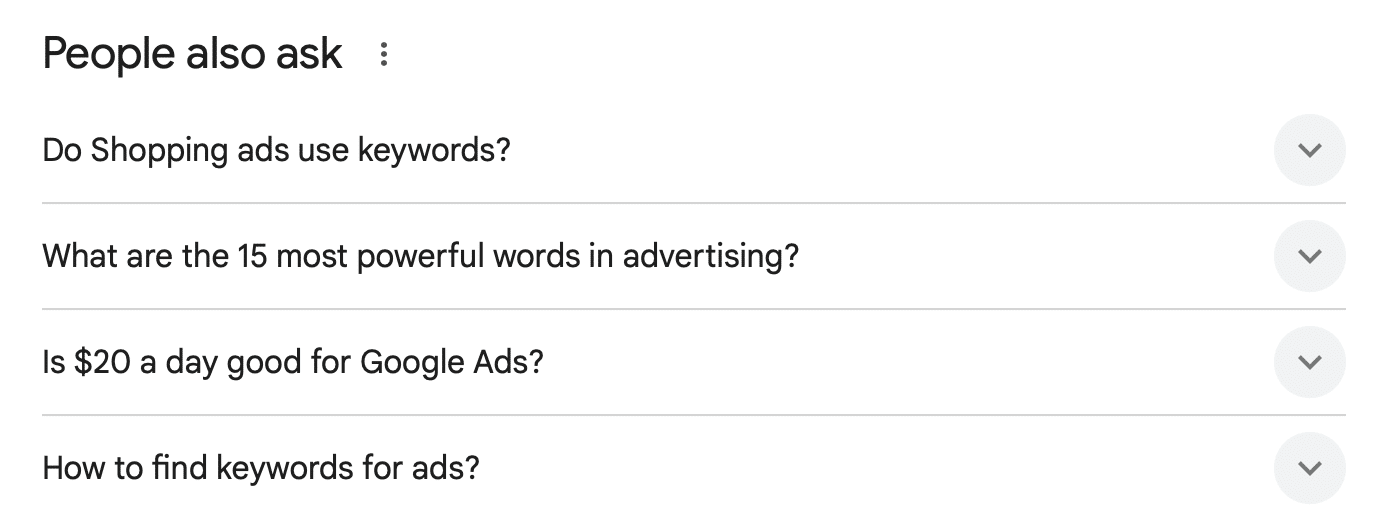
    On Google, also look for the People Also Ask section.

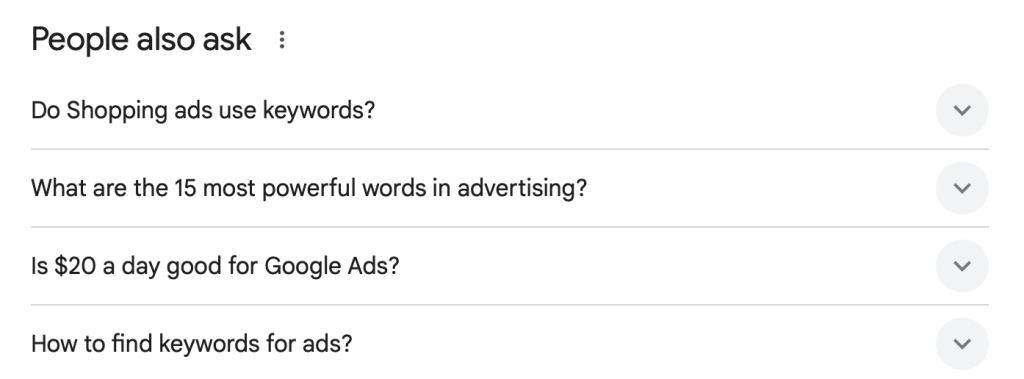
    Google Search section “People also ask”

    The great thing about using this technique to find keyword ideas is that major websites like Google, Amazon, and eBay understand the phrases the people use when searching for products, and they understand buying intent. They will show you answers which you may not have thought of.

    AdWords Keyword Planner

    You can also use the Keyword Planner in Google’s AdWords product to find keywords. You will need to have an AdWords account – it’s free.

    1. Sign in to your Google Ads account.
    2. Click the Tools icon (represented by a wrench symbol) in the top menu.
    3. Under the “Planning” section, select Keyword Planner

    The Keyword Planner will generate keyword ideas, and give you the average number of monthly searches for that keyword. You’ll also find AdWords bid information too, which can also be helpful because you can use the estimated bid for a keyword to get an idea of the level of competition that exists within the ad auction for that keyword.

    Research Your Competition

    The final source for e-commerce keyword research on this list is to check what your competitors use. Ubersuggest is a useful a keyword tool – it’s free to register but throttle control exists for daily searches.

    Also manually check competitor websites and look out for Page Titles of product pages as well as the titles they give to products. These are key words and key phrases.

    Keyword Research for E-Commerce SEO is an Ongoing Process

    SEO never stops. So don’t stop searching and adding to your list, finding new opportunities, and getting rid of under performing keywords. Make this a weekly 15 minute task.

    the numero® SEO team are happy to give your ecommerce store an audit to help you benchmark your performance against key competitors.

  • An Introduction to Keyword Research for E-Commerce SEO

    An Introduction to Keyword Research for E-Commerce SEO

    E-commerce Search Engine Optimisation (e-commerce SEO), is essential if you want to rank your online shop in as a high position on Google as possible. It will help your ranking on other search engines too, including Bing, but Google is the most important search engine for e-commerce businesses in New Zealand.

    Put simply, getting a high ranking in Google will ensure your website is seen by the masses.

    Doing this means knowing the specific keywords and phrases that people use in Google that are related to your content, website, or products

    This involves doing keyword research, which is an essential part of e-commerce SEO.

    Keyword Research

    Keep in mind that keywords needed for blogs and other website content will differ from those needed for your e-commerce store. The reason for this is that there are different types of searchers online. This includes people searching for general information, while others will be looking for products.

    In addition, you will have different types of people looking for products. This includes people who have just started their search right through to people who know exactly what they want to buy and are now looking for an e-commerce store that will give them the best deal.

    Your keywords must first appeal to product searchers, not the information searchers. You then ideally want to capture people who are close to making a buying decision.

    Find Keywords that Have Buying Intent

    The aim is to identify commercial keywords that indicate buying intent.

    Where do you find these keywords, however?

    You can start with places that people often use to search for products. This includes:

    • Google
    • Amazon
    • eBay
    • Any other strong website that sells similar products to yours

    Start by typing into the search box a keyword you think will rank well. You will then see autocomplete options that will show you other ideas that are related to the keyword you type.

    On Google, you can also scroll to the bottom of the search results page. There you will find a list of related search queries which can also be quite useful.

    The great thing about using this technique to find keyword ideas is that major websites like Google, Amazon, and eBay understand the phrases the people use when searching for products, and they understand buying intent.

    AdWords Keyword Planner

    You can also use the Keyword Planner in Google’s AdWords product to find keywords. You will need to create an AdWords account to do this, but getting an account is free.

    Not only will the Keyword Planner tool generate keyword ideas, it also gives you the average number of monthly searches for that keyword.

    It gives you AdWords bid information too, which can also be helpful, even when you don’t plan to run AdWords campaigns. This is because you can use the estimated bid for a keyword to get an idea of the level of competition that exists.

    Research Your Competition

    The final source for e-commerce keyword research on this list is to check what your competitors use. You may need a keyword tool to achieve this, although they can be expensive when you just want to check a few websites.

    You can, however, get information by manually checking the websites of your competitors. Things you should look out for are the Page Titles of product pages as well as the titles they give to products.

    Keyword Research for E-Commerce SEO is an Ongoing Process

    One final tip with keyword research for e-commerce SEO is that it is an ongoing process. Adding to the list, finding new opportunities, and lowering the priority of under performing keywords, will help you stay ahead of the competition.

  • Four SEO Basics to Begin Optimising Your E-Commerce Website

    Four SEO Basics to Begin Optimising Your E-Commerce Website

    Google can send free traffic to your e-commerce website and some of those visitors will then go on to buy something from you. Maximising the number of visitors that you get from Google, however, requires SEO.

    That said, SEO is a big topic, particularly for e-commerce websites. So, to get you started, here are four essential basics you need to know.

    Keywords

    Keywords are the phrases that potential customers type into Google when looking for the products you sell. When it comes to keywords, you should have the following goals:

    • Ensure your website appears on Google search results pages for all crucial keywords related to your products
    • Ensure your website appears as high up on these Google search results pages as possible

    You do this using several techniques:

    • Researching keywords so you know which ones to optimise your website for
    • Having one target keyword per page
    • Optimising each page by including the keyword in the page’s URL, title, heading, and in the content of the page
    • Telling people about the page to get them to link back to it

    That is a very quick overview, but it is a succinct description of the importance of keywords to SEO and how to make them work for your e-commerce website.

    Mobile-Friendly

    Having a mobile-friendly website is essential for SEO, whatever type of website you have. For e-commerce websites, however, this can be a bit more challenging.

    This is because many people consider how a website looks when they think about mobile. In other words, ensuring the website adjusts to display properly on a smaller screen.

    However, having a mobile-friendly website also means ensuring all the functions and features work for people using it on a mobile device. This includes your shopping cart and checkout processes.

    In fact, it should be just as quick, safe, and easy for a customer to buy something from your website using a mobile device as it is to make a purchase on a computer.

    Fast-Loading Website

    Your website should load quickly too. This is one area that many e-commerce websites fall down on, but it is critical. This is because Google loves fast-loading websites and it constantly advises website owners to make their websites faster.

    Consumers like fast-loading websites too. So, not only will a fast loading website help with your e-commerce SEO, it will also get you more sales.

    Reviews and Product Ratings

    The final essential SEO basic for e-commerce websites on this list is to add star ratings to the products you sell as well as getting reviews for your business. You should use one of Google’s approved services when doing this to ensure you get the maximum benefit.

    While the impact on rankings is not as great as other SEO factors, star reviews and ratings enhance the appearance of your website on search results pages. This is because Google displays star ratings on its search results pages, helping to encourage people to click.

    Getting Started with E-Commerce SEO

    Of course, there is much more to e-commerce SEO than the four points on this list. However, getting an understanding of these points and then taking action on them will improve your Google ranking and bring visitors to your website.

  • Choosing the Right Keywords for your Google AdWords Campaign

    Choosing the Right Keywords for your Google AdWords Campaign

    AdWords campaigns are a viable and, potentially, affordable way to bring a fresh influx of customers to your website. However, if you don’t use the right keywords, you run the risk of increasing the number of visitors without seeing any changes in your sales.

    Keywords help you tell Google who should see your ad to ensure you maximise every dollar invested in the campaign. When choosing keywords, there are several important rules to follow.

    #1: Think Like Your Customers

    If you were searching for black yoga pants, what’s the search term you would use in Google? Would it be ‘black yoga pants’ or just ‘pants’?

    When people want to buy, they are looking for specific products. So, to make sure your site pops up first when possible customers search for what they need, you should use specific keywords. True, highly specific keywords won’t bring as much traffic as general ones, but each click has a higher chance to turn into a sale. As a result, your campaign may get amazing results in terms of ROI, which is all you should care about.

    #2: Negative Keywords

    These are the keywords you use to make sure the wrong people don’t see your ads. For instance, if you sell TV sets but not PC monitors, you can add ‘PC monitors’ as a negative keyword. This way, people looking for a monitor won’t see or click on your ad, unnecessarily wasting your money.

    #3: Different Variations

    One way to make sure you reach as many customers as possible is to use different terms for what you’re selling. This includes synonyms, colloquial terms, common misspellings, singular and plural versions, and anything that usually shows up in searches.

    The secret is to use these versions for specific searches; don’t include general terms if you don’t want irrelevant clicks on your ad!

    #4: Use the Keyword Planner

    Google provides site owners with an easy-to-use tool that offers ideas for keywords and gives an estimate of the number of searches per month the keyword receives. As a result, you can estimate your ROI when planning and setting up a new Google AdWords campaign.

    The Keyword Planner tool also helps refine your initial keyword ideas to get a list that is more specific. For instance, if your initial keyword list included ‘snow boots’, the tool may show you that ‘cold weather boots’ is another keyword you should consider adding to your campaign.

    #5: Be Consistent

    As a rule of thumb, the keywords and phrases used in an AdWords campaign should be closely linked to the text you display in the PPC ad. Furthermore, the keywords should match the ones used on the landing page and website in general. This helps Google understand your ads are consistent.

    Overall, it’s important to make sure your ads are being clicked on by relevant viewers, i.e. those who are interested in making a purchase. A lot of that comes down to the keywords you choose, making keyword selection crucial to the success of your Google AdWords campaign.

  • Getting Started with E-Commerce in Auckland – A Beginner’s Guide

    Getting Started with E-Commerce in Auckland – A Beginner’s Guide

    There are plenty of advantages to owning an online e-commerce business in Auckland. This includes lowers costs than physical shops because you don’t have to pay rent and you will need fewer employees. An e-commerce website is also easier to maintain.

    E-commerce also offers advantages if you already have a business but want to expand online. At the top of that list is the fact your business will be in front of a wider and more diverse audience, increasing your brand presence and getting you more sales.

    However, before you move into online sales, you should also know what you’ll have to deal with when starting with e-commerce in Auckland.

    E-Commerce Platforms, Shopping Carts & Currency

    WooCommerce, Shopify, WIX, Magento, PrestaShop: which one is the best for your online store? They are all shopping carts, and the answer depends on your budget, customisation requirements, and the type of shopping cart you need.

    Each of these platforms offers different features, but they all have one thing in common: they power most of the world’s online stores.

    Since each platform offers shopping cart solutions, the only challenging part is setting it up for your business needs. This usually means setting your currency, prices, discounts, special offers, and more, which is why you should hire a specialist e-commerce website developer in Auckland for the job.

    Most big platform shopping carts offer options for e-commerce businesses that sell globally too.

    Regardless of the option you choose, it’s crucial you make sure the settings are correct and that your shopping cart works smoothly.

    Choosing a Merchant Solution

    Merchant solutions, also known as credit card processing solutions, handle the electronic payments coming through your website.

    In most cases, the shopping cart you choose will provide you with several merchant solution options. PayPal is one of the most widely used and trusted, but there are other options too.

    Also, think about your customers. PayPal, for example, is great when selling in Auckland and other parts of New Zealand. It is also popular in other countries, although this isn’t universal. Therefore, if you sell internationally, make sure the merchant solution you choose has a user base in your target countries.

    The SSL Certificate

    SSL stands for ‘Secure Sockets Layer’ and is a protocol that secures and protects data. The protocol encrypts data, such as personal or financial information, as it travels between your customer’s web browser and the server hosting your e-commerce store.

    While the presence or absence of an SSL certificate is important for SEO, when it comes to financial transactions, this certificate is mandatory if you want customers to trust you. After all, would you buy from a site that doesn’t do what it can to protect your personal information?

    Integration with Other Software Platforms

    Finally, make sure the e-commerce platform you choose can communicate with other software in your business such as inventory, storage management, CMS, CRM, and more.

    As you can see, there are many things to consider when starting out with e-commerce in Auckland. Getting them right from the start will save you money, time, and hassle in the future.

  • Website Design and SEO – Getting It Right from the Start

    Website Design and SEO – Getting It Right from the Start

    The easiest time to optimise your website for SEO is during the initial build phase. Getting it right from the start will give you a foundation to build on in the future. This means using a website designer in Auckland who understands SEO, but what are the things you should be aware of to ensure the job gets done properly? Are there things you can do?

    The Website Should be Responsive

    The starting point is your website should be responsive. This means using a design that automatically adapts – or responds – to a visitor’s device. In other words, ensuring your website looks great on phones and tablets as well as computers and laptops.

    Google is very focused on making the internet mobile-friendly, so this should be at the top of your website designer’s SEO checklist.

    One other point you should be aware of is that there are other ways of creating a mobile-friendly version of your website. Making the website responsive is the recommended approach, however, as well as being Google’s preferred option.

    Think About SEO When Writing Content

    Google uses keywords to connect website pages with people searching. Therefore, you should think about keywords when writing the content of your website pages. Specifically, you should include keywords in the content.

    Of course, your primary audience is the people visiting your website, so don’t use too many keywords (which looks spammy) and don’t use keywords in a way that makes sentences sound strange.

    Optimise Page Titles, Use Heading Tags, and Write Unique Meta Descriptions

    The page title is one of the most important SEO elements of your page. Google uses them to understand the content on the page, plus they appear on search results pages. You should have a unique page title for each page, plus you should include the page’s main keyword in the title.

    You should also use heading tags on your pages as Google looks for them. These are often referred to as H1, H2, etc headers. Ideally, include the main keyword of the page in the H1 tag.

    Each page on your website should also have a unique meta description. You will have seen many meta descriptions as they appear on all Google search results pages. They are the two lines that appear on a search result below the page title. Again, include the main keyword of the page in the meta description.

    Page Loading Speed is Crucial

    Google has always been obsessed with speed – it still shows you at the top of a search results page how long it took to do the search. This focus on speed applies to your website too. In other words, if you want to optimise your chances of appearing high on search results pages, you should ensure your website designer makes your website as fast as possible.

    The Design Should be User-Friendly

    User-friendly designs are important for SEO too. This means ensuring your website is free from clutter while also making menus easy to use and content easy to find. The more user-friendly your website is, the more Google will like it.

    Remember, designing a website is not just about making it look great – if this is the primary objective of your website designer you should be concerned. Instead, your website should deliver on your business objectives which, in most cases, means helping you get sales and leads. To do this, you need to get SEO right from the start.