You’re a business owner and you might be feeling the pinch – maybe sales are off or you are seeing inflation and margin erosion. Your thoughts are moving towards doing some marketing as a way to boost sales. If you aren’t confident about where to start and what to expect from different types of marketing activity.
numero® serves many, many business owners in New Zealand as their marketing agency of choice. We know the questions we get asked when speaking to our prospects, we know the results we can deliver in the first 90 days when we’re working with them. Let us help you with some guidance.
Online marketing is vital to the success of your business unless you have recurring contracts that sign up year after year without any sales contact needed. If this is you – congratulations – great business model. For the rest of us, we need to bring in new customers. This can be through any type of promotion, marketing or advertising on digital platforms like websites, social media, and email.
Before you start
Remember your woodwork teacher in school saying “Measure twice, cut once”?
Well marketing is the same. First you plan, define a goal and know exactly what type of customer you’re looking to attract. Then do a quick audit of your business online presence – website, social media, reviews, Google Business Profile. What have you got and what is missing? It’s worth logging how many followers or visitors you have on these digital assets now so you’ve got a baseline comparison for the future.
Here are three areas of online marketing which are effective in NZ – focus your efforts here for a successful digital marketing endeavour. These are vital tools in your online marketing toolbox.
Search Engine Optimisation (SEO)
A cornerstone of online marketing strategies is search engine optimisation. This is any strategy used to drive high quality visitors to your website (unpaid). Specific keywords are selected and used in your website to rank you high up on search engine results. Keywords are the words or phrases that potential customers would use when searching for your type of product or service
Learn more about SEO services.
Content Marketing
When you write or video or photograph anything which is shared online, this called content marketing. We include things like the words (copy) on your web pages, sound bites (podcasts), videos, blogs, articles and social media posts are all forms of content marketing
The aim of producing such material is to be helpful with advice and sharing your expertise. This attracts the attention of customers and potential customers and leads them to your (digital) door. Here you can tempt them into buying your product or service. This content needs to be fresh, exciting, entertaining, informative or provocative to generate interest from prospects.
Learn more about website improvements.
Paid Advertising
Part of your online marketing should include paid advertising. While it may be nice to think you can do marketing for no cost, the reality is that SEO and content marketing take time to build up a head of steam and product results. Whereas advertising can bring instant results.
There are many forms that this can take, including:
Social media adverts
Banner adverts
Paid advertising on search engine results pages
Pop up adverts
Contextual adverts
In pay-per-click advertising (PPC), potential customers click on your advert which takes them to the website home page or product page. The advantage of this method is that you only pay for each click, so customers who aren’t interested in your offer will be automatically excluded. But, as prospective customers arrive at your website, it is a very effective strategy to get traffic.
Learn more about digital advertising.
Contact Numero today to find out how we can help you to set up online marketing campaigns. We are a full service, Google certified digital agency and have a long track record optimising business digital assets that grow sales and profits.
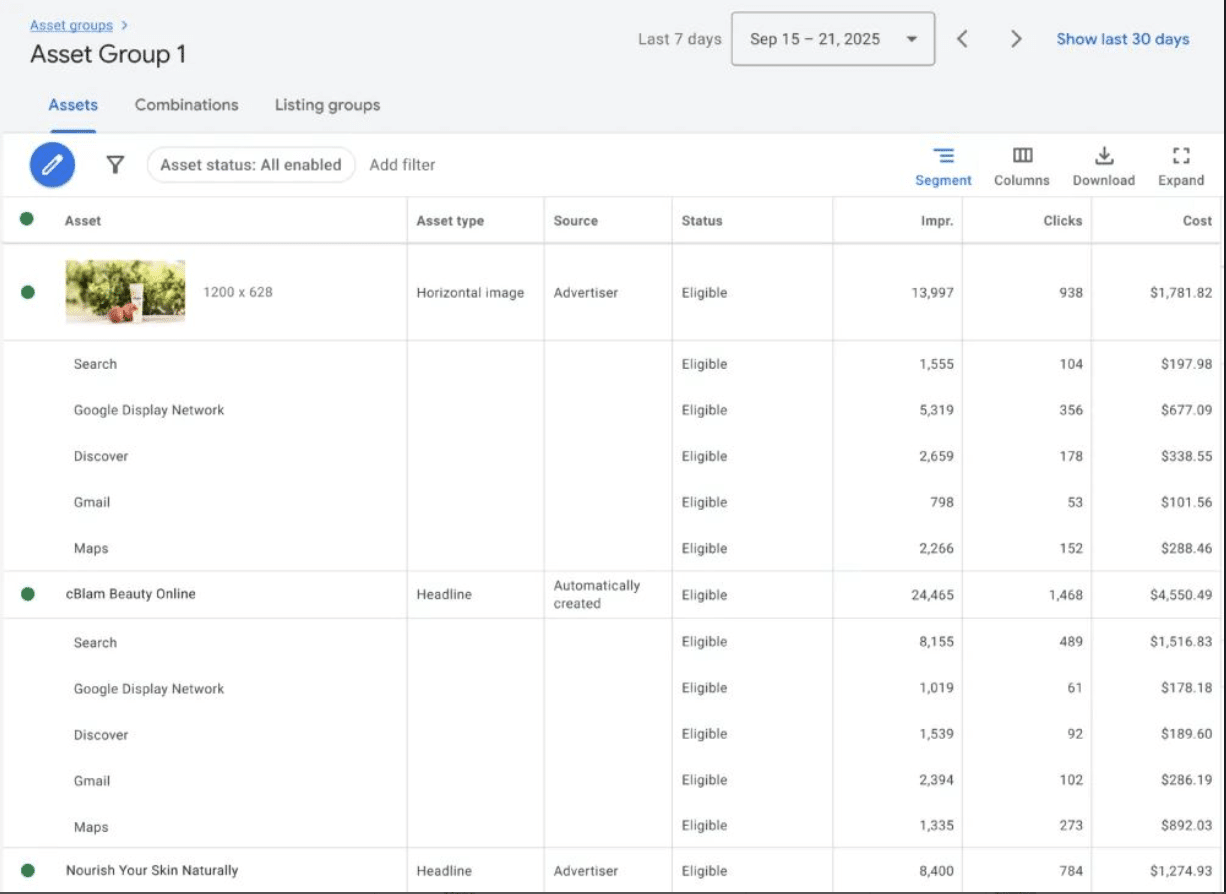
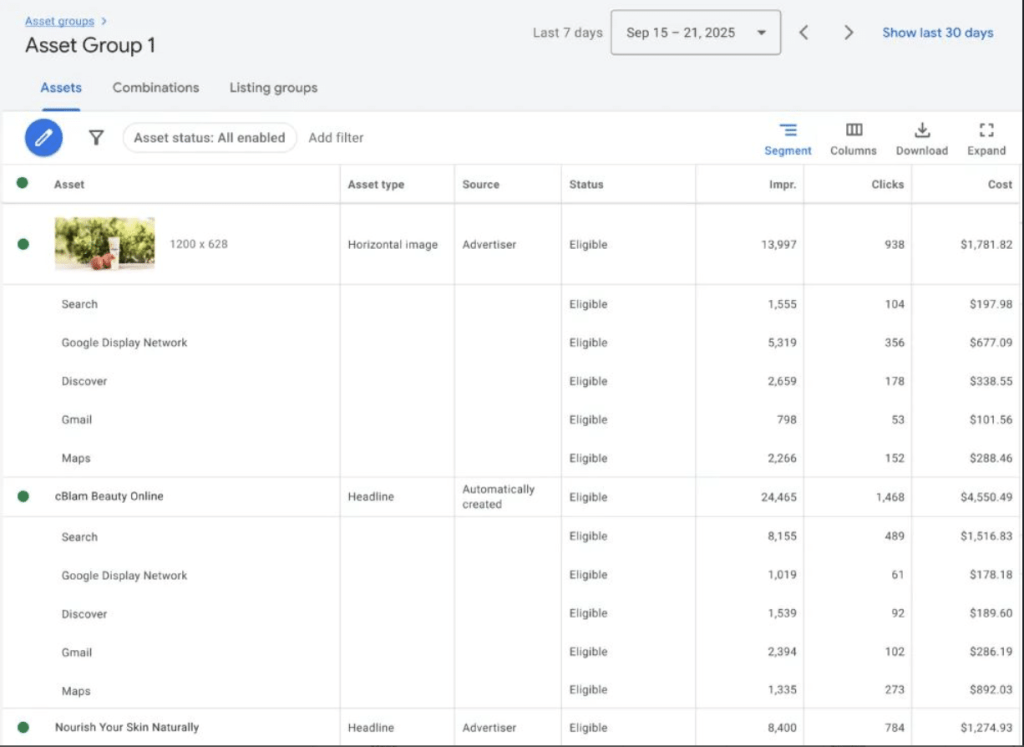
Google has announced new reporting features for Performance Max, giving advertisers more visibility into how campaigns perform across assets and channels.
The updates include:
Asset-level reporting that can be segmented by device, time, conversion type and network
Channel-level reporting with bulk downloads, account-wide insights, ROI columns, and clearer cost allocation.
Segmentation by conversion actions and ad event types.
Diagnostics to flag issues like limited serving from restrictive bid targets.
Screenshot of Google Ads Performance Max reporting dashboard
Why this matters to advertisers
Performance Max has always been powerful, but it’s often felt like a black box. With these changes, advertisers now have a clearer line of sight into what’s actually working. That means:
The ability to double down on high-performing assets and cut wasted spend.
Smarter budget allocation across channels, backed by clearer ROI data.
Faster troubleshooting with diagnostics that show where campaigns are being held back.
More confident conversations with clients and stakeholders, because the data behind results is easier to explain.
Basically, this isn’t just about more data it’s about better decision making. As Performance Max continues to evolve, these upgrades bring us closer to running campaigns with the same level of control and clarity we expect from other Google Ads formats, while still benefiting from automation.
If you’d like assistance and insights into how to maximise your performance across PMAX and multi-channel paid ads give us a shout.
Your David vs. Goliath Guide to Black Friday for Owner-Managed Ecommerce Businesses
Breaking the Discount Death Spiral
Every November, the same script plays out across retail: brands slash prices, margins evaporate, and customer expectations reset to expect everything cheaper. It’s a destructive cycle that turns Black Friday from a profit opportunity into a margin-killing necessity. As a small business retailer you sigh with despair because you just cannot match the discounts or the marketing advertising spend of the big guys.
But here’s what the big retailers don’t want you to know: owner-managed ecommerce businesses have a secret weapon. While corporate giants are trapped in boardroom-approved discount strategies, you have the agility, authenticity, and customer relationships to flip the script and win the Black Friday Race.
This isn’t about competing on price, it’s about competing on value, creativity, and genuine customer connection. Some of the most successful Black Friday campaigns in history have done exactly the opposite of what everyone expects.
The rest of this article explores
Part 1 – Three tried and tested frameworks
Part 2 – Five new frameworks that build brand value
Part 3 – The owner manager advantage – how you can win in 2025
Part 4 – Five campaign concepts you can use
Part 5 – Metrics and success over the long term
Part 1: Tried & Tested Frameworks (And Why They’re Failing)
Before we break the Black Friday marketing rules, let’s understand them. Here are the 3 frameworks that built Black Friday and why they’re becoming less effective year by year.
1. The Classic Discount Stack
What it looks like:
Sitewide percentages (15-50% off)
Tiered discounts (“Spend $100, save $20”)
BOGO offers (Buy One Get One Free)
Bundle pricing (Buy these two things together)
Why it works: Simple to execute, easy for customers to understand, creates immediate urgency.
Why it’s failing: Every brand does this now. Your 30% off looks identical to your competitor’s 30% off. The worst part of this is that it trains customers to only buy when things are cheap, and you’re in a race to zero with your margins. This is a particular problem in New Zealand where “everyone loves a special”.
Best for: High-volume, low-margin products where you can afford the hit and need to move inventory.
2. The Urgency Trinity
What it looks like:
Limited time (“24-hour flash sale”)
Limited quantity (“Only 50 left in stock”)
Limited access (“VIP early access for subscribers”)
Why it works: Leverages FOMO (Fear of Missing Out) psychology and scarcity principles that drive immediate action.
Why it’s failing: Customers have become immune to fake scarcity. They know your “limited time” offer will probably be back next week, and your “only 50 left” might not be true.
Best for: Genuinely limited or seasonal products where scarcity is real.
3. The Bundle Strategy
What it looks like:
Gift sets and curated collections
“Complete the look” packages
Cross-category bundles
Why it works: Increases average order value without deep individual product discounts.
Why it’s declining: Customers are more informed and prefer to choose their own combinations. Generic bundling feels lazy.
Best for: Products that naturally complement each other or themed collections. Works well if you know the customer has already purchased one of the products.
Part 2: The New Rules: 5 Frameworks That Actually Build Value
Framework 1: The Anti-Black Friday Revolution
Patagonia 2011 Black Friday advert
The Strategy: Instead of discounting, take a stand against consumerism and Black Friday culture itself.
Real Example: In 2011, Patagonia published an audacious full-page ad in The New York Times on Black Friday telling viewers not to buy their jacket. With this ad, the company aspired to raise consumer awareness regarding the consequences of over-consumption, especially in the textile industry.
The Result: Instead of hurting sales, the campaign generated massive media coverage, strengthened brand loyalty, and attracted environmentally conscious customers who became lifelong advocates.
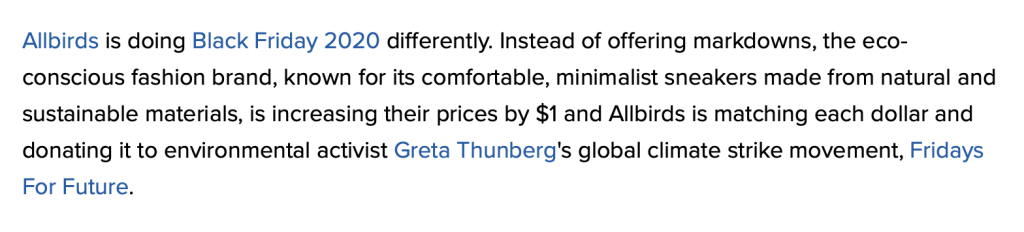
Another Iconic Example: Cards Against Humanity made headlines in 2013 for increasing its prices by $5 as part of a Black Friday “anti-sale”. Despite its higher price, the game maintained its best-selling status on Amazon and experienced a minor spike in sales during that period. In other campaigns they’ve also sold “Nothing for $5” (literally nothing) and made $70K, and even sold boxes of actual bull sh*t.
Cards Against Humanity anti-Black Friday price increase
How to execute for your business:
For sustainable/ethical brands: “We don’t discount quality” campaign with focus on fair wages, sustainable materials, craftsmanship
For luxury/artisan brands: “Black Friday is for mass production, not masterpieces” – emphasise your craftsmanship story
For service-based: “We’re closed on Black Friday” why not give your team the day off and make your brand messaging for this day about values? You value your staff.
Perfect for: Brands with strong values, premium positioning, or customers who align with counter-culture movements.
Framework 2: The Value-First Revolution
The Strategy: Instead of reducing prices, add value through exclusive services, bonuses, or experiences.
Real Examples:
Warby Parker: Free home try-on service becomes “Black Friday: Try 10 spectacles frames at home instead of 5”
Casper Mattresses: Same mattress price but includes premium bedding set, white-glove setup, and extended trial period
Local jewellery shop: “Black Friday Concierge” – personal shopping appointments with complimentary wine and snacks
How to execute:
Premium shipping/service: Express shipping, white-glove delivery, or setup services
Exclusive access: Behind-the-scenes content, founder calls, early access to new products
Educational value: Free courses, consultations, or masterclasses with purchase
Micro-segmentation: Different campaigns for new customers, VIPs, repeat buyers, at-risk customers
Perfect for: Businesses with good customer data, multiple touchpoints, or diverse customer segments.
Cards Against Humanity charity donation on Black Friday
Part 3: The Owner-Manager Advantage
Here’s why these strategies work better for owner-managed businesses than corporate giants:
1. Authentic Storytelling
Corporate brands have marketing committees and brand guidelines. You have a real story, real personality, and real relationships with customers. Use them. Customers recognise your authentic voice.
2. Rapid Execution
While big retailers need months of planning and committee approvals, you can pivot in days. Saw a competitor do something boring? Counter with something memorable by next week tomorrow.
3. Personal Connection
You can personally respond to customers, share your own story, and build genuine relationships. Your customers aren’t buying from a faceless corporation, they’re buying from YOU.
4. Creative Freedom
No corporate legal team is going to approve Cards Against Humanity’s bull sh*t campaign. But as an owner-manager, you can take calculated creative risks that generate massive buzz.
5. Values-Driven Marketing
Customers increasingly buy from brands whose values align with theirs. As an owner, your personal values can become powerful differentiators.
Part 4: Implementation Guide – Choose Your Fight
Get in touch with the numero® team and let us go to fight on your behalf next Black Friday.
Niche down your offer to align with your audience.
For Premium/Luxury Brands: The Anti-Black Friday Revolution
Campaign name: “Craftsmanship Doesn’t Go on Sale”
Key message: Quality over quantity, values over discounts
Execution: Behind-the-scenes content showing craftsmanship, the founder story about why you don’t discount
Channels: Email to VIP customers, social media storytelling, PR outreach
For Service-Based Businesses: The Value-First Revolution
Campaign name: “Black Friday Upgrades”
Key message: Same investment, premium experience
Execution: Add consultations, premium support, exclusive access, or extended guarantees
Channels: Email campaigns, LinkedIn for B2B, Google Ads highlighting value-adds
For Community-Driven Brands: The Community Commerce Model
Campaign name: “Friends & Family Friday”
Key message: Better together, shared benefits
Execution: Referral programs, UGC contests, community challenges
Channels: Social media, email to advocates, influencer partnerships
For Artisan/Maker Brands: The Experience Economy Approach
Campaign name: “Behind the Magic”
Key message: Process over product, story over sale
Execution: Live demonstrations, virtual workshops, maker stories
Conclusion: Your Black Friday Revolution Starts Here
The brands that will thrive in the next decade aren’t the ones with the deepest discounts. They’re the ones that build the strongest relationships. Black Friday gives you a moment when everyone’s paying attention. The question is: what do you want your customers to remember?
While your competitors are trapped in the discount death spiral, you have the opportunity to stand out, build value, and create customers who choose you for reasons that go far beyond price.
The revolution starts with a simple decision: Will you race to zero, or will you build something that lasts?
Your customers are tired of being sold to. They’re ready to be inspired, included, and valued.
The choice is yours.
Ready to plan your value-building Black Friday campaign? Start by identifying which framework aligns best with your brand values and customer base. Remember: the goal isn’t to win Black Friday, it’s to build a business that doesn’t need Black Friday to succeed. Ask numero® to add their expertise to your team.
The future of attribution isn’t in the platform dashboards. It’s post-click.
We’re seeing more and more businesses make critical decisions based on incomplete data. GA4 is a step in the right direction, but even then, attribution is messy.
Marketing attribution defined
Marketing attribution is the practice of assigning credit for conversions or revenue to marketing touchpoints in order to pinpoint the touchpoints and channels that are working best and allocate resources accordingly.
iOS changes, cookie restrictions, and delayed reporting mean that relying on platform-reported conversions alone (Meta, Google Ads, etc.) will almost always give you a skewed view of what’s really working.
Advert performance varies
An ad campaign that looks like it’s underperforming at the ad level might actually be driving high-value leads once you map the full customer journey. But you’d never see that if you’re only reviewing surface-level metrics.
We’ve been shifting more of our clients to blended post-click attribution models, combining GA4, CRM data, and back-end lead quality scoring. The insights are completely different and often surprising.
This is not about ignoring platform metrics. It’s about layering them with the stuff that actually closes deals.
Let me know if you’re navigating the same challenges. Happy to share what’s working here at numero®️ – just ask.
Author Expertise: Harry Kidby
Harry brings senior-level performance marketing expertise and strategic sales leadership to numero®’s partnership approach with forward-thinking businesses. His core strengths include developing comprehensive digital marketing strategies for e-commerce and service businesses, executing multi-channel campaigns that drive measurable content engagement, lead generation, and sales conversion across New Zealand and international markets. He excels in performance-focused campaign deployment and measurement, combining strategic planning with hands-on execution to deliver optimal results. Harry’s expertise spans Google Ads optimisation, SEO strategy implementation, social media marketing, and website performance analysis. His consultative approach encompasses complete business analysis, ensuring deep understanding of partners’ operations to deliver tailored solutions. Harry’s experience extends to client relationship management, cross-channel campaign coordination, and results measurement, making him a strategic digital marketing consultant with proven capability in driving business growth through data-driven marketing initiatives.
Our team recently halved the Google Advertising spend for a professional services client. The result? Their lead volume was unchanged.
If that surprises you – read on to find out why this worked, the context and whether it might work for you.
Spend less get more
The shift came from:
Cutting out low-performing campaign types
Refining targeting to focus on actual buyer intent
Reinvesting only where the data backed it
Most agencies wouldn’t suggest that. Why?
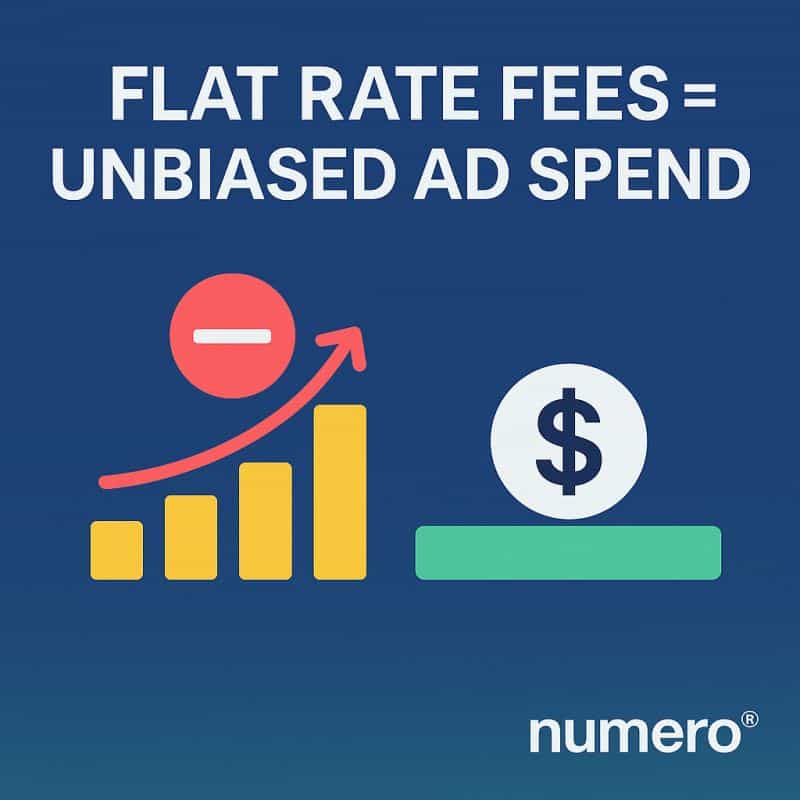
Because many agencies still charge a percentage of media spend. If a client spends more, the agency earns more. Simple as that. Automatic bias to charge more.
At numero®️ we work on flat, fixed-price retainers. That means our recommendations are tied to results, not to how much you’re spending. If the data supports reducing media spend, we’ll suggest it. If a channel isn’t delivering, we’ll say so.
When agency incentives are aligned with performance, not platform spend, you get leaner campaigns, clearer insights and better ROI.
If you haven’t reviewed your media spend recently, and you’re in a shifting market, it might be time to do a review.
Join the discussion
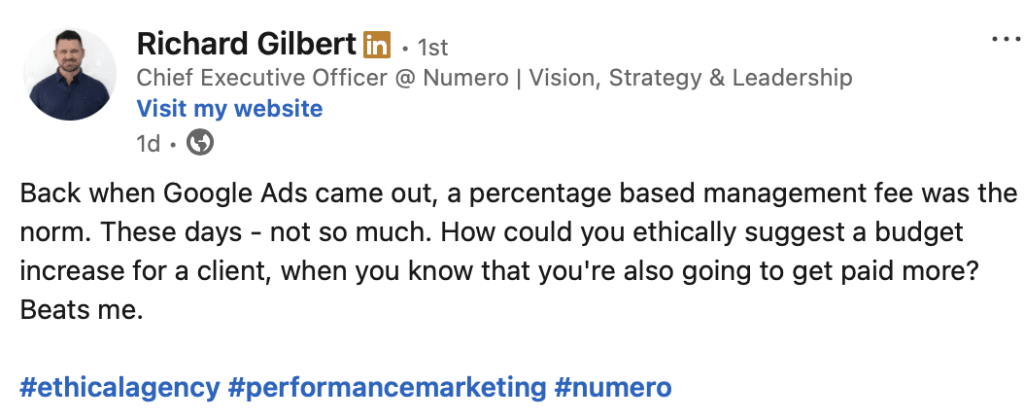
We love hearing different points of view. If you’re on LinkedIn please join the discussion that Harry started. Here’s what our founder, Richard Gilbert said.
Every marketer wants to make the most of their ad spend. Naturally, we all want to increase conversions and keep spending low. This paradox of growing your client base whilst spending less on ads can sound impractical. Impossible even.
Fortunately, there’s a performance indicator that hits the middle ground – return on investment (ROI).
If you, like many other Google Ads marketers, are looking for ways to improve your return on investment from Google Ads, you’re in luck. In this post, we will share our top 5 tips to raise your ROI.
Use Negative Keywords
Negative keywords are search phrases you could add to your ad campaign to filter out irrelevant traffic. When you create a list of negative keywords, Google will no longer trigger your ad when users search for these terms, which ensures your ad shows up only for highly relevant, targeted searches.
By doing this you can reduce wasted ad spend on irrelevant clicks and traffic that won’t ever convert. Negative keywords are also a great way to boost the CTR (click-through rate) of your ads, which will improve your ROI.
Be sure to update your negative keyword list proactively by keeping track of keywords that bring irrelevant traffic. Some negative keywords you can begin to include in your list include:
Jobs (unless your ads are for recruitment)
Free
Closeout
Tips/Tricks/Hacks (unless you are advertising a video or a blog post)
Wholesalers
Turn Off Automatic Audience Targeting Expansion
It’s important to pay attention to some automatic features Google enables when setting up an Ads display campaign.
When you set up a Google display campaign targeting a predefined audience, Google offers you the option (chosen by default) to automatically expand the reach beyond the list provided to them.
Although this strategy can prove successful, this default feature won’t offer any value unless you are using a huge audience list.
If you are setting up new campaigns or working from smaller lists and allow Google to expand its reach by default you will likely spend 2x or 3x more without boosting your revenue.
Understand the Importance of Quality Score
The ROI of your PPC campaign can depend, to a great deal, on your quality score.
Why?
If you offer a low-quality experience, Google doesn’t want to display your ads. By raising your cost per click, they are essentially asking you to do either pause your ads (as they don’t make any financial sense) or improve your user experience.
Here are the aspects that Google looks at to determine your quality score:
Click-through rate – If your ads show up for the keywords you bid for, and only a few people click, it looks like your ads are irrelevant.
The relevance of a keyword to its ad group
The performance of your landing page – Google relies on analytics to assess how users respond to your landing page. If they find your landing pages don’t convert most of the traffic from their ads, you are likely to receive a poor score.
The relevance of your ad text to users’ searches – If people are not clicking on your ads, Google has a reason to believe that your ads are not relevant. Or perhaps they click and bounce off of your page because there’s a mismatch between what you offered and what they saw on the page.
Google will consider these aspects to rate your ads on a scale of 1 to 10 where 10 is best and 1 is a catastrophe.
Even after you’ve updated your user experience, your quality score won’t improve overnight. Google is judging by your past poor performance. For an updated score, they must be sure you have really improved the user experience.
If you find your campaign is performing poorly, it’s best to resolve this situation the soonest.
So how does quality score relate to ROI for your Google Ads?
If your quality score is 7 or greater, you will get a discount compared to others. This discount can reduce your cost by as much as 50%. Your ads would get better placement.
On the other hand, if your score is 6, the cost will rise slightly. If the score is 2 or 1, getting a good ROI on your Google Ads is next to impossible. You may end up paying as high as 400% more compared to those who have a decent quality score.
Target Audience by Income Level
When setting up your PPC ads, the first question you should be asking yourself is – who can afford my products/services?
When you know who to target, half your battle is won already.
So how does income filtering helps improve your Google Ads ROI?
When you take the time to identify who is buying, the effects will trickle down not only to your ROI. When your sales team spends less time providing quotations (be it in person or over the phone), it reduces your overheads as well as the strain on your human resources.
Likewise, when your sales team spends most of their time on quality leads (instead of chasing bad leads), they will be able to make the most of their time and you can divert your sales budget to better, more experienced salespersons, which will again translate to better lead-closure rate.
Use Google Ads Extensions
You can supercharge your ROI by using Google Ads extensions to your advantage. With extensions, your ads will show with added features that make them more ap0ealing to your audience. Some of the best extensions include:
Location – This extension shows your address to your audience.
Calls – Add a call button so viewers can click on it to reach you instantly.
Reviews – Displays customer reviews to establish social proof.
Callouts – Show pop-up notifications for promotional offers.
Site links – Add a link to your landing page.
Conclusion
Google Ads is an excellent tool that every business should leverage to boost sales and revenue. However, sometimes, making the most of your Google Ads campaign might not be straightforward. These five techniques can help you see a better ROI on your Google Ads campaign.
Schedule a free consultation with our PPC specialists to see how we can reduce wasted ad spend and improve your ROI in no time.
Is this what my old primary school teacher called “a silly question”?
When is business spend a cost and when is it an investment? An investment brings a financial return that’s greater than the amount you spent. Costs like rent and utility bills don’t do that – yet these can make you wince.
You only pay for Google Ads when your campaign delivers a result. In most cases a customer clicking on your ads to visit your website or clicking to call your business phone number.
Offline forms of advertising such as billboards, direct mail, or printed media, are charged at a fixed price. You want a billboard, you pay for it.
numero’s performance marketing team sees PPC spend as either a cost or an investment. Why? Because AdWords is a tool and it can be set up as a high-return investment or as a cost. Many clients come to us convinced that it’s a cost and, after working with us, they revise their view to see it as an investment. Here’s why.
The difference lies in the strategy, measurement and management of your advertising inventory. At a minimum numero® resolves to get you a positive return on ad spend (ROAS).
When ads drain your resources
If you are keen on a set-and-forget type of paid marketing you won’t get a positive return. Signs that this has happened is if your campaigns don’t have clear goals, proper keyword research and negative keywords. You will be spending on irrelevant clicks.
Poor conversion mechanics such as sending clicks to a generic web page with no clear call to action. You’ll get high bounce rates and no sales.
Vanity metrics when you love clicks but aren’t tracking cost-per-acquisition (CPA) and return on ad spend (ROAS) means your campaigns aren’t optimised.
When your advertising is not generating a return, it’s a “sunk cost”.
Set up correctly, Google Ads can be growing your business – like any investment. Here’s how to check if your ads are a positive contributor as a performance marketing channel
Clear key performance indicators (KPIs) and target CPAs, Lifetime Value (LTV) and ROAS.
Campaigns are built on data and are improved / iterated regularly. Continuous testing and refinement of your keywords, ad copy and landing pages. Allocate your marketing budget only to what actually works.
Marketing returns are scalable. You know for every $1 spent on ads you get $X back in revenue.
Ads can also be used for brand recognition, lead generation (particularly for B2B marketing) and customer loyalty. Your ROI will come through over a longer time period than direct selling ecommerce, yet it is also trackable and measurable.
Make The Change Happen
As a business owner or marketing manager you know you want Google Ads to be an investment not a cost. Yet the mindset shift needed to make this happen starts before you spend any money.
First define success by articulating your target return on investment
Track everything – you will need conversion tracking as well so that the $ value to your business for each click is known.
Use Test – Measure – Refine as the marketing cycle so that you can identify $ spend on testing as capital spent on finding profitable avenues for your advertising
Calculate your total return on ad spend (ROAS) which should be gross profit not just revenue.