We’re thrilled to welcome Max Sartal Sterling to the numero® team as our new Head of SEO. Max joined us on 13th October 2025, bringing over 12 years of expertise in SEO and conversion rate optimisation, with a particular focus on the future of AI-powered search.
The Future of Search Starts Here
If you’ve been paying attention to the marketing world lately, you’ll know that search is changing fast. The rise of AI search engines, LLM-powered answers, and increasingly sophisticated AI panels means the old playbook isn’t quite cutting it anymore. Enter Max – a strategist who doesn’t just understand how search works today, he’s already thinking three steps ahead about how it’s going to work tomorrow.
Who Is Max Sartal Sterling?
Max has spent over a decade mastering the fundamentals of SEO and CRO, but what sets him apart is his commitment to adapting alongside the tools and technologies that shape search.
What Max Brings to Numero®
Experience and Expertise in SEO & CRO
Acquire & Convert – The bedrock of solid SEO: crawlability optimisation, structured content strategy, and building genuine authority signals that search engines recognise and reward.
Leading with AI and Structured Data Innovation
Adaptation to AI Search – The future frontier is based around structured-data engineering for AI agents, sentiment and entity optimisation for AI “best-answer” slots, LLM performance management, and AI crawler optimisation. In other words, Max is helping brands prepare for a search landscape where AI isn’t just processing results – it’s generating them.
Most recently, Max worked with New Zealand Trade and Enterprise (NZTE), where he gained deep insight into the unique challenges facing NZ businesses trying to compete in increasingly global markets. That combination of practical SEO know-how and strategic thinking is exactly what we need at numero®.
Max speaking at an AI Conference in Argentina, 2025.
What Does This Mean for You (and Our Clients)?
At numero®, we’re all about results. We obsess over ROI, we guarantee what we promise, and we’re constantly pushing to stay ahead of industry changes. Max shares that same philosophy – and then some.
With Max leading our SEO efforts, our clients can expect:
Forward-thinking strategy – SEO approaches that account for AI search evolution, not just today’s Google algorithm.
Measurable outcomes – Max’s work is grounded in data. He’s not interested in vanity metrics; he cares about acquisition, conversion, and the bottom line. This aligns with the numero® approach to performance marketing.
Innovation without losing fundamentals – While Max is excited about emerging technologies, he knows that solid SEO foundations matter. You can’t optimise for AI if your crawlability is a mess. Solid website design and build with both humans and machine viewers underlies our client work.
Tailored solutions – Whether you’re a traditional business getting started with SEO or a sophisticated digital operation ready to navigate the AI search frontier, Max brings the expertise to meet you where you are.
Why Max Fits Numero®’s Culture
numero’s values are about transparency, positive impact, and doing small things well every single day, without compromise. Max embodies those values. He’s a straight-talker who’s interested in real partnerships, not flashy promises. He cares about helping businesses grow, supporting the NZ economy, and building solutions that actually work.
When we talked to Max about joining numero®, he said something that really resonated: “numero®’s results-driven approach and commitment to transparent partnerships resonated with me immediately.” That’s the kind of alignment that leads to great things.
How to get the best out of your SEO Agency – workshop Auckland 2022
Looking Ahead – The Future of SEO at Numero®
The search landscape is shifting beneath our feet, and Max is exactly the right person to help our clients navigate it. Whether it’s optimising for AI panels, managing LLM rankings, or building the technical infrastructure that AI agents need to parse and cite your content – Max has got the expertise to guide the way.
We’re excited about the innovations he’ll drive, the strategies he’ll develop, and the results he’ll help our clients achieve.
Welcome to the team, Max. Let’s make some numbers matter.
Want to stay ahead of search trends and marketing innovation? Check out our blog regularly for insights from Max and the rest of the numero® team. Or get in touch if you’d like to discuss how AI-focused SEO can drive growth for your business.
Don’t do anything rash without thinking carefully about the consequences.
Yes, we’d love to work with you. You need a good reason to change agency because you and they have invested a lot of time and energy working together – breaking up is hard to do.
The #1 reason clients switch to working with numero® for performance marketing is because you aren’t getting good ROAS from your current agency.
Three reasons to consider switching agency
Your business has changed and your future strategic needs aren’t aligned with the agency’s skills and track record.
Ethics – if their business practices do not align with your ethical standards.
Cultural misalignment such as the agency being slow or lethargic when you want to press ahead at speed.
We make shifting to a new marketing agency easy. Just ask us and we’ll share our onboarding process. We’ll also take a look at your GA analytics and Google ads to see where your ROAS can be improved.
Words of caution
The investment in track record together is hard to replicate. Years of doing marketing together build insight, best practices and insider knowledge about what works.
You have spent hours working together learning best ways of getting marketing results. Don’t underestimate the investment in time it will take to rebuild that “institutional knowledge” with a new agency.
New agency ≠ bright future
We’d love to say that it will be love at first blush. But it isn’t.
When swapping teams there’s an upfront learning period – not just team to team but also within your PPC advertising account.
If you stop one ad set there’s a learning / adaptation period which happens in all ad accounts before they perform really well. This is a mix of optimisation by us and by the advertising platform AI tools. Either way, Google takes 7 – 14 days and Facebook (Meta) takes 3-7 days. Both represent a likely dip in performance when your click and lead volumes may decline.
You have to build this into your decision to swap agency.
numero®’s values
Reasons to swap
We’re not going to scream malpractice or fraud, but if you are thinking of working with us, understand that the reasons below are non-negotiables. A respectful business relationship means both sides understand each other and can interrogate the ad account to see what’s going on.
If any of the below apply to you – think hard about switching agency. You might be getting ripped off.
If your agency is not transparent about their monthly fee
If your advertising spend plus monthly fee is just one number and you don’t know how much is for ads and how much is the agency fee
If you do not have access to see the adverts inside the account (the agency just sends you reports)
And lastly, check out our values – that’ll give you clues about cultural fit if you’re thinking of coming over to numero®.
I’ve updated it for New Zealand as seen through the eyes of an American Tourist. These insights help showcase the fun differences visitors notice about Godzone.
And if the Tourism NZ team are reading this…. there are loads more ideas where this one came from.
100 Observations About New Zealand
By a Visiting American (AI).
Note: These observations come from genuine affection for New Zealand and its people. Any Kiwi reading this probably has 100 observations about Americans that would be equally amusing and accurate. Sweet as, bro.
When something happens which might be useful for your business we want to tell you about it straight away.
Back in April ChatGPT (the AI tool) announced that it will shortly be incorporating ecommerce products into ChatGPT answers. So the numero® team have checked it out – and it’s legit.
ChatGPT is a search engine now.
This is gold for shop owners like you.
And best of all it’s a 3 minute job and it’s free of charge!
Here’s how to enable ChatGPT product discovery
Click this link to go to the ChatGPT explainer page for product discovery. At the bottom is a form where you share your shop website, your contact details. Seriously, it’s a three minute job and if it might lead to new customers, what’s not to like?
Quick Win
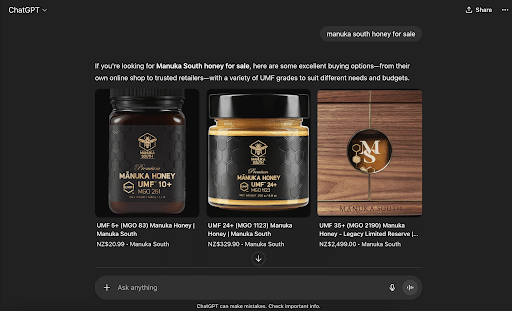
Our client Manuka South took action in June 2025 – by September this was the AI search result for their product range. That was quick (and easy).
Manuka South ChatGPT search results showing honey products
Try it for yourself – open ChatGPT and search “Manuka South Honey for sale” – see what comes up.
Your David vs. Goliath Guide to Black Friday for Owner-Managed Ecommerce Businesses
Breaking the Discount Death Spiral
Every November, the same script plays out across retail: brands slash prices, margins evaporate, and customer expectations reset to expect everything cheaper. It’s a destructive cycle that turns Black Friday from a profit opportunity into a margin-killing necessity. As a small business retailer you sigh with despair because you just cannot match the discounts or the marketing advertising spend of the big guys.
But here’s what the big retailers don’t want you to know: owner-managed ecommerce businesses have a secret weapon. While corporate giants are trapped in boardroom-approved discount strategies, you have the agility, authenticity, and customer relationships to flip the script and win the Black Friday Race.
This isn’t about competing on price, it’s about competing on value, creativity, and genuine customer connection. Some of the most successful Black Friday campaigns in history have done exactly the opposite of what everyone expects.
The rest of this article explores
Part 1 – Three tried and tested frameworks
Part 2 – Five new frameworks that build brand value
Part 3 – The owner manager advantage – how you can win in 2025
Part 4 – Five campaign concepts you can use
Part 5 – Metrics and success over the long term
Part 1: Tried & Tested Frameworks (And Why They’re Failing)
Before we break the Black Friday marketing rules, let’s understand them. Here are the 3 frameworks that built Black Friday and why they’re becoming less effective year by year.
1. The Classic Discount Stack
What it looks like:
Sitewide percentages (15-50% off)
Tiered discounts (“Spend $100, save $20”)
BOGO offers (Buy One Get One Free)
Bundle pricing (Buy these two things together)
Why it works: Simple to execute, easy for customers to understand, creates immediate urgency.
Why it’s failing: Every brand does this now. Your 30% off looks identical to your competitor’s 30% off. The worst part of this is that it trains customers to only buy when things are cheap, and you’re in a race to zero with your margins. This is a particular problem in New Zealand where “everyone loves a special”.
Best for: High-volume, low-margin products where you can afford the hit and need to move inventory.
2. The Urgency Trinity
What it looks like:
Limited time (“24-hour flash sale”)
Limited quantity (“Only 50 left in stock”)
Limited access (“VIP early access for subscribers”)
Why it works: Leverages FOMO (Fear of Missing Out) psychology and scarcity principles that drive immediate action.
Why it’s failing: Customers have become immune to fake scarcity. They know your “limited time” offer will probably be back next week, and your “only 50 left” might not be true.
Best for: Genuinely limited or seasonal products where scarcity is real.
3. The Bundle Strategy
What it looks like:
Gift sets and curated collections
“Complete the look” packages
Cross-category bundles
Why it works: Increases average order value without deep individual product discounts.
Why it’s declining: Customers are more informed and prefer to choose their own combinations. Generic bundling feels lazy.
Best for: Products that naturally complement each other or themed collections. Works well if you know the customer has already purchased one of the products.
Part 2: The New Rules: 5 Frameworks That Actually Build Value
Framework 1: The Anti-Black Friday Revolution
Patagonia 2011 Black Friday advert
The Strategy: Instead of discounting, take a stand against consumerism and Black Friday culture itself.
Real Example: In 2011, Patagonia published an audacious full-page ad in The New York Times on Black Friday telling viewers not to buy their jacket. With this ad, the company aspired to raise consumer awareness regarding the consequences of over-consumption, especially in the textile industry.
The Result: Instead of hurting sales, the campaign generated massive media coverage, strengthened brand loyalty, and attracted environmentally conscious customers who became lifelong advocates.
Another Iconic Example: Cards Against Humanity made headlines in 2013 for increasing its prices by $5 as part of a Black Friday “anti-sale”. Despite its higher price, the game maintained its best-selling status on Amazon and experienced a minor spike in sales during that period. In other campaigns they’ve also sold “Nothing for $5” (literally nothing) and made $70K, and even sold boxes of actual bull sh*t.
Cards Against Humanity anti-Black Friday price increase
How to execute for your business:
For sustainable/ethical brands: “We don’t discount quality” campaign with focus on fair wages, sustainable materials, craftsmanship
For luxury/artisan brands: “Black Friday is for mass production, not masterpieces” – emphasise your craftsmanship story
For service-based: “We’re closed on Black Friday” why not give your team the day off and make your brand messaging for this day about values? You value your staff.
Perfect for: Brands with strong values, premium positioning, or customers who align with counter-culture movements.
Framework 2: The Value-First Revolution
The Strategy: Instead of reducing prices, add value through exclusive services, bonuses, or experiences.
Real Examples:
Warby Parker: Free home try-on service becomes “Black Friday: Try 10 spectacles frames at home instead of 5”
Casper Mattresses: Same mattress price but includes premium bedding set, white-glove setup, and extended trial period
Local jewellery shop: “Black Friday Concierge” – personal shopping appointments with complimentary wine and snacks
How to execute:
Premium shipping/service: Express shipping, white-glove delivery, or setup services
Exclusive access: Behind-the-scenes content, founder calls, early access to new products
Educational value: Free courses, consultations, or masterclasses with purchase
Micro-segmentation: Different campaigns for new customers, VIPs, repeat buyers, at-risk customers
Perfect for: Businesses with good customer data, multiple touchpoints, or diverse customer segments.
Cards Against Humanity charity donation on Black Friday
Part 3: The Owner-Manager Advantage
Here’s why these strategies work better for owner-managed businesses than corporate giants:
1. Authentic Storytelling
Corporate brands have marketing committees and brand guidelines. You have a real story, real personality, and real relationships with customers. Use them. Customers recognise your authentic voice.
2. Rapid Execution
While big retailers need months of planning and committee approvals, you can pivot in days. Saw a competitor do something boring? Counter with something memorable by next week tomorrow.
3. Personal Connection
You can personally respond to customers, share your own story, and build genuine relationships. Your customers aren’t buying from a faceless corporation, they’re buying from YOU.
4. Creative Freedom
No corporate legal team is going to approve Cards Against Humanity’s bull sh*t campaign. But as an owner-manager, you can take calculated creative risks that generate massive buzz.
5. Values-Driven Marketing
Customers increasingly buy from brands whose values align with theirs. As an owner, your personal values can become powerful differentiators.
Part 4: Implementation Guide – Choose Your Fight
Get in touch with the numero® team and let us go to fight on your behalf next Black Friday.
Niche down your offer to align with your audience.
For Premium/Luxury Brands: The Anti-Black Friday Revolution
Campaign name: “Craftsmanship Doesn’t Go on Sale”
Key message: Quality over quantity, values over discounts
Execution: Behind-the-scenes content showing craftsmanship, the founder story about why you don’t discount
Channels: Email to VIP customers, social media storytelling, PR outreach
For Service-Based Businesses: The Value-First Revolution
Campaign name: “Black Friday Upgrades”
Key message: Same investment, premium experience
Execution: Add consultations, premium support, exclusive access, or extended guarantees
Channels: Email campaigns, LinkedIn for B2B, Google Ads highlighting value-adds
For Community-Driven Brands: The Community Commerce Model
Campaign name: “Friends & Family Friday”
Key message: Better together, shared benefits
Execution: Referral programs, UGC contests, community challenges
Channels: Social media, email to advocates, influencer partnerships
For Artisan/Maker Brands: The Experience Economy Approach
Campaign name: “Behind the Magic”
Key message: Process over product, story over sale
Execution: Live demonstrations, virtual workshops, maker stories
Conclusion: Your Black Friday Revolution Starts Here
The brands that will thrive in the next decade aren’t the ones with the deepest discounts. They’re the ones that build the strongest relationships. Black Friday gives you a moment when everyone’s paying attention. The question is: what do you want your customers to remember?
While your competitors are trapped in the discount death spiral, you have the opportunity to stand out, build value, and create customers who choose you for reasons that go far beyond price.
The revolution starts with a simple decision: Will you race to zero, or will you build something that lasts?
Your customers are tired of being sold to. They’re ready to be inspired, included, and valued.
The choice is yours.
Ready to plan your value-building Black Friday campaign? Start by identifying which framework aligns best with your brand values and customer base. Remember: the goal isn’t to win Black Friday, it’s to build a business that doesn’t need Black Friday to succeed. Ask numero® to add their expertise to your team.
Our team recently halved the Google Advertising spend for a professional services client. The result? Their lead volume was unchanged.
If that surprises you – read on to find out why this worked, the context and whether it might work for you.
Spend less get more
The shift came from:
Cutting out low-performing campaign types
Refining targeting to focus on actual buyer intent
Reinvesting only where the data backed it
Most agencies wouldn’t suggest that. Why?
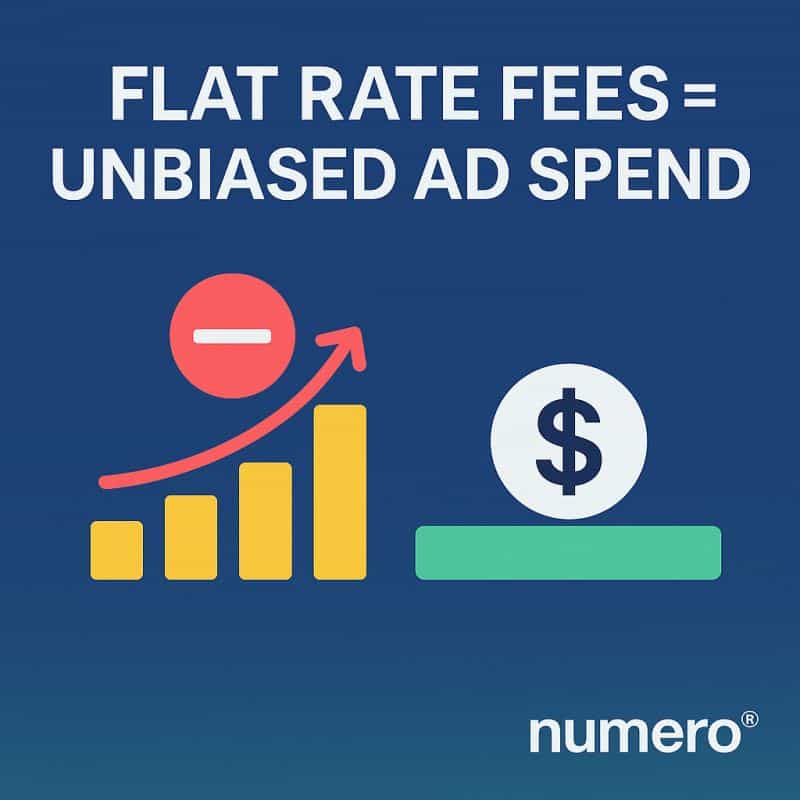
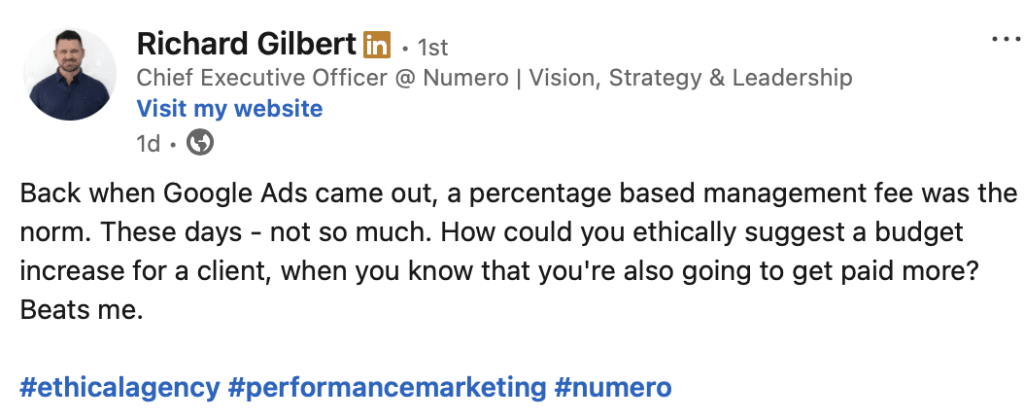
Because many agencies still charge a percentage of media spend. If a client spends more, the agency earns more. Simple as that. Automatic bias to charge more.
At numero®️ we work on flat, fixed-price retainers. That means our recommendations are tied to results, not to how much you’re spending. If the data supports reducing media spend, we’ll suggest it. If a channel isn’t delivering, we’ll say so.
When agency incentives are aligned with performance, not platform spend, you get leaner campaigns, clearer insights and better ROI.
If you haven’t reviewed your media spend recently, and you’re in a shifting market, it might be time to do a review.
Join the discussion
We love hearing different points of view. If you’re on LinkedIn please join the discussion that Harry started. Here’s what our founder, Richard Gilbert said.
The client had a rogue employee who stole the computers containing all the detailed logins needed to keep the company’s marketing running.
Bad things happen in business and numero® will always try to do the right thing to help you out.
How we helped
The website had never gone live – it was hosted on our server and at the time was awaiting client approval to go live. The design was nearly complete; we were just waiting for edits and feedback on the design. In effect, 90% of the website design work was complete.
We have a full backup of the website and all the associated data. It is in our archive and was retrieved within one business day. This is one of the “failsafes” we put into place to support our clients.
Failsafes are what enable numero® to be this helpful. We set up our business to be able to jump in and retrieve what looks like a really bad situation so that we can help our clients smooth the path back to normal business.
Quick Security Checks for Trades Businesses
Be wise before the event – here’s a checklist of failsafes which will support your business if trouble comes looking.
secure storage – all tools are locked up when not in use
vehicles – overnight is your main security concern. Alarms and GPS trackers can help
insurance – cover the trade tools, vehicles and office equipment that covers loss, theft and damage
inventory – know what tools and equipment you own and which site they’re on
digital security – strong, unique passwords and MFA (multi-factor authentication) for logins. Back up office computers daily including client contact details and project information. Cloud servers are better than local storage on your computer. Make sure your business wifi uses a strong password and encryption
contracts – keep digital copies of signed contracts
emergency plan – know what you will do if your business suffers interruption like a power outage, a flood or an earthquake. We were all unprepared when Covid-19 hit and we couldn’t go to our offices
Your Business Growth
A website is essential for business growth. Few new clients hire you without first checking your website. numero® knows how NZ business works; marketing is the vehicle we use to drive your business growth.
When clients partner with us, you get to use all our long experience in business. We know the ups and downs. So we use failsafes like website backups to keep your marketing projects on track and reduce your business risk.
Do trades hate marketing?
Tradies have a reputation of hating marketing. It’s because you are on the tools, you’re practical and you are a visual person. You need to see it to understand it.
Obscure technical jargon does not interest you because it makes you feel lost and out of control.
So no, tradies don’t hate marketing, they hate working with marketing people who don’t understand tradies.
Why tradies work with numero®
We get it – you’re on the tools, not behind a desk crunching marketing numbers. That’s exactly why most tradies have avoided marketing for years. It feels like speaking a foreign language with no guarantee it’ll actually bring in jobs.
Here’s the thing: we make trades marketing work because when you work with us, you understand what’s happening with your marketing. No jargon, no mysterious ‘brand awareness’ just clear explanations of what you’re paying for and what jobs it’s bringing in.
Think of working with numero® like your toolbox – you wouldn’t buy a tool without knowing exactly what job it does, right? We explain marketing the same way.
When we run Google Ads, it’s like having a sign on every street corner where your ideal customers are driving past. When we optimise your website, it’s like having your best salesperson working 24/7.
We’re your marketing partner, not your marketing mystery box. You’ll know exactly what’s working, what isn’t, and why.