If you’re asking “what does SEO cost in New Zealand?” — you’re not alone. Thousands of Kiwi businesses search for answers every month. The truth? SEO pricing in NZ varies depending on your business size, goals, and the agency you hire.
Below, we break down the average cost of SEO in New Zealand, so you know what to budget.
Let’s explore some numbers.
For in-depth information on what would SEO cost for your business call us at 09 390 3997 to discuss your requirements with an SEO specialist. Book an SEO audit for your website.
Average SEO Costs in NZ
Service Type
Average Cost (NZD)
Best For
Monthly Retainer
$1,837 – $6,300+
Ongoing SEO for small–medium businesses
Monthly Retainer
$6,850 – $12,900
Ongoing SEO for enterprise business
One-off SEO Project
$5,000 – $25,000
Website rebuilds, migrations, penalty recovery, or major campaigns
Small businesses in NZ often spend between $1,800 – $3,500 per month on SEO. This typically includes:
Keyword research
On-page SEO
Content optimisation
Local SEO (Google Business Profile, maps, citations)
Monthly reporting
Tip: Avoid “cheap SEO” (e.g. $200/month). These usually involve spammy links or outdated tactics that can hurt your rankings.
SEO Pricing for Enterprise Business & E-commerce
Enterprise SEO: $6,850+ per month, due to scale, technical depth, and content demands.
E-commerce SEO: Often $3,000+ per month, depending on product range and competition.
SEO Packages vs. Custom Pricing
Some NZ agencies advertise “SEO packages” with fixed deliverables. Others (like enterprise agencies) create custom strategies.
When comparing SEO plans, look beyond the price tag. Ask:
How many hours of work are included?
Is content creation part of the package?
Will you build external links, or is that extra?
Do you provide reporting & transparency?
Why Do SEO Costs Vary So Much?
Competition in your industry (e.g. local plumber vs. national e-commerce site).
Scope of services (technical SEO, content, backlinks, local SEO, GEO, AI).
Agency experience (junior freelancer vs. specialist team).
Timeline & goals (ranking in 6 months vs. 18 months).
How Much Should You Budget for SEO in NZ?
Small businesses: $1,000 – $2,500 per month
Medium businesses: $2,500 – $5,000 per month
Large/enterprise: $5,000+ per month
The key is ROI: a strong SEO strategy should generate leads or sales that far outweigh the cost.
FAQ – answers to your SEO questions
Q: What is the average cost of SEO in New Zealand? Most NZ businesses pay between $1,850 – $3,900 per month.
Q: What’s included in an SEO audit? We review your website starting with the words and pictures through to how it is built, the software set-up, internal links, and how fast it loads. Then we start working on your current keywords, blog articles and we do a content analysis. Lastly we look at your search rankings, external links and then review the gaps in your current content and keywords where we can get SEO quick wins for you. All this is written into a detailed report which we send you.
Q: How much does a detailed SEO audit cost? A one-off SEO audit costs $1,500 – $5,000 depending on website size. If you hire numero® we include an SEO audit AND SEO strategy in your monthly fee. A basic SEO audit is available free of charge to you – register here.
Q: Is SEO worth it for small businesses? Yes. When done properly, SEO drives consistent traffic and leads, often with a higher ROI than ads.
Q: How long does SEO take to see results?
The fastest results can come from technical on-page SEO which may show results within weeks because once your website is correctly structured it will be correctly indexed by Google. However, GBP can also be very fast. Content SEO is the next fastest as we build the keyword hierarchy that aligns with your business products. Month by month we add new content – when you have a good back catalogue of content, this becomes more effective as an SEO strategy. Lastly, link building is the long-burn in our SEO services. It works, but not overnight.
Q: How much does SEO cost for small businesses? Small businesses typically spend $1,800 – $2,500 per month for ongoing SEO.
When the web was young, search engine optimisation was a wild west – back then many, many search engines existed with friendly names like Ask Jeeves and Alta Vista. Most are defunct – you may not know that Yahoo started as a search engine. One of my favourite names was Dogpile – you can imagine who came up with a name like that!
Once search engine businesses launched to index and create signposts around the world wide web, canny marketers started trying to game the system. They quickly worked out ways to get their websites to appear on the first ten listed results, also known as page 1. This marked the beginning of SEO evolution, a significant shift in the landscape of digital marketing.
Google only started in 1998 and quickly became the industry leader because they approached search results differently. Their focus on link building (as proof that a site was important because other sites linked to it) rather than keyword matching meant that the answers you got from Google were not only fast, they served to reinforce already-popular websites who had strong inbound links.
What is Black Hat SEO?
Understanding the stages of seo evolution is crucial for leveraging modern strategies in digital marketing.
Recognizing the importance of understanding the stages of SEO evolution can significantly enhance your strategies and effectiveness in today’s digital marketing environment.
Unethical and manipulative techniques that have been used to improve website search results, are called “Black Hat”. It’s a wonderful phrase that originated from early cowboy western movies where the baddies wore black hats and the good fellows wore white hats so you could tell them apart!
Once Google had developed its web bot search spiders to scan web pages, they built a database index of all the websites and links that they could find. This index includes the linkages between sites and assessments of visitor volumes and the frequency of updates with new content and information. Google quickly had a stranglehold on the search industry. And the consequence of this is that once you’re the top dog – you also get to be the policeman.
Changes to the Google algorithm affect search results.
Over time their engineers have announced major updates to the algorithm – each has a fancy name like Penguin, Florida, and Helpful. Understanding these updates and how they have changed the priority of search results is what has driven the evolution of SEO as a marketing activity.
High-profile businesses whose marketing team used black hat techniques got severely penalised after Google updates. Some of the most famous include
BMW (2006) used cloaking and doorway pages of different content for humans vs search engines
J.C. Penney (2011) used paid backlinks to manipulate rankings
Rap Genius (2013) asked users to embed lyric pages with backlinks in exchange for social shares
eBay (2013) created millions of low quality pages such as auto-generated product variants
Expedia (2021) used aggressive affiliate linking with keyword-stuffed anchor text
All these serve to remind us that eventually Google finds you out. Their algorithm updates are often designed to target bad actors demoting them from search results and causing them to publicly apologise and do a lot of work disavowing links and changing web pages in order to regain their rankings. Not a “good look” for a marketing team.
Put simply, Google may be the policeman, but they are also very clear about what is allowed in their Webmaster Guidelines; you can monitor warnings from your Google Search Console.
The AI gamechanger
Google has been the dominant search engine for the period from 2000 to 2023 when AI again changed the game. Before AI, SEO professionals (like the numero® team) needed to understand 4 things
the search algorithm
the competitive landscape for keywords for each client’s website
technical SEO on websites
ways of writing web content to tick all these boxes.
Since 1988 we’d visit a search engine and type in our question or search sentence, and results would be delivered as links to websites (natural search results) and as advertisements (from companies advertising against those keywords). No longer.
Today, writing in mid 2025, this has all changed. Many customers experience “zero-click searches” when they use a search engine but never click through to a destination website. Many people only use AI tools like Grok or ChatGPT to get answers which they’d previously got from search results.
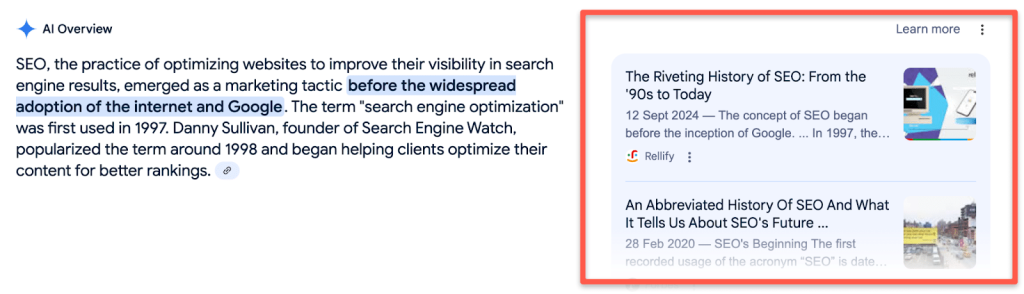
Read the answer in the AI Overview search result and not need to click anywhere.
Zero-click GEO search results
Richard Gilbert, numero’s Founder, described search engines in 2024 as “answer engines” because using voice search means we now expect conversational questions and answers in our search results.
I see a future when chatbots provide search answers which may be drawn from multiple sources, not necessarily Google, and these are faster, more personalised and concentrated on the very top websites only. This has implications for non-US business websites and smaller niche businesses who risk never being cited in AI search results. In 2025 numero created a SEO service that neutralises these tendencies.
The search engine professional has also adapted so that all the Google algorithm changes (RankBrain 2015, BERT 2019, MUM 2021) as well as the Helpful Content Update from 2022 are incorporated into our best practices. Numero prides ourselves on staying at the forefront of SEO evolution, best practice and ethical SEO so that our clients benefit.
The many changes to SEO marketing have been classified into four stages by Rob Hoffman, Founder at Content Studios. He defined each with a phase in an ebook, the Road to SEO 4.0.
SEO 1.0 Wild West from early 1990s – 2000
SEO 2.0 Content is King from mid-2000s – early 2010s
SEO 3.0 Machines Start Thinking from mid-2010s – 2020s
SEO 4.0 The AI Revolution from 2022 onwards
These are somewhat helpful for us all to understand because the SEO techniques used in each are different – and many of the methods used in earlier phases are now classified as Black Hat after Google’s algorithm updates specifically outlawed their practices.
If you are discussing SEO services with a performance marketing agency, take a close look at what they offer to do for you. Not all the early techniques are bad – many are the foundation of best practice SEO today. But if you’re being offered only SEO 2.0 techniques in 2025, beware.
SEO techniques through the 4 evolutions of SEO
These are the top-level SEO methods which align with each of the major development stages since the 1990s. Do ask us to explain any which you need in more detail and context.
SEO 1.0 Exact match domains, dense keyword stuffing, link farming, directory listing
SEO 2.0 Low quality, thin, and duplicate content, social media sharing strategies, shareable content, influencer outreach and guest blogging.
SEO 3.0 User-friendly meta titles, descriptions and tags. Mobile first results, conversational queries, and links between people, concepts and place entities. Page experience becomes a ranking factor, complex query resolution, E-A-T for YMYL content, E-E-A-T (Experience, Expertise, Authoritativeness and Trustworthiness) firsthand experience for all content, local SEO and featured snippets
SEO 4.0 Programmatic SEO, AI created content, E-E-A-T with verified credentials, citations and peer reviews.SGE delivers answers directly in SERPs followed by Answer Engine Optimisation [link to our blog article]. Vertical search for social, visual and AI search results as well as search engines.
While the AI machines have got smarter and faster, so have the AI policemen!
Any content which is not fact-checked and high quality will not rank well; E-E-A-T is an ever-larger quality signal, and programmatic SEO has to be high quality. Underlying all of this is the deep reliance on user intent signals and website schema markup / structured data. That’s why numero builds websites as well as offering SEO services – the two sit side by side mutually reinforcing each other. Numero continues to see deep advantages for client websites who are SEO optimised. You can be sure we’ll be continuing to test new SEO methods which help your website to rank well and bring the right sort of customers who are ready to buy. CTA.
Want your website to thrive in the AI era of SEO? Contact us today or explore our SEO solutions for 2025 and beyond.
Author Expertise: John Anthony Talaguit
John brings comprehensive digital marketing expertise spanning strategic planning, technical optimisation, and multi-channel execution to numero®’s clients. His core strengths include developing timeline-driven marketing strategies, advanced SEO implementation with schema markup and Core Web Vitals optimisation, and comprehensive Google Analytics tracking. He excels in paid advertising across Google Ads, YouTube, and display networks, whilst maintaining expertise in conversion rate optimisation and email marketing. Technical capabilities encompass WordPress development, mobile-first optimisation, and scripting in HTML, PHP, CSS, and JavaScript. John’s experience extends to social media management, e-commerce optimisation, and cross-team project management, making him a well-rounded digital marketing strategist with strong technical acumen.
![How Much Does SEO Cost in NZ? [2025 Pricing Guide]](https://demo.numeroagency.co.nz/wp-content/uploads/2025/09/firmbee-com-jrh5lAq-mIs-unsplash-scaled-1.jpg)