That was a direct quote from a customer. They believed that for modern business websites seeking to rank in natural search results there was no need for link building.
Link Building is not BS.
It remains a valid and essential strategy for search engine optimisation in 2025.
The numero® SEO team works on both on-page and off-page linking for our clients. Both contribute to natural search success.
Link building is essential
Here’s why. Link building remains a core signal for the search algorithms. I did some research into 8 reasons why you should not abandon link building when doing SEO on business websites.
Emphasisequality over quantity – High quality “link signals” remain a key part of the Google Search algorithm. Prioritising authoritative, relevant backlinks from trustworthy sources is essential for the modern business website. Search Engine Land
Competitive advantage – 52% of businesses believe link building is the toughest part of SEO. Link farms and thin content pages get penalised so it’s harder to game the algorithm Coalition Technologies
Trust and authority signals [EEET] – Link building remains core to SEO best practice SEO Space
Local SEO benefits – For many businesses, local links from authoritative local domains, Google Business Profiles, or local directories definitely boost regional search visibility
Content amplification – High quality links are part of the content distribution tactics used by the numero® SEO team. These drive referral traffic of human readers.
Long-term investment – SEO is not a quick-fix – it’s a consistent and persistent task for modern marketers. Website backlinks give lasting value and they compound over time
Local SEO is essential for bricks and mortar businesses where you want customers to visit your premises. And a nice chalk board is a friendly sign that you appreciate your customers too.
SEO does not stand still
Marketing is a diverse and evolving business discipline. It changes and the horizon of “best practice SEO” changes regularly. This isn’t just driven by algorithm updates and the 4 stages of SEO, it’s based on real life work for our clients and our own website. The fact that you’re reading this shows that SEO is an effective marketing tactic.
In 2025, numero® has found that by having a focus on earning links through valuable content proves that expertise continues to be a strong basis for delivering excellent natural search results.
We continue to develop new techniques – read about GEO and how AI is affecting search results, or just give us a call and we’ll assess your website’s SEO for context, relevance and give you our views about how you can improve outcomes.
Author Expertise: John Anthony Talaguit
John brings comprehensive digital marketing expertise spanning strategic planning, technical optimisation, and multi-channel execution to numero®’s clients. His core strengths include developing timeline-driven marketing strategies, advanced SEO implementation with schema markup and Core Web Vitals optimisation, and comprehensive Google Analytics tracking. He excels in paid advertising across Google Ads, YouTube, and display networks, whilst maintaining expertise in conversion rate optimisation and email marketing. Technical capabilities encompass WordPress development, mobile-first optimisation, and scripting in HTML, PHP, CSS, and JavaScript. John’s experience extends to social media management, e-commerce optimisation, and cross-team project management, making him a well-rounded digital marketing strategist with strong technical acumen.
The future of attribution isn’t in the platform dashboards. It’s post-click.
We’re seeing more and more businesses make critical decisions based on incomplete data. GA4 is a step in the right direction, but even then, attribution is messy.
Marketing attribution defined
Marketing attribution is the practice of assigning credit for conversions or revenue to marketing touchpoints in order to pinpoint the touchpoints and channels that are working best and allocate resources accordingly.
iOS changes, cookie restrictions, and delayed reporting mean that relying on platform-reported conversions alone (Meta, Google Ads, etc.) will almost always give you a skewed view of what’s really working.
Advert performance varies
An ad campaign that looks like it’s underperforming at the ad level might actually be driving high-value leads once you map the full customer journey. But you’d never see that if you’re only reviewing surface-level metrics.
We’ve been shifting more of our clients to blended post-click attribution models, combining GA4, CRM data, and back-end lead quality scoring. The insights are completely different and often surprising.
This is not about ignoring platform metrics. It’s about layering them with the stuff that actually closes deals.
Let me know if you’re navigating the same challenges. Happy to share what’s working here at numero®️ – just ask.
Author Expertise: Harry Kidby
Harry brings senior-level performance marketing expertise and strategic sales leadership to numero®’s partnership approach with forward-thinking businesses. His core strengths include developing comprehensive digital marketing strategies for e-commerce and service businesses, executing multi-channel campaigns that drive measurable content engagement, lead generation, and sales conversion across New Zealand and international markets. He excels in performance-focused campaign deployment and measurement, combining strategic planning with hands-on execution to deliver optimal results. Harry’s expertise spans Google Ads optimisation, SEO strategy implementation, social media marketing, and website performance analysis. His consultative approach encompasses complete business analysis, ensuring deep understanding of partners’ operations to deliver tailored solutions. Harry’s experience extends to client relationship management, cross-channel campaign coordination, and results measurement, making him a strategic digital marketing consultant with proven capability in driving business growth through data-driven marketing initiatives.
Our team recently halved the Google Advertising spend for a professional services client. The result? Their lead volume was unchanged.
If that surprises you – read on to find out why this worked, the context and whether it might work for you.
Spend less get more
The shift came from:
Cutting out low-performing campaign types
Refining targeting to focus on actual buyer intent
Reinvesting only where the data backed it
Most agencies wouldn’t suggest that. Why?
Because many agencies still charge a percentage of media spend. If a client spends more, the agency earns more. Simple as that. Automatic bias to charge more.
At numero®️ we work on flat, fixed-price retainers. That means our recommendations are tied to results, not to how much you’re spending. If the data supports reducing media spend, we’ll suggest it. If a channel isn’t delivering, we’ll say so.
When agency incentives are aligned with performance, not platform spend, you get leaner campaigns, clearer insights and better ROI.
If you haven’t reviewed your media spend recently, and you’re in a shifting market, it might be time to do a review.
Join the discussion
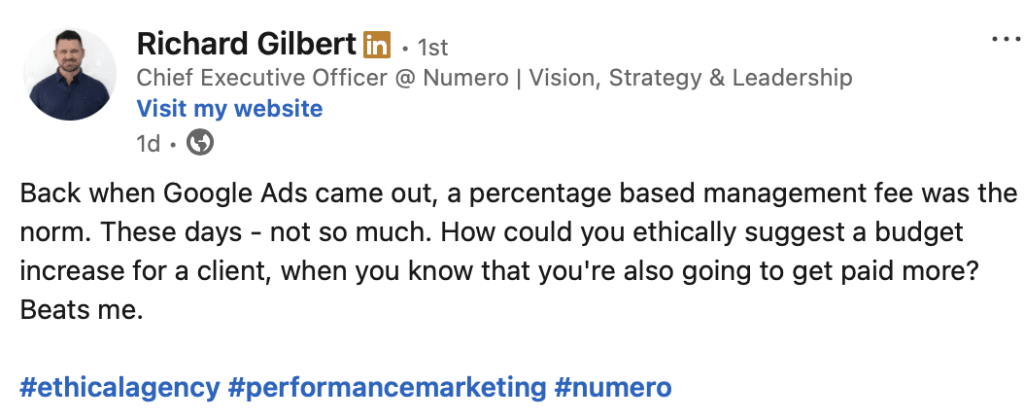
We love hearing different points of view. If you’re on LinkedIn please join the discussion that Harry started. Here’s what our founder, Richard Gilbert said.
We all use Google but now AI-powered search results are appear at the top of search results, offering complete answers without requiring you to click through to websites. This risks killing your online business because nobody visits your website.
Three key SEO strategies for 2025:
GEO (Generative Experience Optimisation) – Ensures AI tools like ChatGPT and Google AI cite your content as sources
SEO (Search Engine Optimisation) – Gets your business found in traditional search results
AEO (Answer Engine Optimisation) – Helps you appear in featured snippets and answer boxes
GEO is so new that we (like you) are on a steep learning curve. Working out effective SEO strategies is evolving. Below are four worked examples – take our work and adapt it for your own business website SEO. To learn the principles of SEO for AI bots, read our ebook SEO, AEO, GEO appear everywhere your clients are looking in 2025.
Click the image to download the ebook.
Google AI search Mode
At the time of writing (September 2025) Google has launched AI Mode – this is a different way of searching which uses Gemini’s advanced search and reasoning. Try out AI Search Mode.
Numero supports its ecommerce clients – we wrote this article about enabling ChatGPT product discovery back in June 2025 – by September our client Manuka South was showing up in product search results inside ChatGPT. Follow the link to read the article and submit your ecommerce store product list for indexing by ChatGPT.
AI Content Optimisation: Before & After Examples
Here are four fictional businesses who implemented GEO for their website. Each one has a “Before” and “After” text demonstrating what changes you need to make to website landing pages in order to show up in AI search results.
Pick the business which is closest to your own, and edit the text to suit your situation.
Industrial electrician
E-commerce fashion retailer
Construction building renovation specialists
Specialist car parts retailer
Case Study: Apex Industrial Electrical Services
Company Profile: Apex Industrial Electrical is a 35-person electrical contracting firm specialising in commercial and industrial projects across Auckland and Hamilton. They handle everything from factory rewiring to emergency power system installations for manufacturing facilities.
BEFORE: Traditional SEO-Focused Content for Electrician
Welcome to Apex Industrial Electrical Services, your premier choice for industrial electrical solutions! Our team of experienced industrial electricians has been serving the commercial sector for over 15 years. We provide top-quality electrical services that exceed expectations.
Our industrial electrical services include comprehensive electrical solutions for all your commercial needs. From electrical installations to electrical repairs, our certified electricians deliver professional electrical work. We are the leading industrial electrical contractors in the region, offering competitive pricing and exceptional customer service.
When you need reliable industrial electricians, choose Apex Industrial Electrical Services. Our electrical expertise and commitment to excellence make us the best choice for your electrical project. Contact our electrical team today for a free electrical estimate!
AFTER: AI-Optimised Content for Electrician Business
RevisedPage Title: How Long Does Industrial Electrical Installation Take? | Apex Industrial Electrical
RevisedContent:
Industrial electrical installation timelines vary significantly based on project scope and facility size. Here’s what businesses can expect:
Small Commercial Facilities (Under 1,000 sq metres):
Basic rewiring: 3-5 business days
Switchboard upgrades: 1-2 days
Emergency power systems: 5-7 days
Large Manufacturing Plants (Over 5,000 sq metres):
Complete electrical infrastructure: 4-8 weeks
Production line power installation: 2-3 weeks
Backup generator integration: 1-2 weeks
Factors That Affect Timeline:
Building occupancy during work (adds 20-30% to timeline)
Building consent approval process (typically 2-3 weeks)
Equipment availability and delivery schedules
Integration with existing systems
Emergency Industrial Electrical Services:
Apex Industrial Electrical provides 24/7 emergency response for critical power failures. Our average response time is 45 minutes for manufacturing facilities within Auckland and Hamilton.
We maintain a team of 35 licensed industrial electricians and stock common industrial electrical components to minimise downtime. Our service area covers greater Auckland, Hamilton, and the Waikato region.
Why this works for AI search:
The new text has lists, short sentences, includes key phrases that answer questions which customers may ask AI to answer such as How long does it take to do a new industrial electrical installation? Not only is this in th page title, it’s also answered in the body copy and bullet lists for different situations.
Case Study: Luxe & Lane Fashion
Company Profile: Luxe & Lane is a direct-to-consumer online fashion retailer specialising in contemporary women’s clothing priced between $200-$1,200 NZD. They focus on sustainable materials and limited-edition collections, targeting professional women aged 28-45 across New Zealand.
BEFORE: Traditional SEO-Focused Content for Fashion Retail
Shop the latest designer women’s clothing at Luxe & Lane! Our luxury fashion collection features the most stylish women’s clothes for the modern woman. From designer dresses to luxury tops, our women’s fashion is perfect for any occasion.
Discover our exclusive designer clothing collection featuring premium women’s fashion. Our luxury women’s clothing is crafted from the finest materials and designed for the sophisticated woman who appreciates quality fashion.
Browse our designer women’s clothing sale and find amazing deals on luxury fashion. Our women’s designer clothes are perfect for work, weekend, and special occasions. Shop luxury women’s fashion online with free shipping on orders over $300.
Experience the best in women’s luxury fashion with our curated collection of designer clothing. From casual luxury wear to elegant evening dresses, Luxe & Lane offers premium women’s fashion that makes a statement.
AFTER: AI-Optimised Content for Fashion Retail
RevisedPage Title: What Size Should I Order in Contemporary Women’s Clothing? – Luxe & Lane Sizing Guide
RevisedContent:
Contemporary women’s clothing typically runs smaller than traditional department store sizing. Here’s how to find your correct size:
Size Conversion Guide:
If you wear size 12 in Farmers or The Warehouse → Order size 14 in contemporary brands
If you wear size 16 in department stores → Order size 18 in contemporary brands
Designer brands often run 1-2 sizes smaller than expected
Luxe & Lane Specific Sizing:
Our garments are cut for a tailored, professional fit. Most customers order one size up from their usual New Zealand department store size.
Body Measurements vs. Size Tags:
Bust: Measure around the fullest part
Waist: Measure at natural waistline (narrowest point)
Hips: Measure around fullest part, about 20cm below waist
Fabric Considerations:
Structured blazers: True to size due to tailored cut
Knit tops: Size up for comfortable fit
Trousers: Check inside leg length – our standard inside leg is 81cm
Free Exchanges:
We offer free size exchanges within 30 days. Keep tags attached and items in original condition. Our most popular exchange is sizing up by one size.
Customer Service: Text ‘FIT’ to 021-555-0123 for personalised sizing advice based on your measurements and the specific item you’re considering.
Why this works for AI search:
The new text sets out to answer questions about clothing sizes and explains the difference from standard sizes in other stores. It also has lists and a handy size conversion guide that answers questions which customers may ask AI such as How to find the right clothes size for me? The inclusion of a SMS question and answer service reinforces the helpful nature of this page.
Company Profile: Metropolitan Apartment Renovators specialises in full-scale apartment building renovations, working primarily with property management companies and building owners in Wellington and Auckland. They handle projects ranging from single-unit updates to entire building modernisations.
BEFORE: Traditional SEO-Focused Content for Construction Business
Page Title: Apartment Building Renovation Contractors | Metropolitan Renovators
Content:
Metropolitan Apartment Renovators is your trusted partner for apartment building renovations and apartment renovation services. Our experienced apartment renovation contractors provide comprehensive renovation solutions for apartment buildings.
We specialise in apartment building renovation projects of all sizes. From single apartment renovations to full building renovations, our apartment renovation experts deliver quality results. Our apartment building contractors have extensive experience in residential renovation and apartment complex renovations.
Choose Metropolitan Apartment Renovators for your apartment building renovation needs. We are the leading apartment renovation company providing professional apartment renovation services. Our apartment renovation contractors are licensed, insured, and committed to excellence in every apartment building renovation project.
Contact us today for apartment renovation estimates and learn why property owners choose Metropolitan Apartment Renovators for their apartment building renovation projects.
AFTER: AI-Optimised Content for Construction Business
RevisedPage Title: How Much Does Apartment Building Renovation Cost in New Zealand? – Metropolitan Renovators
RevisedContent:
Apartment building renovation costs in New Zealand vary significantly based on scope, age of building, and location. Here’s what property owners can expect:
Per-Unit Renovation Costs (2024):
Basic refresh (paint, carpet, minor fixtures): $8,000-$15,000 per unit
Mid-range renovation (kitchen, bathroom updates): $25,000-$40,000 per unit
Full renovation (complete fit-out): $45,000-$70,000 per unit
Building-Wide Infrastructure Costs:
Lift replacement: $80,000-$150,000 per lift
Building re-cladding: $200-$400 per square metre
Fire safety system upgrades: $15,000-$30,000 per floor
Seismic strengthening: $500-$1,200 per square metre
Regional Price Variations:
Auckland: 15-20% above national average
Wellington: 10-15% above national average
Other main centres: At or below national average
Factors Affecting Cost:
Building age (pre-1980 buildings require more infrastructure work)
Council consent requirements
Earthquake strengthening needs
Tenant displacement costs
Access limitations in CBD locations
Timeline and Budgeting:
Most apartment building renovations take 6-18 months. Budget an additional 10-15% for unexpected issues commonly found in older buildings, particularly plumbing and electrical infrastructure.
Metropolitan Renovators provides fixed-price quotes after comprehensive building assessments. We’re licensed building practitioners with experience in Wellington and Auckland council processes.
Why this works for AI search:
The new wording has price ranges for different types of renovation jobs – the regional specificity allows it to be a good search results for questions such as Residential reno prices for Hamilton. Having suggestions about budget flexibility and the situations this applies to will also support searches for “older buildings”.
Business 4: Kiwi Performance Parts
Company Profile: Kiwi Performance Parts is an e-commerce retailer specialising in performance car parts and modifications. They serve New Zealand’s car enthusiast community, focusing on popular models like Subaru WRX, Mitsubishi Evo, Honda Civic Type R, and Ford Focus ST.
BEFORE: Traditional SEO-Focused Content for Automotive Business
Page Title: Performance Car Parts NZ | Turbo Parts | Kiwi Performance Parts
Content:
Welcome to Kiwi Performance Parts, New Zealand’s premier performance car parts store! We stock the best performance car parts, turbo parts, and car modifications for all performance vehicles. Our performance parts catalogue includes top-quality car performance parts from leading brands.
Shop our extensive range of performance car parts including turbo kits, exhaust systems, and engine performance parts. Whether you need performance car parts for your Subaru, Honda, or Mitsubishi, we have the performance parts you need.
Our performance car parts are competitively priced with fast shipping across New Zealand. From turbo performance parts to suspension upgrades, we are your one-stop shop for all performance car parts needs. Buy performance parts online with confidence from New Zealand’s trusted performance parts supplier.
Choose Kiwi Performance Parts for genuine performance car parts, expert advice, and excellent customer service. We are passionate about performance cars and committed to providing the best performance parts for New Zealand car enthusiasts.
AFTER: AI-Optimised Content for Automotive Business
RevisedPage Title: Will a Cold Air Intake Void My Car Warranty in New Zealand? – Kiwi Performance Parts
RevisedContent:
Installing a cold air intake in New Zealand may affect your warranty, but it won’t automatically void it entirely. Here’s what you need to know:
Consumer Guarantees Act Protection:
Under New Zealand’s Consumer Guarantees Act, dealers cannot void your entire warranty due to aftermarket modifications unless they can prove the modification directly caused the specific failure.
What Dealers Can and Cannot Do:
Can refuse warranty claims: If the cold air intake caused the specific problem (e.g., water damage from poor installation)
Cannot void entire warranty: Unrelated systems (brakes, transmission) must still be covered
Must prove causation: Dealer must demonstrate how your modification caused the specific failure
Documentation Requirements:
Keep receipts and installation records. Professional installation by a qualified mechanic strengthens your position if warranty issues arise.
Popular Models and Warranty Considerations:
Subaru WRX/STI: Dealers often more accepting of performance mods
Honda Civic Type R: Generally warranty-friendly for basic intake upgrades
Mitsubishi Evo: Check with dealer before modification
Ford Focus ST: Varies significantly between dealerships
Best Practices:
Inform your dealer before installation
Use quality, well-known brands (AEM, Injen, K&N)
Keep original airbox for warranty work
Choose reversible modifications when possible
Professional Installation Available:
Kiwi Performance Parts partners with certified mechanics in Auckland, Wellington, and Christchurch for professional installation with documentation for warranty protection.
Why this works for AI search:
Including bulleted and numbered lists is great for AI search results. Along with named car marques which are likely included in questions Cold intake fitting for Honda Civic. And the best practice list allows the reader to quickly see possible pitfalls which they can avoid.
Worked examples of AI Generative Experience Optimisation
These four fictional business examples all use the same principles which are explained in detail in our GEO, AEO and SEO ebook – download it to read for yourself.
numero® is an expert SEO agency specialising in New Zealand business. Can we help you?
Since Google came on the scene in 1991 we Kiwis have trained ourselves to use Google to answer questions on life, love and business. Over 91.7% of us only use Google for online search (April 2025 data) compared to Bing 5.2% and Yahoo 1%. The training data we’ve created by being such heavy users has made Google a very successful and valuable business.
Enter artificial intelligence and suddenly the world of search is changing. Generative Experience Optimisation (GEO) is the term used for the process of encouraging AI agents like ChatGPT, Grok or Gemini to use your website content as a source for their synthesised answers to search queries.
Search is evolving beyond traditional Google results. Whilst most Kiwis still use Google, AI-powered search results are now appearing at the top of pages, offering complete answers without requiring clicks through to websites.
Three key optimisation strategies you need:
SEO (Search Engine Optimisation) – Gets your business found in traditional search results
AEO (Answer Engine Optimisation) – Helps you appear in featured snippets and answer boxes
GEO (Generative Experience Optimisation) – Ensures AI tools like ChatGPT and Google AI cite your content as sources
The shift matters because: AI search results get prime real estate at the top of pages with no adverts, and they’re becoming the preferred way people find information. These “zero-click searches” mean users get answers without visiting your website.
What to do: Start with quality content that answers questions directly, use clear headings and FAQ sections, write conversationally (as if speaking to a friend), and structure your content so both humans and AI can easily understand it. Most tactics that work for traditional SEO also benefit AI optimisation.
Bottom line: Businesses that optimise for all three approaches now will have a competitive advantage as AI search adoption accelerates throughout 2025.
Businesses use search engine optimisation (SEO) to align website content with search phrases on Google. Now we need our websites to also show up in artificial intelligence search (GEO) – in Google AI search results.
It’s a whole different ballgame – an audience of computers rather than humans. AI agents and LLMs try to synthesise “answers” rather than showing web links for you to click through and read. These AI search results are based on utility or usefulness. They use contextual relevance in order to try to solve the user’s needs as interpreted from the tone of voice, phrases and sentiment used to write the search prompt. Unlike SEO, these AI answers are not driving web traffic because they present a complete answer and often don’t include links.
At the time of writing (June 2025) the AI search results are getting prioritised by all the search engines. These results are highly visible, top of page and are unsullied by adverts. Let’s take a look.
The rest of this article is going to give you actionable strategies and tools to start making this change. If you want to skip ahead, here are the key sections:
It’s easier to explain the differences between Search Engine Optimisation SEO, Answer Engine Optimisation AEO and Generative Experience Optimisation GEO by seeing the search results delivered by each.
I typed this search “When did SEO become a marketing tactic?”. The results and the sources used in the results are different. Why?
Each search technique has different goals – SEO enables your business to get found, whereas AEO is about being understood, and GEO builds trust as a source used by AI platforms. Together, they make a future-ready digital strategy for your business website.
Compare these screenshots from a SEO result, an AEO featured snippet result, and an AI GEO result.
SEO Result – three websites showing title tag of the site, title of the page, meta description of 150-160 characters and URL.
AEO Result – this featured snippet can have variable length answers from 40 to 60 words and a date for the answer (helpful when recency matters). It’s one type of “answer box” search result and importantly, in this case it also includes the source URL immediately below. When you click through the page highlights text copied to form the AEO result. Note that sites appearing in featured snippets are not included in the 10 natural search results below.
AEO click source page result showing highlighted text.
GEO Result – Flagged as an AI overview, this is the GEO search result including two source websites on the right hand side (I put the red box around it). You can see how it no longer copies text from the source websites and instead summarises into full sentences. The tiny grey link circle at the bottom provides the source link and the reminder “AI responses may include mistakes”.
Notice that there’s no clutter in the AI result? There are no video or image search results; no paid search listings appearing above the natural search results. Draws the eye doesn’t it? Rather like Google’s home page – a lot of white space.
And this reinforces the recent growth in Zero Click Searches – where the answer is displayed and you don’t need to click to a website to read more.
Call me cynical, but it’s as if the tech giants want to train us to use AI.
They do. You’re right, I am a skeptic.
Now is the time to take action and realign your website to cover SEO, AEO and GEO, before the near-inevitable enshittification of the AI search results kicks in.
Definitions of SEO AEO and GEO
GEO is Generative Experience Optimisation and it has been active since the mid 2020s.
Optimising web content to be effectively utilised by generative AI models, ensuring it is structured, contextually rich, and easily interpretable for AI-generated outputs,
What a mouthful. A word of warning – many web articles reference Geographic Engine Optimisation as GEO. This is about optimising for local marketing and is not what we’re working on here. There’s a lot of confusion here and here where the writer talks about search for AI results and then describes local search as the example – they aren’t talking about generative experience optimisation.
Now let’s look at definitions of its two predecessors AEO and SEO.
Answer Engine Optimisation started around 2018 and is
The process of optimising content to be featured in search engine answer boxes by providing clear, concise and structured responses to common user queries,
Search Engine Optimisation began from the late 1990s, when search engines became popular and so marketers wanted their web sites showing up in the search results on page one. SEO is
The practice of optimising a website to improve its visibility in search engine results thereby increasing organic traffic through techniques like keyword optimisation, content quality and backlinking.
No clearer?
Let’s dive into the outcomes you may want as a business and then we can work out whether GEO, AEO or SEO is better related to your needs, You may need all three!
Key features of GEO generative experience optimisation
Appearing in AI answers means your source website pages have to be optimised to enable easy retrieval and summarisation by AI systems. Because AI uses natural language (how people speak) you will need to write your source pages as if you were speaking. Further, AI answers are not just about answering questions – it’s moved on from voice search results which were also based in natural language.
The AI sounds much more chatty; the November 2022 ChatGPT training model launch described itself as conversational AI.
What works for all SEO, AEO and GEO
Fortunately there are some common underpinnings of all three search optimisation methods which everyone should implement on their business website. If you already know how to do this for SEO or AEO, you’ll find that the same technique works for Generative Engine Optimisation.
If you are just getting started, these are your first six tasks.
High quality website content
Relevance and value – good information that actually answers user questions, that showcases your expertise and provides actionable insights will continue to do well. It must be aligned with your target audience. Clarity and simplicity – write to your lowest common denominator audience who may be non-native English speakers (of which there are many in New Zealand). Use language that a 12 year old can understand with short sentences, few three-syllable words, clear explanations and case study examples.
Keyword optimisation
Research and integration – make sure that you’re up to date with relevant keywords, the Domain Rating (DR) score of your competitors and don’t forget to include keywords throughout headings, subheadings and body text. Semantic richness – writing with synonyms and antonyms are good ways to provide case study examples of what not to do as well as covering off a range of relevant and related keywords for your business niche. These allow you to become the best answer for a wider range of queries, prompts and questions and to give examples which deepen the contextual richness of your content.
Structured data
Schema markup – no surprises here, website schema markup is essential for any search optimisation. Different types of schema markup are used for ecommerce product snippets, articles, local businesses, and reviews. Use Google’s markup helper tool. Metadata – same as the answer above, you must use heading hierarchies in a systematic way and include meta descriptions that accurately align with your website topic.
Content structure
Headings and subheadings aren’t just for structured data, they help organise the sequence of information in your writing. Including Heading tags in metadata simplifies data extraction and learning by AI agents as well. Bullet points and lists serve a similar purpose for both human readers and AI. Your ability to organise the article helps humans skim read and jump to the section they need to read.
User engagement
Interactive elements – use a diverse range of techniques like comments and “click to share” snippets which can easily be sent and shared to public social media sites or dark social sharing (private groups or through messaging apps). Feedback loops involve continually updating your article as the landscape changes or new AI search practices emerge. There really is a benefit of being the first to answer and update your article.
Comprehensive coverage
Depth of information continues to be key so that the AI GEO will deliver high-level results as well as taking your explanations and case studies as source inputs for detailed answers which they give users. Remember that some AI platforms include web links to their sources and some do not. I have not listed these because each new software release changes the landscape – do your own research! Updates and accuracy – keep improving your content. Based on your business a well-rounded content marketing plan will include “cornerstone content” that align with your primary keywords, audience top of funnel (TOF) pages and are destinations for paid search. Mutual reinforcement helps to keep your best pages at the top of search rankings for the long term. Remember the pareto principle (80:20 rule) supports best practice SEO and content marketing.
Unique tactics for GEO
Clear and structured content.
Simplicity – write using clear language that’s easy for AI to summarise (parse), understand and reproduce in short sentences. Avoid complex, long sentences and jargon. Check your work by reading it out loud as if you were talking to a friend or teaching a class. Structure – use H1 headings, sub-headings (H2-H6 tags), bold text, bullet points and numbered lists to organise your content so it’s logical and sequential. This aids data extraction by AI.
Semantic richness.
Contextual information – explain the background and context to your topic so that AI understands the nuances of your text. Remember that diverse media types can help readers who prefer images, infographics or video results to also find your website through search. Synonyms and variations – this enables a range of keywords so that your text shows up as an answer in a broader range of queries. It’ll improve your chances of being selected as relevant.
Question/answer and FAQ formats
Pairs of questions and answers – this structure makes it easier for AI to identify both questions and answers. Frequently asked questions are a worthwhile section to include so that direct answers can be retrieved and matched against search queries by AI agents.
Metadata and schema markup
Schema markup tools structure your content so that AI can assess context and relevance. Metadata fields should be accurate and reflect the rest of the content and keywords.
Comprehensive content
Depth of information is rewarded by AI systems so that answers are deep, relevant and can provide answers for both an initial response and more detailed AI prompts. Updates and accuracy based on dates and recency are increasingly important for relevancy and reliability as source answers for AI.
Engagement and feedback
User engagement continues to be an important signal for good quality search results. So any review, comment or social media sharing enhances your GEO. If you can also include checklists, quiz, polls these are additional data points which generative LLMs use as quality scores. Feedback loops from reader answers enable you to continuously update and improve the source article content.
1. BEFORE Page Title: Best Industrial Electricians – Commercial Electrical Services | Apex Industrial
Content:
Welcome to Apex Industrial Electrical Services, your premier choice for industrial electrical solutions! Our team of experienced industrial electricians has been serving the commercial sector for over 15 years. We provide top-quality electrical services that exceed expectations.
AFTER Page Title: How Long Does Industrial Electrical Installation Take? – Apex Industrial Electrical
Content:
Industrial electrical installation timelines vary significantly based on project scope and facility size. Here’s what businesses can expect:
Small Commercial Facilities (Under 1,000 sq metres):
– Basic rewiring: 3-5 business days – Switchboard upgrades: 1-2 days – Emergency power systems: 5-7 days
Large Manufacturing Plants (Over 5,000 sq metres):
– Complete electrical infrastructure: 4-8 weeks – Production line power installation: 2-3 weeks – Backup generator integration: 1-2 weeks….. Read the full case study.
Shop the latest designer women’s clothing at Luxe & Lane! Our luxury fashion collection features the most stylish women’s clothes for the modern woman. From designer dresses to luxury tops, our women’s fashion is perfect for any occasion….. Read the full case study.
AFTERPage Title: What Size Should I Order in Contemporary Women’s Clothing? – Luxe & Lane Sizing Guide
Content:
Contemporary women’s clothing typically runs smaller than traditional department store sizing. Here’s how to find your correct size:
Size Conversion Guide:
– If you wear size 12 in Farmers or The Warehouse → Order size 14 in contemporary brands – If you wear size 16 in department stores → Order size 18 in contemporary brands – Designer brands often run 1-2 sizes smaller than expected
Luxe & Lane Specific Sizing:
Our garments are cut for a tailored, professional fit. Most customers order one size up from their usual New Zealand department store size….. Read the full case study.
3. BEFOREPage Title: Apartment Building Renovation Contractors | Metropolitan Renovators
Content:
Metropolitan Apartment Renovators is your trusted partner for apartment building renovations and apartment renovation services. Our experienced apartment renovation contractors provide comprehensive renovation solutions for apartment buildings.
AFTERPage Title: How Much Does Apartment Building Renovation Cost in New Zealand? – Metropolitan Renovators
Content:
Apartment building renovation costs in New Zealand vary significantly based on scope, age of building, and location. Here’s what property owners can expect:
Per-Unit Renovation Costs (2024):
– Basic refresh (paint, carpet, minor fixtures): $8,000-$15,000 per unit – Mid-range renovation (kitchen, bathroom updates): $25,000-$40,000 per unit – Full renovation (complete fit-out): $45,000-$70,000 per unit
Building-Wide Infrastructure Costs:
– Lift replacement: $80,000-$150,000 per lift – Building recladding: $200-$400 per square metre – Fire safety system upgrades: $15,000-$30,000 per floor – Seismic strengthening: $500-$1,200 per square metre….. Read the full case study.
4. BEFOREPage Title: Performance Car Parts NZ | Turbo Parts | Kiwi Performance Parts
Content:
Welcome to Kiwi Performance Parts, New Zealand’s premier performance car parts store! We stock the best performance car parts, turbo parts, and car modifications for all performance vehicles. Our performance parts catalogue includes top-quality car performance parts from leading brands.
AFTER Page Title: Will a Cold Air Intake Void My Car Warranty in New Zealand? – Kiwi Performance Parts
Content:
Installing a cold air intake in New Zealand may affect your warranty, but it won’t automatically void it entirely. Here’s what you need to know:
Consumer Guarantees Act Protection:
Under New Zealand’s Consumer Guarantees Act, dealers cannot void your entire warranty due to aftermarket modifications unless they can prove the modification directly caused the specific failure.
What Dealers Can and Cannot Do:
– Can refuse warranty claims: If the cold air intake caused the specific problem (e.g., water damage from poor installation) – Cannot void entire warranty: Unrelated systems (brakes, transmission) must still be covered – Must prove causation: Dealer must demonstrate how your modification caused the specific failure
Documentation Requirements:
Keep receipts and installation records. Professional installation by a qualified mechanic strengthens your position if warranty issues arise….. Read the full case study.
Which search strategy is best for me?
Your business will need to agree on a strategy that aligns with what you sell, who you sell it to and where they are located.
Below we share scenarios for each of the 3 search best practices and common errors to avoid. To use this information you should decide if that scenario applies to your business products or services, your type of customers and the location of the customer base. If the answer is yes to all three, you’ve got your answer about whether this is a relevant strategy.
Don’t expect perfect alignment with your unique situation – and if you’d like help, book a call with the Numero expert team [LINK]. We will help validate your choice to get the right mix of performance marketing to suit your sales and lead generation goals.
Three solid use cases
Use SEO for stable, keyword driven traffic (e-commerce retail, brand names, localised content, Google Business Profile (GBP) optimisation, news publishers, B2B lead generation)
Use AEO if your niche has customers who ask quick questions (health, DIY or personal finance)
Use GEO when your audience relies on AI tools for research (tech, travel, SaaS, and education)
Case studies of best practice
Search Engine Optimisation is best used by businesses who want to increase their online visibility and attract a broad audience using organic search traffic. When search includes keywords such as your business name, the brands you sell (Nike Air shoes), or local geographic optimisation words (Post Office near me) these are “static” keywords. They don’t change over time – your business location, the name of your business and the brands you sell are constants for your search marketing work.
A local bakery can optimise its website using keywords which respond to searches like
Best Bakery in Porirua
Artisan Bread wholesale
Gluten Free baking ingredient shop
Custom birthday cakes
When NOT to use SEO marketing. If your business relies on direct sales and in-person visits serving a niche, local customer base who does not use the internet.
Answer Engine Optimisation answers questions really well. So your content which has question/answer pairs and frequently asked questions (FAQs) as well as detailed “how to” guides will serve you well.
A tech startup with a complex software solution needs to use education-led marketing to showcase its solutions to prospective customers using quick answers to common technical questions,
A comprehensive FAQ section on the website backed with schema markup
Written in natural language and optimised for voice search for top of funnel (TOF) and middle of funnel (MOF) sales stages
Concise, informational content with links to deeper, more explanatory answers.
Adding an AI chat bot, an AI tech support or sales team chat function to drive website visitor engagement.
When NOT to use AEO marketing. Your business has a highly technical or complex product that requires customisation and detailed explanations as part of the sales process and these cannot be easily summarised into short answers.
Generative Experience Optimisation works best where both the business and their target audience use AI and know that this is where their search results must feature to kickstart prospect engagement.
A travel agency uses GEO to optimise its content articles about travel packages and guided tours to overseas countries favoured by New Zealanders.
The website content is structured for local search which aligns with the agency’s known customer preferences
Flight departures from New Zealand airports are prioritised to demonstrate relevancy
Showcasing travel guides, recommended itineraries and FAQs on visas and inoculations specific to local clients.
When NOT to use GEO marketing. If your business prioritises human interaction and personalised customer service to achieve sales, the human touch does not translate well into AI search results.
Q&A on differences and similarities between SEO, AEO and GEO
Q: Do I need to choose between SEO, AEO and GEO, or can I use all three?
A: You don’t need to choose – in fact, most businesses benefit from using all three strategies simultaneously. They work together rather than competing against each other. The foundational work you do for SEO (quality content, structured data, keyword optimisation) also supports AEO and GEO. Think of it as building layers: SEO forms your base, AEO helps you capture featured snippets, and GEO ensures you appear in AI-generated answers.
Q: How much time should I spend on GEO versus traditional SEO?
A: This depends on your audience and industry. If your customers are early adopters of AI tools (tech, education, research-heavy sectors), allocate 30-40% of your effort to GEO. For traditional industries or local businesses, maintain 70% focus on SEO whilst gradually incorporating GEO principles. The beauty is that good GEO practices often improve your SEO as well.
Q: Will GEO eventually replace SEO entirely?
A: Unlikely in the near term. Whilst AI search results are more prominent on Google, traditional search results still drive significant traffic and conversions. However, the landscape is shifting rapidly. Since the start of 2025, we’re seeing AI overviews appear for more query types, so businesses that start optimising for GEO now will have a competitive advantage as adoption grows.
Q: How do I know if my GEO efforts are working?
A: Currently, measuring GEO success is challenging because traditional analytics don’t track AI-generated citations well. Look for:
Increases in direct traffic (people finding you through AI, then visiting directly)
Brand mention tracking across AI platforms
Monitoring when your content appears in AI overviews for your target keywords and unique key phrases (e.g. long tail key phrases, registered trademarks)
Engagement metrics on pages optimised for GEO. New tools are emerging to help track this – the measurement landscape will improve significantly over the next year. We recommend using AH Refs Brand Radar as a reliable measurement tool.
Q: Should I rewrite all my existing content for GEO?
A: There’s no need to start from scratch. Begin with your highest-performing pages and most important topics. Use the techniques we describe above like adding FAQ sections, simplify complex sentences, and ensure your content answers questions directly. Focus on your cornerstone content first – the pages that drive the most traffic or conversions. You can gradually update other pages over time as resources allow.
Q: What’s the biggest mistake businesses make with GEO?
A: Writing for robots instead of humans. Whilst GEO requires AI-friendly formatting, the content still needs to engage real people. Don’t sacrifice readability for the sake of structure. Also, many businesses create content that’s too shallow – AI systems prefer drawing from comprehensive, authoritative answers over brief snippets.
Q: How is voice search different from GEO?
A: Voice search and GEO share some similarities (both favour natural language), but they’re distinct. Voice search typically delivers single, quick answers, whilst GEO can provide more comprehensive responses that synthesise an answer from multiple source websites. GEO also appears in text-based AI platforms, not just voice assistants. However, optimising for one can benefit the other.
Q: Do I need technical expertise to implement GEO?
A: Basic GEO improvements (clearer writing, FAQ sections, better semantic structure) can be implemented by anyone with content creation skills. However, advanced techniques like schema markup and comprehensive technical optimisation benefit from SEO expertise. Start with content fundamentals – clear, conversational content that directly answers questions – before moving to technical implementations.
Q: Will paid advertising become less effective as AI search grows?
A: Paid advertising will continue to evolve rather than disappear. We’re already seeing AI platforms experiment with sponsored content and AI-generated ad copy. However, the traditional pay-per-click model may shift towards pay-for-mention or pay-for-citation models in AI responses. Businesses should maintain their current paid strategies whilst monitoring how AI platforms develop their advertising offerings.
Q: How do I optimise for different AI platforms (ChatGPT, Google AI, etc.)?
A: Focus on universal best practices rather than platform-specific tactics, because the AI landscape changes rapidly. Each time a new version of an AI platform is released, they may be using different training data. As different AI platforms have varying source preferences, casting a wide net with quality content is more sustainable than trying to game individual systems.
Q: What are ways for me to target topics?
A: Topic targeting is a valid marketing strategy that moves your web content away from a reliance on keywords towards topics. Identify detailed topics within the niche which your business serves and solves for. This is a great way to get recognised by search engines as an expert. The more comprehensive you can be, the better as this drives your ranking.
Q: Can I just write for my website or do I need a content expert?
A: Content marketing experts and copywriters will never be as knowledgeable as you are about your business, your niche and the detailed knowledge your team has. Where they excel is in writing clearly, explaining detailed concepts so the non-expert can understand and enabling your content to rank in search results. A content marketing expert will be much better at formatting, re-purposing and aligning your content for your target audience and your marketing plan than you can be.
Q: I’m worried about zero click searches. What can I do about these?
A: writing your website content to respond to the GEO search results will help with zero click searches. Using your brand and product names within expert web content can enable them to be picked up by GEO results. Remember some AI search engines include web links (others don’t). Brand mentions can include the names of your key staff members as well as product names.
Ready to get started? Contact our expert SEO team today. [LINK]
Q: Should I still worry about my competitors?
A: Yes, always keep an eye on your top 3-5 competitor brands. Do incognito searches for their AI generated answers. Take note where these overlap with target search queries for your brand. Use these results to double down on your content marketing to counter their ranking results.
Q: Do E-E-A-T signals still matter?
A: Absolutely. Google prioritises Experience, Expertise, Authority and Trustworthiness (E-E-A-T) in search result rankings. So continue to build your business’ content marketing in these areas. You could include interviews with subject matter experts from your staff and customers, keep your case studies and testimonials up to date, try doing novel research and don’t forget storytelling as a content marketing tool. The more you can give the reader actionable advice the better and so checklists, case studies and FAQs should be part of your broad content and SEO strategy.
Future trends and challenges for GEO
As with any developing marketing and technology, the detailed topics of the day will evolve – maybe very fast. Checking back regularly is your best defensive marketing strategy for GEO.
Here is a non-exhaustive list of techniques which Numero is watching closely. We will normally implement new techniques on our own website assets first, but we appreciate working with client partners who also want to stay ahead of their competition and are comfortable with some SEO risk.
Deep personalisation – enable content variations for different audience segments
Dynamic UX (user experience) based on user behaviours like dwell time or click patterns
Predictive search intent modeling to second-guess what trends will rise to popularity and so get ahead of the competition.
Google has SGE Search Generative Experience Insights (SGE) which rank the AI-generated answers.
Expect ever more tools to interpret and summarise your GEO results. We are keeping an eye on MarketMuse, Clearscope and Frase as tools to identify content gaps and semantic keyword opportunities.
Numero is already tracking SERP fluctuations – this is where the AI tools evolve and start to serve different answers to the same search strings. Use these as a guide to adjust your existing content to align with the newly prioritised AI answers.
Website functionality continues to improve and dynamic content tools already exist which show different information to different customers. Working out how the AI tools react to this variability and deliver search results is not yet clear.
And yes, we’re watching this space and so should you. Stay in touch with us [LINK to contact form or register on our CRM?]
In summary
Your approach to modern SEO has to be grounded in a solid marketing strategy which includes content marketing tactics and campaigns within the monthly marketing activities. You will need to keep your web content optimised, website technical optimisation up to date and also track on-site user engagement.
By starting with expert topic-based content which aligns with your business you will be off to a great start. Keep regularly assessing your results and returning to optimise and improve your cornerstone content as part of your marketing calendar. You will soon be ranking well in AI search from GEO results.
The client had a rogue employee who stole the computers containing all the detailed logins needed to keep the company’s marketing running.
Bad things happen in business and numero® will always try to do the right thing to help you out.
How we helped
The website had never gone live – it was hosted on our server and at the time was awaiting client approval to go live. The design was nearly complete; we were just waiting for edits and feedback on the design. In effect, 90% of the website design work was complete.
We have a full backup of the website and all the associated data. It is in our archive and was retrieved within one business day. This is one of the “failsafes” we put into place to support our clients.
Failsafes are what enable numero® to be this helpful. We set up our business to be able to jump in and retrieve what looks like a really bad situation so that we can help our clients smooth the path back to normal business.
Quick Security Checks for Trades Businesses
Be wise before the event – here’s a checklist of failsafes which will support your business if trouble comes looking.
secure storage – all tools are locked up when not in use
vehicles – overnight is your main security concern. Alarms and GPS trackers can help
insurance – cover the trade tools, vehicles and office equipment that covers loss, theft and damage
inventory – know what tools and equipment you own and which site they’re on
digital security – strong, unique passwords and MFA (multi-factor authentication) for logins. Back up office computers daily including client contact details and project information. Cloud servers are better than local storage on your computer. Make sure your business wifi uses a strong password and encryption
contracts – keep digital copies of signed contracts
emergency plan – know what you will do if your business suffers interruption like a power outage, a flood or an earthquake. We were all unprepared when Covid-19 hit and we couldn’t go to our offices
Your Business Growth
A website is essential for business growth. Few new clients hire you without first checking your website. numero® knows how NZ business works; marketing is the vehicle we use to drive your business growth.
When clients partner with us, you get to use all our long experience in business. We know the ups and downs. So we use failsafes like website backups to keep your marketing projects on track and reduce your business risk.
Do trades hate marketing?
Tradies have a reputation of hating marketing. It’s because you are on the tools, you’re practical and you are a visual person. You need to see it to understand it.
Obscure technical jargon does not interest you because it makes you feel lost and out of control.
So no, tradies don’t hate marketing, they hate working with marketing people who don’t understand tradies.
Why tradies work with numero®
We get it – you’re on the tools, not behind a desk crunching marketing numbers. That’s exactly why most tradies have avoided marketing for years. It feels like speaking a foreign language with no guarantee it’ll actually bring in jobs.
Here’s the thing: we make trades marketing work because when you work with us, you understand what’s happening with your marketing. No jargon, no mysterious ‘brand awareness’ just clear explanations of what you’re paying for and what jobs it’s bringing in.
Think of working with numero® like your toolbox – you wouldn’t buy a tool without knowing exactly what job it does, right? We explain marketing the same way.
When we run Google Ads, it’s like having a sign on every street corner where your ideal customers are driving past. When we optimise your website, it’s like having your best salesperson working 24/7.
We’re your marketing partner, not your marketing mystery box. You’ll know exactly what’s working, what isn’t, and why.