
Category: Blog

  • Do Small Businesses Need SEO?

    Do Small Businesses Need SEO?

    SEO is a powerful process that has the potential to make the difference between success and failure for your business. As a small business you may think you can’t afford the same marketing as big business. BUT today I’m going to challenge that.

    Some Quick Questions

    1. Are most of your customers local?
    2. Do they live or work near your business location?
    3. Do you trade in a niche industry?

    If your answer to any of these questions is yes, then your business absolutely needs SEO.

    Why SEO Matters for Small Businesses

    This may sound dramatic. But, 50% of people who conduct a local Google search on their smartphone end up visiting a store the same day. Your business needs to in that search result and at the fingertips of local customers. This is one of the biggest competitive advantages local business has.

    This isn’t the only benefit of SEO, though, here are some more

    1. Local SEO delivers long-term return on investment

    Organic SEO should always be part of your long-term marketing strategy. When the time is right, paid campaigns can have a place in the short-term marketing strategy. After all, paid advertising generates clicks and potential customers almost immediately.

    This is because organic search brings you engaged visitors over the long term. Once you’ve added keywords, links and meta information to your website, they stay there for ever. And you can publish useful content that answers questions (FAQs), informs, and entertains. Then you’ll find customers interact naturally with your website because it shows up in search results.

    As a result, your return on investment from SEO improves over time – the more visitors search and click to your website, the higher it will rank in local search results.

    The same applies to niche businesses. If you are the only firm selling leather saddles for ponies; or kitchen implements for left-handed users – you will get found easily in search results. The more you can present a niche product or a service for a niche audience, the easier your SEO will be. This is one of the ways the internet has “democratised” business – people looking for your niche can find you from overseas.

    2. Customers are making more local searches

    We all prefer using our mobiles rather than desktop computers. The number of hours we spend on the phone each day continues to rise. The search tool lives in your pocket, daily.

    Where does this fit into SEO? Well, according to Google, nearly half of all mobile searches are related to location. As more and more users turn to their smartphones to find out about the world around them with local searches, you need to be there. The best way to get in front of these searchers is through local SEO.

    3. A solid local SEO strategy is key to success

    Check out this statistic:

    • 76% of local searches result in a phone call
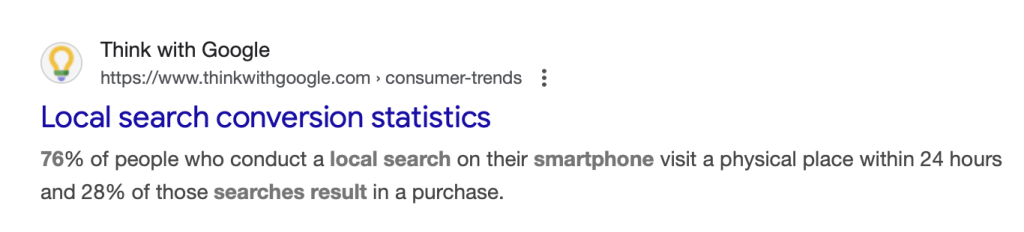
    Every local business wants customers and potential customers to get in touch. This lets you start building a relationship early. As 76% of local searches result in a phone call, without SEO you risk losing those relationships.

    A solid, well-structured SEO strategy will put you in front of customers with an immediate need from your business.

    Your Competitors Are Already Doing SEO

    Whichever industry your small business operates in, your competitors are almost certainly involved in Search Engine Optimisation too. The marketing arms race means that if they are doing SEO, you have to do the same or you risk losing customers to them.

    To gain the best advantage, start as early as possible. It takes time to build SEO authority and rankings, and you never know when your competitors are going to power into the picture.

    Remember one thing from this article: SEO is not just for large businesses. Small business owners with local clients and/or niche products and services like you absolutely can benefit.

    Explore more digital marketing strategies
  • SEO Optimisation of Parallax Scrolling Websites

    SEO Optimisation of Parallax Scrolling Websites

    SEO Optimisation of Parallax Scrolling Websites

    Website design and SEO are two things that should go hand-in-hand. In other words, you should not include a design feature on your website unless you consider the implication for SEO. Parallax scrolling is a design feature, so how will it impact the SEO of your website? How can you optimise a parallax scrolling website?

    What is a Parallax Scrolling?

    Parallax scrolling has its origins in video game design. It is a website design technique where the background of the website’s page scrolls slower than the foreground (or content) of the page. So, you could have a background image that will scroll slower than the text on the page.

    The effect is to add depth to the page, making it feel more interactive and making it look almost 3D.

    It is an effect, however, and it can be overwhelming and/or distracting when used in the wrong context or when used too much. When used subtly, however, and when the focus remains on the content of the page rather than letting a design quirk take over, parallax scrolling can enhance a website and make it more memorable and eye-catching.

    The SEO Impact of Parallax Scrolling

    Generally, parallax scrolling is not, in itself, problematic for SEO. The search engine optimisation issues occur in its application.

    There are two ways that website designers use parallax scrolling:

    1. To add a design feature to a page on a website
    2. To make parallax scrolling a central feature of a one-page website

    The first approach is the least problematic. So long as the website has a good SEO architecture, the addition of a parallax scrolling feature to a page will have minimal impact on search engine ranking, although you do need to consider site speed – see below.

    Big problems arise, however, when you use parallax scrolling on one-page websites. The issue isn’t necessarily with the parallax scrolling feature but, with the fact the website has a one-page design.

    We’ll come to the issue of one-page parallax scrolling websites in a moment, but there is an important factor to point out for any parallax scrolling element on a website, even if it’s a design feature on a single page of a multi-page website – speed.

    Website Speed and Parallax Scrolling

    Parallax scrolling will slow down your website – it really is as simple as that. This could impact the SEO of your website, particularly if you already have speed issues.

    Where the problem of speed is most acute, however, is on the mobile version of your website. Parallax scrolling can slow down websites viewed on phones considerably, so you should think carefully before adding it.

    One helpful approach is to remove the parallax scrolling effect for anyone viewing your website on a mobile device.

    Why Parallax Scrolling is So Popular on One-Page Websites

    Back to one-page websites and why parallax scrolling is so popular.

    One-page website design is a design approach favoured by some for its minimalist style. You need to overcome the issue of having one long page of content, however. How do you stop the page from becoming boring?

    The solution that many website designers turn to is parallax scrolling. Parallax scrolling helps to break up content and grab the attention of visitors with visual uniqueness.

    In other words, it can be the difference between a one-page website design that is flat, uninspiring, and boring, and a website that works and visitors love (notwithstanding the speed caveat mentioned above).

    What’s the Problem with One-Page Websites?

    Parallax scrolling can make one-page websites work from a user’s perspective, but single page websites are problematic for SEO. This is because Google views them as one-page websites. While you might think that’s the whole point, this is not what search engines want.

    Instead, search engines want each section of your website (i.e. each section of your one-page website design) to have its own page and information. This helps give Google a better understanding of the content on the page and where it fits into its search results.

    So, to get the best results, you should abandon the idea of a one-page website altogether, giving your website a multi-page site architecture instead. You can then add the parallax scrolling design feature to individual pages wherever you think it will enhance the user experience.

    What If You Want to Stick with a One-Page Design?

    What if you want to stick with a one-page design that uses parallax scrolling? This approach will never be as good as having multiple pages, but there are some things you can do to improve the SEO of your site.

    While you won’t have multiple pages on a one-page website, you will have sections of content. This could be About Us, Services, Contact, etc. Most one-page websites have a menu that lets users jump to these specific sections on the page.

    Google doesn’t treat the links to these sections as separate URLs, but you can use workarounds. Specifically, you can use code that makes your website appear to Google as multiple pages with each page having its own unique content, page title, and meta description.

    This will enable Google to more effectively index your website which, in turn, helps ensure your website appears on searches for crucial keywords.

    The way to achieve this is to use Google’s guidelines for pages with infinite scroll. Infinite scroll pages and one-page websites with parallax scrolling are different, but the solution for infinite scrolling pages will optimise your site for Google search.

    Importantly, it will improve the SEO of your website while maintaining the one-page design for users. Therefore, you get the design features you want – one-page design with parallax scrolling functionality – while ensuring your site has the SEO structure it needs.

    Final Thought – Analytics

    The above solution doesn’t solve all the issues that exist with one-page websites that have parallax scrolling. The biggest is the problem of analytics.

    The analytics data you get from a one-page website is restricted to a single page. This means you can’t drill into the performance of each section of your website. Chunking your one-page website into different sections for SEO will not change that.

    Summary

    In summary, many people like the parallax scrolling feature, but it does have implications for SEO. Make sure you take the necessary steps to optimise your site if you choose to implement parallax scrolling.


    Contact Numero Now

  • These Digital Marketing Agency Tools In Auckland Will Get You Noticed Online

    These Digital Marketing Agency Tools In Auckland Will Get You Noticed Online

    All the hype is about SEO and SEM and how to use these tools to get companies noticed online and drive traffic to their door. But there are other tools that a digital marketing agency in Auckland will employ as part of your online marketing campaign.

    Read on to find out what other techniques can be employed to generate leads to convert into sales.

    Social Media Marketing

    With over four million active social media users in New Zealand, social media marketing is a must, especially for e-commerce sites. Facebook, Twitter, LinkedIn, Instagram and Pinterest are all excellent choices considering their high volume of users.

    Establishing a profile of your target audience is essential when deciding which social platforms to use for your campaign. It is wise to concentrate your efforts on only one or two platforms; otherwise, you risk spreading your resources too thinly and having inadequate coverage on too many platforms.

    Your digital marketing agency in Auckland can steer your efforts in the right direction to benefit from this ever-growing marketing opportunity.

    Content Marketing

    Your digital marketing agency in Auckland will tell you what a valuable tool content marketing is. It involves creating and sharing various materials online, including blogs, videos, podcasts, social media posts and newsletters. This content aims to engage, inform and attract users to your products and services by boosting your brand’s image.

    By consistently producing high-quality content, not only will you engage your potential customer but also help you to build up a loyal customer base that returns to your pages and sites seeking your new content.

    To yield reliable results, there needs to be a commitment to a long-term strategy of producing high-quality content on an ongoing basis.

    Email Marketing

    Despite being around for a long time, your digital marketing agency in Auckland will tell you that email marketing is still an extremely effective advertising tool. It allows you to build a relationship with customers by supplying them with valuable information via email.

    Examples of the types of emails you can use for this purpose include:

    • Informative newsletters
    • New or updated product and service notifications
    • Invitations to events such as product launches
    • Seasonal campaigns
    • Confirmation emails (for subscriptions, purchases, deliveries)
    • Invitations to connect with you on your social media platforms

    Avoid overloading your recipients with too many emails or irrelevant material; this is a sure way to lead them to hit the unsubscribe button.

    Contact Numero today for all your online marketing requirements. We are a leading digital marketing agency in Auckland and can help you build your online presence with pleasing results.

  • Facebook Marketing 101

    Facebook Marketing 101

    With over 2.7 billion monthly active users, Facebook is the most popular social media platform. So Facebook marketing should be a top priority for your business.

    Take a look at these statistics:

    The point is that consumers are searching for businesses on Facebook. A well-defined Facebook marketing strategy can help you to reach this audience.

    Why Use Facebook Marketing?

    • Highly targeted – Facebook ads allow you to choose the people you want to target based on interests, age, behaviour, gender and location. If you have a good idea about your target audience, Facebook is an excellent platform to engage them.
    • Economical – Facebook is one of the most cost-effective advertising channels. You could literally spend $10 and reach 2,000 people.
    • Quick results – Facebook marketing delivers immediate results. You can begin by reaching thousands of people right away.
    • Increase brand awareness – Facebook marketing is a wonderful way to reach out to people and show them what you have to offer. The more familiar your audience is with your brand, the more likely are they to choose you when they are ready to make a purchase.
    • Measurable results – With Facebook marketing, you can measure the results effortlessly. You can see the number of impressions, clicks as well as conversions your ads received. To track conversions, you will have to install conversion pixels on your website.
    • Build your list – You can use Facebook marketing to boost your email marketing strategy. You can use the “lead ad” forms feature to capture email addresses with Facebook ads. You can even direct traffic to a third-party form on your site to build the list.
    • Wide range of ad formats – With 10 ad formats, Facebook offers the most diverse range of options. Each ad format allows you to combine text and visuals to describe and showcase your brand.

    Creating a Facebook Marketing Strategy

    Identify Your Target Audience

    When you want to effectively engage your audience, it’s important to know who your target customer is. Ask these questions to begin with:

    • How old are my target customers?
    • Where do they live?
    • What are their pain points?
    • When and how do they use Facebook?

    Once you have answered these questions, head to Facebook Audience Insights to narrow your audience further. You can use Audience Insights to find information on aspects like gender, age, education, location, relationship status, language, past purchase activity and Facebook usage.

    Set Your Goal

    The next big step is to define your goals. Without a definitive goal, you are simply aiming in the dark. Use can map your progress against this roadmap to measure the success of your Facebook marketing strategy.

    For your marketing strategy to be effective, you must have a clearly defined goal that aligns with your business objectives.

    The goals differ from business to business. But aim for actions that can have a direct impact on your bottom line. Here are some examples:

    • Increase the quality of sales
    • Generate leads
    • Improve customer service
    • Increase website conversions

    Once you have a broad goal in mind, it’s time to reach a specific, measurable goal.

    Plan Your Content Strategy

    Now it’s time to decide how you will achieve your goal.

    A critical step in this process is to determine the content mix. We suggest you begin with the 80-20 rule. That is:

    • Use 80% of the posts to educate, inform and entertain
    • Use 20% of the posts to advertise your brand/products/services.

    Bear in mind that the Facebook algorithm may penalise brands that are extremely sales-oriented. The platform wants you to offer content that its users will want to Like and Share.

    Optimise Your Facebook Page for Engagement

    For you to achieve your Facebook marketing goals, you must ensure your brand is easy to find on Facebook. And once your audience is on your page, it should be compelling enough for them to Like it.

    You can choose from premade templates to optimise your page to suit your business best. Each template features unique tabs and buttons optimised for that business type.

    If you provide a professional service, a call to action is an important element. Choose one that can help achieve your goals.

    If you are a brick and mortar or local business, adding your address can ensure search engines can index your page and show it in local search results.

    Identify Your Facebook Ads Strategy

    Whether you’ve just started your presence on Facebook or you have been managing your page for a while, you can’t escape the need to advertise for brand exposure.

    Aim to increase brand awareness. To this end, your ads should always be:

    • Cost-effective – Keep within the monthly/weekly budget you’ve allocated for Facebook ads. This way, you can steer clear of over-exposure and wasteful clicks. Ad spend can go up in no time when your targeting is ineffective or incorrect.
    • Relevance – We can’t emphasise enough the importance of keeping your Facebook ads relevant. Be sure to customise your audience to reach customers who’d best fit your content.

    Keep your ads fresh. It’s important to ensure your content doesn’t get stale with your audience. To that end, be sure to repurpose and update your ads once every week or fortnight.

    Track and Analyse the Results

    The final step of your Facebook marketing strategy is to keep a track of the metrics and assess the results. You can rely on a range of tools including Facebook Insights and SproutSocial to track the results.

    Final Thoughts

    These steps will help you kick-start your Facebook marketing plan today. Should you need professional help with Facebook marketing, get in touch with our specialists today. With years of experience in Facebook marketing, we can help you achieve your marketing goals with a customised marketing strategy.

  • Why It’s Important to Ask Your Web Designer in Tauranga to Implement Local SEO

    Why It’s Important to Ask Your Web Designer in Tauranga to Implement Local SEO

    If you have a brick-and-mortar premises for your business, or if you simply rely on local customers, you should ensure that your web designer in Tauranga has fully optimised your site for local SEO. Local SEO is slightly different to traditional SEO as it focuses mostly on your location and helps nearby customers come across your website when making searches with their location on or by using localised keywords.

    What Details do You Need to Provide Your Web Designer in Tauranga with? 

    If you want to help your web designer in Tauranga do the best possible job for your local SEO, you want to ensure that you provide them with the correct following details:

    • Your business address if you have one
    • Directions to your business premises
    • Your opening hours
    • Phone number
    • Customer reviews if you have anything
    • Your target market (perhaps you want to target customers from surrounding areas too)

    They are then able to implement this information onto your site, as well as local business directories, in the best possible way.

    Tauranga can be quite competitive when it comes to optimising for local SEO, across all industries. That’s why you want to ensure that you are working with true professionals that have your brand’s best interest at heart.

    Some Local SEO Strategies Used by SEO Experts and Web Designers

    Some of the local SEO strategies that are used by SEO experts and web designers alike are:

    • Incorporating localised keywords into blogs and web copy throughout your site
    • Listing your business info in local directories
    • Making use of Google My Business
    • Customer review generation and encouraging customers to make more reviews

    Do All Web Designers in Tauranga Offer SEO/ Local SEO Services?

    While we can’t speak for all web designers in Tauranga, here at Numero, we take SEO very seriously and take pride in creating websites that are fully optimised for SEO and local SEO. We really care about the success of your business and want your brand to experience the incredible benefits of having a fully optimised website.

    Some web designers only focus on the web design aspects of a website and do not have the skills to implement certain SEO strategies, but not at Numero. We do it all!

    Looking for a trusted web designer for your business in Tauranga? We’d love to handle all of your web design needs! Get in touch with us today on 0800 897 605.

  • How to Spend Your Digital Marketing Budget

    How to Spend Your Digital Marketing Budget

    A business owner, there is only a limited amount of money that you can spend on digital marketing execution. There are so many options when it comes to budgeting for digital marketing so it can definitely be challenging to decide where your digital marketing budget will be best spent.

    Choose wisely – it’s like being a kid in a sweetshop – don’t get distracted by shiny objects.

    In this article, our digital marketing experts offer some advice as to how you can best spend your digital marketing budget for optimal outcomes based on different types of business. Either way, the numero® digital marketing experts are happy to help you out with a free appraisal of options suitable for your needs.

    Strategy first

    Always begin with your plan first. A quick checklist for you

    • Define your marketing goals – do you want lead generation, direct eCommerce sales, shop visits or brand awareness.
    • Target audience – who are your customers and which websites do they spend time on?
    • Analyse past performance – do you know where your best customers came from? Were they referrals, did they walk in, respond to an advert….?

    Have Defined Goals

    Know what you want to achieve with your digital marketing strategies. Are you looking for new leads? Do you want to improve customer loyalty? Do you need to drive more sales? Are you looking to increase your brand visibility?

    Having defined goals will help you determine where your digital marketing budget will be best spent. What you needs are general benchmarks – what percentage of your annual revenues can you afford to spend, what return on investment is possible, do you have a salesforce, how long does it take to get a sale through – you get the idea.

    These goals will vary if you’re a business to business (B2B) firm compared to business to consumer (B2C) and which industry you’re in. We know benchmark averages for most industries

    Know Your Target Audience

    Knowing your target market is absolutely essential when it comes to performance marketing in NZ. If you don’t know your target market, how do you know how you’ll appeal to them?

    If you are unsure of the details of your ideal customer, you may want to look into running some market research so that you have a starting point. A good place to start is analysing your existing customers – who are they, where do they live and work, why did they choose to work with you?

    You should also know if your ideal audience is local so that you know whether to invest in local SEO marketing.

    Balancing your digital marketing budget

    Budget breakdown

    Knowing how to divide up your budget takes practice. There are some general rules of thumb.

    In general half your budget will go on cornerstone marketing. This includes:

    • Website and user experience
    • Search engine optimisation – long term organic growth engine
    • Content marketing – valuable assets that engage your prospects

    Paid Growth is the second group of marketing tactics. These can be 30-40% of your budget

    • Search engine marketing (SEM/PPC) capturing high intent search web traffic
    • Social media advertising targeting prospects based on interests, geography and demographics
    • Display and retargeting ads – getting past visitors to come back and buy again

    Community and Relationship building is 10-20% of your budget.

    • Email marketing for nurturing leads, staying in touch with past and current customers
    • Organic social media management – sharing content that builds brand loyalty and conversation

    Lastly the Tools, Technology and Analytics

    • paying fopr the technology that supports your marketing like CRM, Analytics and marketing software (email marketing in particular)

    Speak to our Digital Marketing Experts

    By speaking to our digital marketing experts, you’ll be able to get a clear idea of the results you can expect to get with your digital marketing budget, and how it is currently being used. We can suggest improvements and come up with a completely customised, result-driven digital marketing strategy.

    Interested in getting the most bang for your buck when it comes to digital marketing in NZ? Get in touch for a free assessment today and we can come up with the best solutions based on your budget.

  • How to Spend Your Digital Marketing Budget in NZ

    How to Spend Your Digital Marketing Budget in NZ

    A business owner, there is probably only a limited amount of money that you can spend on digital marketing strategies in NZ. There are so many options when it comes to digital marketing so it can definitely be challenging to decide where your digital marketing budget will be best spent.

    In this article, our digital marketing experts offer some advice as to how you can best spend your digital marketing budget.

    Know Your Target Audience

    Knowing your target market is absolutely essential when it comes to digital marketing in NZ. If you don’t know your target market, how do you know how you’ll appeal to them?

    If you are unsure of the details of your ideal customer, you may want to look into conducting some market research so that you have a starting point.

    You should also know if your ideal audience is local so that you know whether to invest in local SEO or not.

    Have Defined Goals

    Know what you want to achieve with your digital marketing strategies. Are you looking for new leads? Do you want to improve customer loyalty? Do you need to drive more sales? Are you looking to increase your brand visibility?

    Having defined goals will help you determine where your digital marketing budget will be best spent.

    You Don’t Have to be on Every Social Media Platform

    There are currently dozens of popular social media platforms out there, including Facebook, Instagram, TikTok, and linked in just to name a few. It can be tempting to be active on as many social media platforms as possible, and to make use of their marketing opportunities. But honestly, trying to do too much can exhaust your budget very quickly.

    By knowing your target audience you will be able to become very selective about the social media platforms you choose to be on.

    Speak to our Digital Marketing Experts in NZ

    By speaking to our digital marketing experts in NZ, you’ll be able to get a clear idea of the results you can expect to get with your digital marketing budget, and how it is currently being used. We can suggest improvements and come up with a completely customised, result-driven digital marketing strategy.

    Interested in getting the most bang for your buck when it comes to digital marketing in NZ? Get in touch with our digital marketing experts in NZ today and we can come up with the best solutions based on your budget.

  • Three Ways SEO Experts In NZ Can Help Your Business

    Three Ways SEO Experts In NZ Can Help Your Business

    The whole point of having a website is to showcase your brand, your organisation, your products or services and generally to present yourself in such a way as to generate more business and increase your bottom line.

    To ensure you get the best value for your website spend, you are well-advised to hire the services of SEO experts in NZ. Read more about why you need SEO experts in NZ to increase traffic to your website.

    Optimising Your Website To Build Your Brand

    The main aim of SEO is to increase your website’s rankings in search engine searches.  The purpose of obtaining these high rankings is to attract more traffic and, in an ideal situation, to convert the traffic into leads and then into sales.

    A further spin-off of this is brand-building.  While most would consider establishing and building a brand to be more part of your traditional marketing strategy, it can certainly be assisted by increased traffic.  Remember that brand-building revolves around two key concepts: displaying your product or service and influencing how people feel and think about what you provide.

    So in an SEO strategy, it is all about the content you provide and influencing how people feel and think about this content.  SEO experts in NZ can help you build the trust and credibility you need to achieve this.

    SEO Experts In NZ Can Boost Organic Traffic 

    Organic traffic is when visitors arrive at your website from unpaid sources, not from paid advertising.  By employing SEO tactics, it is possible to rank higher in search engine searches and increase your organic traffic.

    This is important because organic traffic is targeted.  The visitor to your website that arrived from a search engine’s organic results is looking for something particular.  You now have the opportunity to provide them with a product, solution or answer and thereby convert that lead into a sale.

    SEO Helps To Keep You Ahead Of Your Competitors

    Not only does SEO help to improve your rankings on search engine searches, but it also helps to give you better rankings than your competitors.  Statistics show that the top three organic search results receive more than two-thirds of a Google search page hits.  Also, the higher the ranking, the higher the number of clicks.  For example, top-ranked pages receive over 35% of clicks, down to 15-18% for second position and only around 10% for third place.  And so the numbers decrease as you go down the list of results.

    The takeaway from this is that you need to get the help of SEO experts in NZ to ensure that you are increasing your rankings and have higher rankings than your competitors.

    For all your SEO needs, contact Numero today.  We are leading SEO experts in NZ and can help you achieve the search engine results you are looking for.

  • What Should I Use for My Marketing: SEO, AdWords, or Both?

    What Should I Use for My Marketing: SEO, AdWords, or Both?

    Your website should deliver increased sales for your business. SEO and AdWords are both strategies that can help you achieve this. Which is best, however? Should you use both? Here is a comparison of what you can expect from both strategies.

    Speed

    • AdWords – you can launch an AdWords campaign in less than a day, generating immediate results.
    • SEO – SEO is more of a slow build that delivers results over time.

    Cost

    • AdWords – as AdWords is a PPC (pay per click) form of advertising, you only pay when someone clicks on your ad. Also, you can control the amount of money you spend on a daily basis.
    • SEO – if you use an SEO service, there is usually an initial fee and then an ongoing, lower fee to help keep your website as high as possible in search engine rankings. In many cases, SEO costs more initially but over time it becomes the cheaper of the two options.

    ROI

    • AdWords – AdWords delivers immediate results so you can determine ROI very quickly. This is because you will know how much you spend, the number of leads generated, and the number of sales you make. Assuming you have optimised your campaign, you must continue spending at the same level to continue getting results.
    • SEO – the results you get from SEO will take longer to come in so the ROI will not be as good initially. SEO actions you take now, however, deliver long-term results. This means the returns you get on an SEO investment will overtake the ROI you get from AdWords.

    Competition

    • AdWords – to compete in a strong AdWords market you must laser target your campaigns and, in most cases, increase your budget per click. This will reduce ROI.
    • SEO – dealing with strong competition is a challenge for SEO too, but there are options. Specifically, you can target local searches and long-tail keywords.

    Beating the Competition

        • AdWords – it can be easy for your competitors to create a more optimised AdWords campaign or to increase the budget they are prepared to spend. This can result in a competitor’s ad appearing in a better position than yours overnight.
        • SEO – the fact SEO takes time to have an effect can work to your advantage. Specifically, if you have a good position in a search results page for a crucial keyword, it will be hard for your competitors to dislodge you so long as you maintain SEO good practice.

    Targeting

        • AdWords – you have a lot of targeting options available when running an AdWords campaign. This includes targeting by interest, targeting people that have previously visited your website, targeting people on your email list, and targeting lookalike audiences.
        • SEO – your targeting options are more limited with SEO. The main option you have is to focus your efforts on particular keywords. For example, focusing on keywords with buying intent, not just keywords related to your industry.

    Algorithm Updates

        • AdWords – AdWords can change the way it works but those changes are rarely disruptive.
        • SEO – with SEO, you are at the mercy of Google’s search algorithm. When Google changes this algorithm, the position of your website could go up or down.

    Search Results Page Position

        • AdWords – Google puts up to four ads at the top of a search results page, ahead of the organic results. This is the most visible position on the page.
        • SEO – even when you get to position one in the organic search results, AdWords’ ads will appear before you.

    Credibility and Branding

        • AdWords – AdWords can have a positive effect on brand awareness, but it’s not as good as SEO.
        • SEO – SEO is excellent at increasing the awareness of your brand. In addition, many people scroll past ads to get to the organic search results. You will enhance the credibility of your brand if you have a high organic position on the page.

    Integrated Approach

    As you can see, there are pros and cons to both SEO and AdWords. For many businesses, it is not a decision of one or the other. Instead, they use both strategies, allocating part of their budget to each. This means you get the immediate benefits that PPC offers and the long-term benefits of SEO.

    An integrated approach is often the best way to maximise traffic, leads, and conversions.

  • What is SEO in Marketing?

    What is SEO in Marketing?

    If you are looking to boost your online presence, you would want to know a thing or two about SEO marketing and how to leverage it for your website.

    In this SEO marketing guide, we will teach you what is SEO and all about the process of search engine optimisation. By the end of this guide, you will know what SEO means and how it works.

    Here at Numero, one of the most common questions we get from small business owners is: “What is SEO in marketing?”

    If you have just started your digital marketing journey or build your website recently, SEO can be overwhelming. However, that doesn’t necessarily have to be the case.

    So let’s get right to the topic.

    What is SEO?

    SEO is an acronym for search engine optimisation. It is the process of improving your website’s ranking in the search engine’s organic results or the unpaid section.

    In plain English, SEO involves optimising your website’s content to make it highly relevant to your target keywords so that the search engines would find it extremely relevant to specific search queries and show the page as a top result for them.

    In essence, SEO is all about making some changes to your website content and design to make it more appealing to the search engines.

    Benefits of SEO

    There are several advantages of investing in SEO for your Kiwi business

    • By optimising your website for your target keywords, you are working to boost your visibility in the search engines. This in turn will improve your traffic, leads and sales.
    • By adding useful, engaging, optimised content, you can improve your chances of driving targeted traffic to your website organically.
    • By improving your site and content for better online visibility and readability, you make your SEO process meaningful.

    How SEO Works in Marketing?

    Search engines seek to offer the best experience to their users.

    This means showing results that are extremely useful and relevant to the search intent. To that end, the search engines crawl or scan different websites to understand their topic and relevance. This allows the search engines to deliver highly relevant listings for a given keyword or topic.

    The search engines don’t stop there. Remember, they aim to offer the best experience to search users. And that doesn’t end with high quality, relevant content. That’s why the search engines will crawl your website to identify how user-friendly it is, how easy it is to navigate, whether it is mobile-friendly among other things to reward websites that offer the best user experience with a higher ranking in the search engine results pages (SERPs).

    There are three crucial parties in the context of SEO – your website, Google (or any other search engine for that matter) and the search user. If you have a page about how to take still photography, you want Google to list it at the top of the search results when someone searches for the words “still photography”.

    SEO is the secret ingredient that you add to your article to improve your chances of Google showing up your page in the top results when people search for that keyword.

    Google considers more than 200 ranking factors when ranking a website in its search index. However, just like everything, there are two sides to SEO – the good and the bad. Let’s take a look at these.

    White Hat vs Black Hat SEO Techniques

    SEO is a long-term strategy and shortcuts don’t work. However, in your quest for lowering your cost on SEO, if you end up choosing a cheap SEO consultant, you may end up doing hurting your search rankings.

    You must make sure you are investing in white hat SEO techniques and not black hat SEO by an experienced SEO agency in NZ. What’s the difference?

    Black hat SEO is all about ranking a site in the search engines without any regard for the target audience. This strategy results in poor quality, spammy pages that are likely to get banned quickly. Common black hat strategies include duplicate content, links from websites that don’t have any relevant content, keyword stuffing, invisible text and cloaking.

    On the other hand, white hat SEO is the way to build a sustainable online presence. By going down this route, you are prioritising your target audience and are focused on providing the best user experience.

    A white hat SEO strategy means creating useful, relevant content, unique page titles, relevant references and links, standards-compliant HTML, good grammar and spelling among other things.

    On-page SEO

    On-page SEO is all about optimising the elements that are in your control, the elements that occur on your website. Here are some crucial on-page SEO factors that will boost your search rankings in Google:

    • Title tag
    • Meta description
    • Sub-headings
    • Internal links
    • Optimised images
    • ALT tags
    • Content
    • Site architectures
    • Page load speed
    • Mobile-friendliness

    Off-page SEO

    Off-page SEO elements are things that happen out of your website. You don’t have any direct control over these elements but they have an immense impact on your rankings.

    Here are some important off-page SEO factors that affect your search rankings:

    • Trust – Trust is an extremely important factor that Google considers when ranking websites. The quality of your backlinks plays a great part here. There are four aspects to building trust:
      • Domain & page authority
      • Bounce rate
      • Domain age
      • Brand identity
    • Links –  Backlinks a great way to improve your rankings. However, the quality of the links matters. Links from spammy websites can get your website banned from the search engine results pages. Instead, you must put in the time to launch an outreach campaign to earn backlinks from authority websites.
    • Social Profile – Social signals are another important off-page SEO factor.

    Conclusion

    We hope this helps answer your question: “What is SEO in Marketing?”

    Having the right online presence is ever more important and a well-designed SEO strategy is essential to that end.

    If you are not sure where to begin or can’t find the time to launch your own SEO strategy, trust the experts at Numero to boost your online presence with our carefully crafted SEO strategy for your business.

    Request a Quote | Get Free SEO Audit