Category: Blog

  • Is There Money in Web Design?

    Is There Money in Web Design?

    Whether you are looking to make money on the side or as a major income source, if you are wondering whether there’s money to be made using web design, the short answer is a big, resounding YES.

    “But isn’t e-commerce the only real way to make money with a website?”, we hear you wonder. Not really.

    There are several ways to monetise a website and generate revenue. Sure, online stores are one way to go about it, but there are other ways to make money with a website. In this post, we will look at those strategies.

    Some of these website monetisation strategies are straightforward, some a little complicated. However, when done right, all these strategies can boost your revenue to unbelievable levels.

    Below, we look at the five most common strategies to make money with a website.

    Sell Products Online

    This is perhaps the first idea that came to your mind when you wondered, “Is there money in web design?” Right?

    E-commerce shopping in New Zealand has seen a rapid rise. About 88% of people from ages 16 to 64 search for a product to shop online.

    You can use a website builder like Shopify to build your e-commerce store. However, if you are not sure of how to go about it, then you can hire a web design agency in Auckland to build you a professional online store.

    Sell a Service

    Another common strategy that people rely on to generate revenues online is by selling professional services. From window cleaning, plumbing and electrical work to filing returns, tax planning and creating a diet plan, you could sell any service to make money online with your website.

    This works just the same was as e-commerce stores. However, you don’t need an e-commerce functionality.

    When it comes to selling a service, it’s important to identify your unique selling point (USP). What is it that makes your service a cut above the rest? And why should your prospects buy your services?

    Affiliate Marketing

    With the onslaught of influencers and bloggers, affiliate marketing has seen a resurgence in popularity. In all probability, you may have used an affiliate link without knowing it. So what is affiliate marketing and how can it help you make money?

    Affiliate marketing is an agreement between your site and a company wherein you send prospective customers to their website.

    Here’s how it works:

    There are two distinct ways to generate money from affiliate marketing – CPA (cost per acquisition) and cost per click (CPC).

    Just like PPC advertising, CPC allows you to generate revenue when someone clicks an affiliate link on your website that directs them to the affiliate website (your partner company).

    With CPA, you make money only when someone actually converts – i.e. the user signs up for a service or makes a purchase from the affiliate website. Naturally, CPA fees are a lot higher when compared to CPC as you are helping the affiliate generate revenue.

    Instead of showing up ads to users, affiliate marketing involves incorporating links in your content. Users today are a lot more tolerant of affiliate marketing, and it’s an extremely lucrative strategy too.

    When you have an affiliate relationship with a brand, you will produce content that’s relevant to the brand and include unique links to the affiliate’s website. These links are very important. That’s how the affiliate tracks that you helped generate a sale for them. These are called affiliate links and are very easy to create.

    Sell Ad Space

    You may feel they are irritating and pointless, but advertising on websites is a simple and straightforward way to make money online.

    The most popular strategy is to use the pay-per-click model. In this model, you receive a commission from marketers every time someone clicks on an ad from your website.

    The average cost per click (CPC) for selling ad space is $0.35. So if you want to make $100,000 a year selling ads, you should be generating about 1000 clicks a day.

    You can begin selling ads on your website in one of two ways. The first and the most popular strategy is to use Google Adsense, where Google will embed the code on your site to display ads on your site and understand the topic of your page to display relevant ads.

    The second method is to sell ad space to businesses directly. This involves a lot more work on your part, but you get complete control over the type of ads being displayed and the payout.

    Although website ads are easy to set up, you can’t expect to make a lot of money, unless, of course, your site generates a ton of monthly traffic.

    Sell Subscriptions

    Subscriptions are not just limited to newspapers and magazines these days. You can sell anything on the subscription model from software and online tutorials to premium content and even food.

    The subscription e-commerce market has grown rapidly over the last five years. It’s a great way to generate guaranteed recurring revenue.

    Subscriptions are an excellent option for products/services that you can’t buy physically but require access to on a regular basis.

    If your website is extremely popular, you could offer premium content on a subscription basis that visitors have to pay to access. This strategy could turn risky if your content was free originally. When done right, this strategy can generate excellent revenue.

    For this model to work, you must create a members only section on your site. This part of your website could be password protected that only paid subscribers can access.

    Make Your Web Design Work for You with Business Website Design

    A website is a great way to make money online. However, you need a professionally designed website that’s tailored for your target audience and goals. Here at Numero, we can help bring your ideas to life. Whether you want to build an e-commerce website or a lead generation website, we can design and build a website that wins customers for you.
    Contact us today to get started!

  • How Much Does a New Website Design Cost?

    How Much Does a New Website Design Cost?

    Whether you are looking to build or redesign your business website, you are perhaps wondering this all-too-familiar question – how does a new website design cost in New Zealand?

    A business website can cost anywhere from $1,000 to over $100,000 depending on the aspects like the features you need, the functionality required, the number of pages, and so on.

    Want to know all the aspects that affect the cost of a new website?

    Request a Free Quote

    How Much Does a New Website Cost?

    Building a new website can cost as low as $8 a month with a website builder whereas hiring a website design agency in Auckland can cost you anywhere from $700 to $5,900 or even more, depending on your requirements.

    Let’s take a look at some of the important aspects that will determine the cost of your new website design.

    Website Design

    Typically, the simpler the website design, the lower the price. This in no way means that you should opt for a basic website design. Instead, your business should consider your target audience to build a website that is highly targeted, captures their attention and is built to convert your visitors into leads and customers.

    If your business sells luxury products such as cologne, your website should reflect the premium quality of your product. Design a simple website and you will fail to impress your target customers, and end up losing valuable customers and revenue.

    As your website design agency, Numero will begin by researching your target audience. This will allow us to tailor your website design to your target audience.

    Number of Pages

    Your website is incomplete without content. That’s why most web design agencies charge according to the number of pages you need. Factors like business, industry, products/services can affect the page count.

    An e-commerce website with an extensive list of products, for instance, will need more pages compared to a website for a local electronics store. If you are investing in digital marketing, you may invest in additional pages to compliment your SEO or content marketing strategy.

    Typically, web design agencies will offer packages like:

    • 1 to 5 pages – $500 to $1,500
    • 5 to 10 pages – $1,500 to $3,000
    • 10 to 20 pages – $3,000 to $5,000
    • 25 to 50 ages – $6,500 to $10,000 and more

    If you are redesigning your business website or building a new one, your web design agency can help you decide the number of pages your site needs. By getting the page count right, your agency can build a stunning, user-friendly, intuitive website for your company.

    At Numero, we offer a wide range of packages to suit every budget. So whether you need a one-page website or a 25-page website, we’ve got you covered through our web design packages.

    Interactive Media

    Interactive media is an excellent way to engage your visitors and improve the user experience. This can range from engaging graphics to product demo videos to interactive games. This is an excellent way to capture and retain the attention of your prospects.

    When you are looking to improve your brand awareness, engage users or explain technical products, interactive media can come in handy.

    The more complex the interactive media you need, the higher the cost. That is why several business owners choose a web design agency over a freelancer who charges an hourly rate instead of quoting a flat rate.

    E-commerce Functionality

    An e-commerce system includes several tasks such as:

    • Incorporating a payment processing system
    • Integrating payment gateways
    • Creating product pages
    • Testing payment options, shopping carts and shipping systems

    An e-commerce system not only ensures buyers can shop for your products but also enables your team to process those orders. That’s extremely critical to the success of an online business.

    For an e-commerce business to succeed, an e-commerce system is inevitable. Without functions like a shopping cart, payment gateway or shipping system, your business cannot take or process online orders.

    Given that an e-commerce functionality is vital to your operations, you must consider the cost of building an online store when budgeting for website design. It’s also important for your business to choose an e-commerce system that offers a seamless shopping experience to your shoppers.

    The cost of an e-commerce website depends on factors such as the size of your business, the number of products you have and the average daily, monthly and annual orders.

    Copywriting

    Copywriting is another element that influences the cost of your website design project.

    Depending on your online marketing strategy and budget, you may use your agency’s help for creating copy for your website. If you do decide to do that, be sure to hire a full-service online marketing company like Numero that offers the complete range of digital marketing services.

    A full-service agency can create optimised copy that reflects your brand, its USP and the features of your product/service. And what is optimised copy? Content that incorporates your target keywords to help reach the target audience.

    For instance, let’s assume someone wants to buy “baby diapers”. This phrase contains the keyword “baby diapers”, which you could target on the product page for Baby Diapers.

    If you are not sure what search engine optimisation (SEO) is and how it works, then it’s best to have an expert handle the copywriting task. This way, you can be sure of maximum results and ROI.

    The good news is that copywriting is a standard inclusion in all of our website design packages. So no matter which web design package you choose, we will provide SEO optimised copy.

    Discuss Your Website Design Project

    We hope this post helped you understand how much a new business website costs in New Zealand. If you would like to know more about our web design services in Auckland or would like to discuss your requirements with a web design specialist, contact us today. Feel free to call us at 09 390 3997.

  • How Much Does a New Website Design Cost? [pricing guide]

    How Much Does a New Website Design Cost? [pricing guide]

    Most businesses review, revise or redesign their website every three years. This might sound like overkill but the pace of change from digital marketing means that you don’t want to appear out of date when customers visit. Easy telltale signs are elderly features and old fashioned styling. There’s a list of out of date features below for you to check.

    Whether you are looking to build from scratch or redesign your business website, you need to know how much a new website design costs.

    A business website can cost anywhere from $1,000 to over $100,000 depending on the features, functionality required, and the number of pages. It’s a long piece of string answer. So let’s help you focus down to what your business website needs.

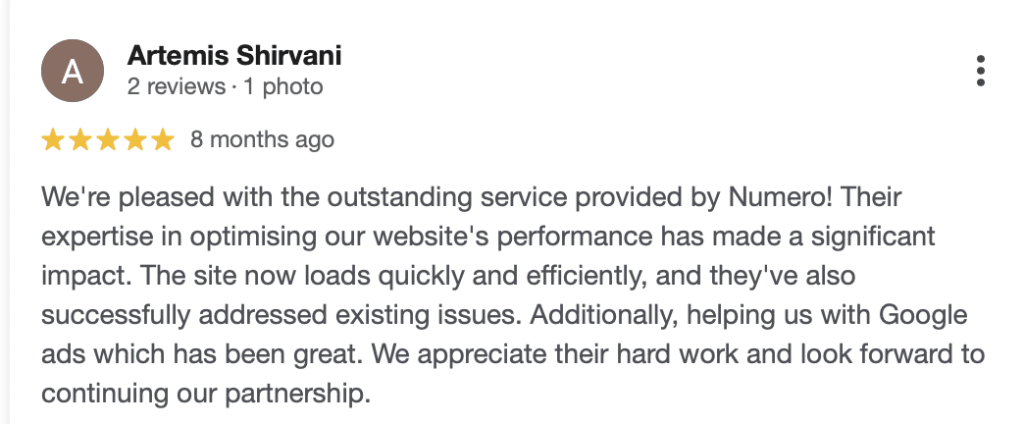
    Website speed improvements for Art Kollocsion

    Aspects that affect the cost of a new website

    Request a Free Quote

    1. Types of websites and their costs – from a simple one page site or a personal blog, modern websites are hugely varied. A simple business website needs a minimum of five pages (Home page, About Us, People, Services/Products and Contact Us). If you’ve got an ecommerce store, your site can have thousands of pages (one for each product you sell). And enterprise websites are frequently complex as they’ll include custom designed elements such as a CRM database and integrations with external APIs.
    2. Key cost factors start with buying a domain, hosting costs (numero® provides this), designing the website front end, the back end, any custom functionality, the development / coding to build the site and content such as words, pictures and videos. You may have a lot of these ready-made or they may need to be built from scratch.
    3. DIY vs hiring a professional – well…. this is interesting. There are simple, free drag-and-drop websites from Wix or Squarespace which you can build yourself. In general, learning as you go will be a much slower process than hiring a web design professional. We find that businesses start enthusiastically but then get busy with their jobs and the website project falls behind schedule. numero’s project managers are skilled at taking the load off you and delivering finished websites.
    Website testimonial from Whitestone Group Real Estate new build property developer

    4. How to budget for your website – the core ongoing costs you have to pay include maintenance and software updates, security and backups (daily is recommended), SEO / marketing to find new customers, and lastly the annual renewal fees for your domain, hosting and premium software plugins.

    5. Hidden costs to watch out for include premium plugins (many have a free version but advanced functionality costs), custom integrations with other business ERP systems or APIs, scalability (high traffic spikes, load balancing, page load speeds, caching, modular design and scalable hosting) and future upgrades. Allow for an upgrade cycle annually and a substantial redesign every 3 years for a business website.

    Dr Benjamin Chan’s medical practice website redesign

    How Much Does a New Website Cost?

    Building a new website can cost as low as USD $16 a month with a website builder whereas hiring a website design agency can cost you from $3,500 to $20,000 depending on your requirements. numero’s website builds are in the middle of this price range.

    Is it worth paying a lot for a website? Business website pricing needs to be decided based on CRO – conversion rate optimisation. If you don’t need a fast website, if your customers will wait for slow load times and if they won’t go to a competitor instead – you can build a simple, low-cost website. Most businesses know their clients are impatient, have a ‘time-is-money’ attitude and need high quality customer service.

    Do not choose the cheapest website designer. numero’s team work as hard on your website’s speed, performance and search engine optimisation as they do on the design. You are buying the full sweep of our expertise in performance marketing when we build your business website.

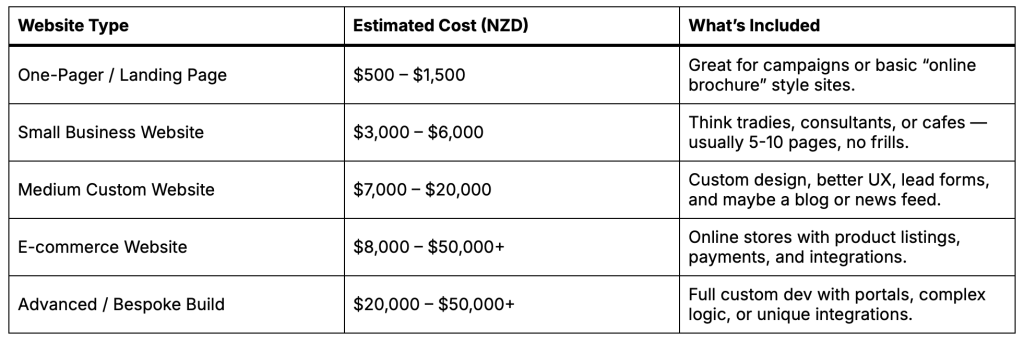
    Types of Websites and Typical Costs

    Website indicative prices suitable for NZ businesses in 2025

    Let’s take a look at some of the important aspects that will determine the cost of your new website design.

    Website Design Considerations

    Buying a pre-designed templated website theme can keep development costs low – but it also means that your website won’t be unique. A popular accountancy practice management service offered an out-of-the-box website as part of their software. The result was that every small-town accountant had an identical website (just different logo colours).

    numero’s web design team will often recommend using a ‘headless’ content management system. This means website editing is decoupled from the front end software and yet is still intuitive for your marketing team to use – ask us why this is a good choice. We aren’t tied to any software – getting the right outcome to suit your needs is what matters to us. For example there are many options for payment integrations – Stripe, Windcave, GoCardless and Paypal – their features and charges differ. numero® will help you choose the one best suited to your needs and budget.

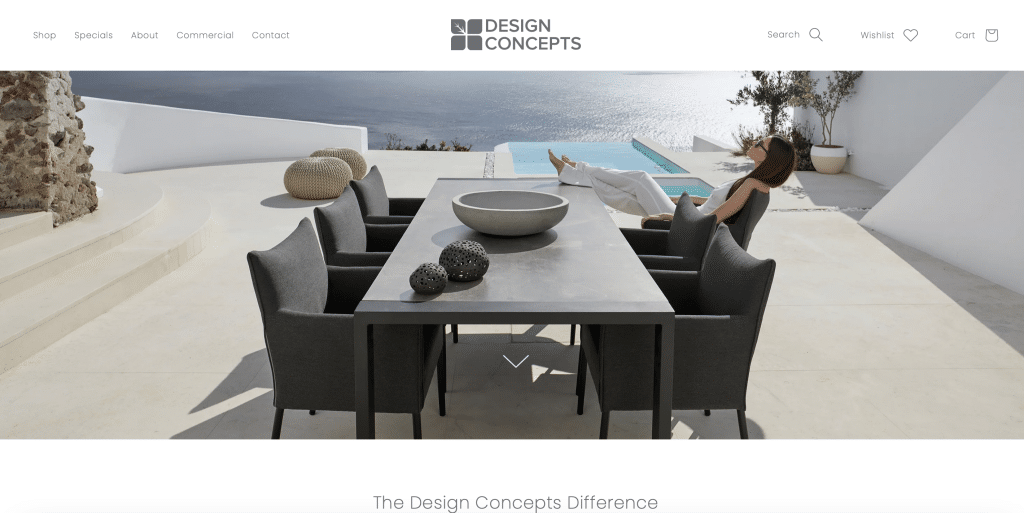
    Design Concepts ecommerce website built with Shopify by numero®

    Number of Pages

    Your website is incomplete without content. Web design agencies may charge based on the number of pages you need. Factors like business, industry, products/services affect the page count. An ecommerce website with a large list of products, for instance, will need more pages compared to a website for the local dentist.

    Typically, web design agencies will offer packages from the simple to the ultimate custom design. It’s worthwhile shopping around especially if your business only needs a simple website. Typical prices are based on

    • 1 to 5 pages
    • 5 to 10 pages
    • 10 to 20 pages
    • 25 to >50 pages
    Rapid Slabs and Precast Concrete site redesign testimonial

    Content slows you down

    Ask numero’s expert website project managers and they’ll tell you that the number one cause of late-running website design projects is content. Planning the production of your new website content starts with defining your goals for the redesign, auditing your existing content (keep, renew, replace), write an inventory of all content on a spreadsheet, assign roles (content lead, stakeholder alignment, external resource), then agree workflows for briefing, production and version control. If you’re an enterprise team integrating your website with sales enablement / CRM then Seismic is worth considering. Consider your collaboration platform for project management, team meetings and how feedback and approvals will work. When close to launch we recommend a content freeze to avoid last-minute changes, the redirect plan and testing must be completed on staging sites before setting the new website live.

    Out of date features website checklist

    The functionality and feature set is a clear sign that your website is elderly. Take “dark mode”, this was introduced on digital phone browsers during 2019 for both Android and Apple’s iOS. Dark mode affects websites when viewed on a mobile phone because the phone’s dark mode will try to force the website into that style. If the site isn’t built to flexibly switch from light to dark mode, you may find white text on a white background – making your website unreadable.

    Quick checklist for outdated visual, functional and content features

    If your site has one or more of these, get a quote for website remediation.

    • aesthetics – the site design has clunky layouts and screen widths
    • flash – don’t use this – trust us
    • non-responsive design – doesn’t adapt to mobile or tablet screen sizes
    • image quality is pixelated or stretched
    • slow load times
    • broken links and error pages (404 errors)
    • insecure – lacking HTTPS and no SSL certificate
    • display is broken on modern browsers like Edge, Firefox or Chrome
    • old copyright dates – a personal bugbear
    • events that are years old
    • no recent news
    • poor SEO
    • contact forms are broken, search bars don’t work
    • lack of social media integration, chatbots and payment choices (Apple Pay / Google Pay)
    • navigation is cluttered and menus are crowded
    • low use of accessibility features (alt text, poor contrast)

    Frequently Asked Questions About Website Design Costs in New Zealand

    How much does a new website design cost in New Zealand?

    A new website design in New Zealand typically costs between $3,500 and $20,000 NZD, depending on the number of pages, features, and integrations required. Simple one-page sites may start from $1,000, while larger ecommerce or enterprise websites can exceed $50,000.

    What factors affect the cost of a website?

    Website pricing depends on the design complexity, functionality, content creation, hosting, and integrations such as CRMs or payment gateways. Custom-built features and advanced SEO setup can add to the total cost.

    Is it better to build my own website or hire a professional agency?

    DIY builders like Wix or Squarespace are affordable but limited in SEO and scalability. A professional web design agency like numero® Auckland provides higher-quality design, faster load speeds, and conversion-focused optimisation.

    How often should I redesign my business website?

    Most businesses update or redesign their website every 3 years to keep up with modern design trends, mobile responsiveness, and SEO best practices.

    What are the ongoing costs of maintaining a website?

    Ongoing website costs include domain renewals, hosting, maintenance, security updates, and SEO. Budget approximately $50–$200 NZD per month for quality website upkeep and marketing support.

    Discuss Your Website Design Project

    We hope this helps you understand how much a new business website costs in New Zealand. If you would like to know more about our web design services in Auckland and to discuss your requirements with a web design specialist, contact us today. Or call us to fix a time for a no-obligation discussion about your options and choices for website design 09 390 3997.

  • Where can I get a website built?

    Where can I get a website built?

    Looking to build a website for your small business?

    There are essential three ways to go about it. You can either build it yourself using website builders, hire a freelance web designer or work with a website design agency in Auckland.

    Most small businesses may opt for the cheapest option, which in this case is a website builder. They are cheap (at least in terms of the upfront cost) and make the task of building a website easy and quick if you can find the time, of course!

    On the other hand, businesses that may find the features of website builders limited and unsuitable for their needs may be willing to invest the money to build a professional, feature-rich website that’s not just a brochure website, but a complete marketing system that can generate quality leads and sales for you.

    So before you sign up for the cheapest website builder, put down a deposit with a freelance designer or sign a contract with a digital agency, it’s important to identify your needs and goals. This will help you determine the best way to build your website.

    What Are Your Goals?

    If you thought a website is merely an online calling card or a brochure providing essential information about your business, products/services and contact details.

    Whether you are a brick and mortar business, a one-man business, a professional service, start-up, online business or an enterprise, a website is an essential investment in today’s digitally connected world.

    No matter what type of business you operate or the industry you are in, a website can help achieve your goals. Here are some things you could achieve through your small business website:

    • Showcase your portfolio
    • Generate bookings
    • Take payments
    • Have customers contact you
    • Collect email address to promote your business/products via email marketing
    • Sell online through an e-commerce website
    • Create a marketing campaign
    • Retarget visitors through PPC ads
    • Connect your social media platforms
    • Write blog posts to establish your authority
    • And more

    As you can see, there are unlimited possibilities to promote your business and market your products/services when you have a website. Not only can you do more with a website but you can use your website to improve your online presence, reach more customers and grow your business.

    Now that you know what you can use your website for, let’s take a look at the options to get your website built for your New Zealand business.

    Website Builders

    The internet is flooded with DIY website builders aimed at small business owners looking to build entry-level websites cheaply and quickly. From Wix and Weebly to Squarespace and Webnode, there are tens of site builders that make the task of building your website easy and simple.

    If you are looking to build a website cheaply and want complete control over the process, this is a good choice. But just because you can build your own website doesn’t mean it’s the right option for you.

    Even though the drag and drop interface of these builders makes the process easy, you will still have to spend a lot of time building your site. That’s not counting the time to learn how to use the interface and features of these builders.

    Your website on a site builder is not really your own. You can’t take it with you if you choose to move it to another platform or hosting service.

    The customisation options are limited, which means you will end up with a website that looks like thousands of other websites floating on the web.

    Hiring a Freelance Website Designer

    This is another most common option that business owners look to in the hope of building an affordable website. This option is definitely better than using a website builder as you get more sophisticated design and you enjoy the benefits of working with a professional designer.

    Although it’s not impossible to find a freelance website designer who can build a stunning, functional, user-friendly website, they don’t come often come cheap.

    On the downside, freelancers are typically one-person armies, which means they come with limited expertise. For other services such as SEO and copywriting, you may have to hire someone else.

    Another downside of working with a freelancer is that there’s no assurance for the kind of work you will get. You will have to do additional due diligence to find a reliable freelancer.

    Hiring a Website Design Agency in Auckland

    If you thought this option is only for medium and large businesses, think again! Whether you are a small business owner or a start-up, an agency will work with you to deliver a solution that meets your needs.

    Hiring a web design agency is the ideal option. If you are worried about the cost getting out of hand, there’s no need to worry. There are many professional web design agencies that offer stellar work at affordable packages.

    A web design agency in Auckland has a team of experienced web designers, developers, SEO specialists, PPC experts and copywriters. The team works together to deliver a holistic solution that helps meet your goals.

    Moreover, you won’t have to spoon-feed the experts at an agency. While you focus on your business, the agency will take care of building an aesthetically appealing, user-friendly and functional website that’s optimised for the search engines.

    The benefits far outweigh the cost of hiring a web design agency. You will get a website that represents your brand in the best possible light. Your website will be completely customised to suit your requirements, goals and budget. And you can expect excellent ROI with a lead generation machine that delivers the results you seek.

    Contact Numero

    Ready to discuss your web design project? At Numero, we have many years of experience in building bespoke websites for businesses across New Zealand. No matter the size or scope of your project, we will take the time to understand your goals to build a marketing system that generates quality traffic, leads and sales for your business. Contact us online to schedule a free consultation.

  • How Do I Create a Free Website NZ?

    How Do I Create a Free Website NZ?

    So, you’ve decided you want to create a free website NZ, but you are not sure where to begin. You are wondering whether building a free website is easy. With the availability of several different website builders, building a website is pretty straightforward.

    However, the question you should be asking yourself is whether you want to build a free website or a cheap, affordable website for your business.

    A free website builder comes with some limitations that you may not be fond of, especially if you are building a website for your NZ business.

    The first issue is the domain, which is never free. What you will get instead is a free subdomain with the site builder’s name in it.

    Second, the free website will feature ads, some explicitly visible and some not so.

    In short, your free website will not have the visual appeal and the essential features that you need to create the right first impression on your visitors.

    If you are still looking to create a free website in NZ, here are the steps to take.

    Step 1 – Choose a Website Builder

    The biggest hurdle is finding the right website builder to build your free website on. As you may already know, several site builders are offering free plans where you can build your website.

    What’s more, you won’t even have to worry about hosting your website as most of these site builders are hosted in the cloud. This also means that no matter where you are in New Zealand, you can build your free website easily. All you need is a computer and an internet browser.

    Let’s take a look at some of the top free website builders.

    • Wix – Wix is the biggest website builder. Its biggest draw is the stunning array of features that Wix offers for free. You get access to almost everything – appointment booking systems, photo galleries, email marketing and more. However, with the free plan, you have to make do with the sticky ad that shows up even as you scroll down. Not to mention the lengthy URL, which isn’t easy to remember.
    • Weebly – Weebly is another option. But then again, you get a website with a very visible and sticky ad on the page that expands when visitors hover over it. Weebly is a good website builder for its ease of use and the simple drag and drop website builder. The design options are limited but you can also add some features to your site.
    • Webnode – The biggest reason to choose Webnode is that the ads are not that visible. The ad is only visible when you scroll down to the bottom of the page. It blends so well with the design that you may hardly notice it, at least at a glance. Webnode allows you to build as many pages as you like. No limits whatsoever. And there’s a good variety of mobile-friendly templates. If you would like to connect your own+- domain name, you can do so by upgrading to their Limited plan, which is the cheapest plan the service offers.
    • UCraft – This is a good option if you already have a domain name and want to use it with your free website without upgrading to a paid plan. However, there’s a downside – you can only create one page with the free plan. Moreover, the website builder is not as easy to use when compared to other website builders. On the flip side, the ad is very subtle and does not take away the limelight from your brand or message.

    These are some excellent free website builders but as you can see, they are not really free. If you want to connect your domain name, need access to all features or in some cases add additional pages to your website, you will have to upgrade to the paid plans.

    Step 2 – Choose Your Domain Name

    Once you have decided which website builder is right for you, it’s time to choose a domain name for your business website. When it comes to a business website, there’s no scope for a subdomain as it looks unprofessional. When you want to build credibility and earn the trust of your prospects, you need a domain name.

    Step 3 – Sign Up with the Site Builder

    The next step is to sign up with the website builder of your choice and set up your website. Here are the steps to take:

    • Sign up using your email address. Some site builders allow you to sign up using your social network account.
    • Pick a template. Explore the templates by categories and choose one that you feel suits your business and goals best.
    • Customise your site. Head over to the dashboard and look for the customisation tools to create your website. Explore the available options before you move on to the next step.
    • Design your business website. It’s time to build your website and set it all up. Upload the content including text, videos and images. Create as many pages as needed. This step can take a lot of time – from a few hours to even weeks depending on the time at hand, your skills and the kind of design that makes you happy.
    • Choose your plan. Look for a plan that covers your website building requirements.
    • Connect your domain name. If you already have a domain name, it’s time to connect it to your website builder. If you don’t already have a domain name, you can pick one right from your site builder.
    • Publish your website. Your website is ready to go live.

    Is a Free Website Really Free?

    Now that we have looked at the important steps of building a free website, it’s time to consider the real cost of a free website. As we have already seen above, a free website offers limited scope and comes with a lot of caveats, which are not favourable for a business website.

    Eventually, you will have to upgrade to a paid plan. A better option is to hire a web design agency in Auckland to build a professional website at affordable prices. You will not only end up saving your time but you will get a customised website that’s tailored for your business and needs. Contact Numero today for a free quote.

  • How Do I Get Leads from Web Design?

    How Do I Get Leads from Web Design?

    Every business owner dreams of having an unlimited flow of leads. No matter the business you operate or the industry you are in, a professional website can go a long way in generating quality leads for your business.

    So what does it take to build a lead generation website? In this post, we take a look at some of the essential features to include when building a lead generation website.

    Provide Social Proof

    People want to get a product that’s proven to work and is trusted by others. Your prospects would like to know that others are using your products/services and are happy with your company.

    Including case studies and testimonials to your site will help boost your credibility and add validation to your brand. And that’s social proof! In short, people trust your brand if they see that others trust you. So if others are using your product/service, your visitors would want to do use it too.

    For instance, if your target customer is a working mom, your visitors will feel at ease with your brand when they see case studies and testimonials from other working moms. They will instantly relate to their experience and testimony. These testimonials will act as references for your business.

    Use a Call to Action on the Homepage

    The aesthetic appeal of your homepage will help grab visitors’ attention but it’s your call to action (CTA) that will help retain that attention.

    But it’s wise not to bombard your website visitors with a wall of text.

    Your homepage is the starting point of your marketing funnel. So make the most of this by offering a valuable lead magnet to encourage your visitors to subscribe to a recurring campaign, like a newsletter.

    Here are some excellent CTAs to add to the homepage:

    • “Book Your Free Trial” – A free trial/demo is a great way to grow your company. This allows you to generate demand for your products/services and build a list of prospects who are currently trying your product. On the homepage, place a CTA button and form for a limited-time free trial of your product. Use the form to collect the visitors’ name and email address. Once the demo/trial is complete, follow up with the prospect to take things forward.
    • “Subscribe to Our Newsletter” – Most people visiting your website for the first time aren’t ready to make a purchase. You can help them to get to know your brand and products/services better without any commitment/effort by inviting them to subscribe to your newsletter. Follow up with the prospects who opt-in to your mailing list to understand their level of interest and eventually convert them into qualified leads.

    Contact Information

    Including a contact number on your website boosts consumer trust and adds credibility to your brand and offerings. Even if your visitors do not contact you, seeing a contact number will give them peace of mind.

    Live Chat Service

    Live chat programmes are becoming a must-have tool to have on a website. Many visitors expect this feature when they want to know about a business they are considering. In the absence of a live chat feature, you may be missing out on highly valuable leads.

    Before you put in place a lead generation strategy using live chat, begin by auditing your site to identify the pages that your visitors spend the most time on. A professional web design agency in Auckland can seamlessly integrate a live chat tool with your website.

    You could even consider integrating your customer care team with the live chat feature. This way you can make sure the needs of every visitor are addressed.

    Use Videos

    Online videos are a great way to close the gap between the online world and reality while increasing your conversion rates greatly. This is especially true for e-commerce websites.

    Not just any video will do. Be sure the video speaks to your visitors rather than at them. Users who watch a product video are more likely to convert compared to those who just view an ad.

    Videos make your visitors feel more informed and help validate their purchase.

    Invest in a Customised Website Design

    This goes without saying, but when you want to generate quality leads, you must avoid generic templates and websites that look like a million others already floating on the internet.

    Instead, get a customised website within your budget. Be sure to make the purpose of your website clear so your web design agency can build a website that’s tailored to your business, target audience and goals.

    With a clear goal in mind, your web design agency can customise your website for lead generation rather than simply building a visually appealing website. A professionally designed, user-friendly website also builds trust and confidence in your brand, prodding your visitors to take the next step.

    Test Continuously

    No tip will work for you unless you test them to identify what works for your specific goals and requirements. When you want to improve the quality and number of leads coming your way, it’s important to proactively test new lead generation techniques and make constant improvements to your website. There’s no other way to identify what works for your business than proactive testing.

    There are many aspects of your website that you can test and improve including:

    • Calls to action
    • The layout of the landing pages
    • Images and visuals you are using
    • Test different offers – free trial, free training, free gift, free coupon, etc.
    • Sales copy

    Need a Lead Generation Website?

    If you are ready to build a lead generation website for your business, contact Numero today. We are New Zealand’s premier web design agency with years of experience. Whether you want to build your online presence or need help taking your website to the next level, we can work with you to bring your vision to life.

    Contact us today to discuss your website design requirements.

  • How Much Does it Cost to Build a Website in NZ?

    How Much Does it Cost to Build a Website in NZ?

    There’s no straightforward answer to the question – “how much does it cost to build a website in New Zealand?”

    It’s somewhat like asking “how much does a watch cost?” You could buy one for a few dollars. It may work for a few years or even a few days; no one can tell. On the other hand, you could buy a luxury watch for thousands of dollars, but for most of us, that could be excessive.

    The same holds for web design costs. So the answer depends entirely on your requirements and how you go about getting the job done. At the lower end of the scale, you could get a website for almost next to nothing by building one yourself. On the other end of the scale is a website designed by a web design agency, which can cost a few thousand dollars. And then there are many other options in between.

    Countless Options, But Only One True Choice

    • There’s no dearth of free DIY website builders these days. But it can take weeks and months to set things up what with learning the ropes and experimenting with different layouts and designs! You may have to make do with limited features and even ads on the website.
    • Then there are premium website builders, but you will still have to take the time to build the website. The big question is – do you have the time?
    • You could hire your friend’s, cousin’s son who knows how to work with WordPress, to build you a website. Sure, you won’t have to put in all the hard work, but you may pay a bit more. Not to forget, the cost of fixing all the things when things begin to go south (and they will!)
    • You could hire a freelancer or a one-man web design agency. The fees may be close to the more realistic cost of professional service, but you’ll have to make do with limited experience, resources and expertise. There’s no guarantee it will be a hassle-free experience. More often than not it isn’t!
    • You can even hire a web design agency in New Zealand to build your website – like Numero, for instance! With a team of web designers with years of experience building websites for an array of businesses, you will have a completely hassle-free experience.

    If you are looking for a website that delivers the results you seek and a website that’s free of bugs, errors and issues – there’s only one true option to consider – hiring a web design agency!

    How Much Does a Small Business Website Cost in New Zealand?

    In our opinion, the question shouldn’t be “how much a website costs?” Instead, the question should be, “how much do I need to invest to get a website that delivers results for my business?”

    You need a website that is user-friendly, SEO-friendly and conversion-friendly. Building such a website is no mean feat. It takes experience and lots of time. And that can never come cheap!

    At the end of the day, you get what you pay for. The lower the web design fees, the higher the compromises you can expect to make. You may save in the short-term but you must also account for the cost of the business you will lose owing to a poorly developed website!

    A well-developed website can deliver traffic, leads and sales for your business.

    And that’s something you don’t want to compromise, do you?

    When you think from that point of view, your website is not a cost but an investment!

    So how much would that investment be?

    A custom small business website in New Zealand would cost from $1,000 to $10,000 and upwards, depending on the features you want and the size of your site.

    Aspects that Determine the Cost of Your Website

    There are 5 important aspects of web design that directly affect the cost.

    • Project Size – The cost of your website is directly proportional to the size of your project. The greater the scope of your project, the more the time needed to build and hence, the higher the cost. The scope of your project is defined by the number of pages you need, the kind of features you need (booking system, newsletter integration, etc.), and the complexity of the design.
    • Design Style – The cost of your website design project will depend on the number of unique designs your project needs. For instance, the homepage, blog, product page, and contacts page, each demand a unique design. The more the number of unique designs your site needs, the higher is your investment.
    • Ecommerce – An e-commerce website demands an array of features such as security, shopping cart, payment gateway, cookies, products, users, etc. This will increase the budget of your project significantly.
    • Database – If your project involves a database integration, it will call for extensive technical expertise and experience in solving issues that arise. If you need database integration, your web design cost will go up.
    • SEO Integration – A good web design agency will make SEO optimisation a part of its web design project. But when you need to create new content for your website, it must be optimised for SEO and that will carry a cost.
    • Additional Features – There are additional aspects that can increase the cost of your website such as content writing, additional pages, blog setup, photo galleries, newsletter integration, professional photography, etc.

    Web Design New Zealand – What to Expect?

    A professional web design agency will offer the following features as standard for all their standard web design charges:

    • Custom website design (instead of a template)
    • Content Management System (such as WordPress)
    • Responsive design to make sure your website works on all devices
    • Optimised code to make sure the website loads quickly
    • Features such as slideshow, contact form and social media links

    Contact Numero for a Professional Website Today!

    As mentioned above, your website is an investment. So make the right choice. Rather than choosing an agency based only on cost, it’s important to look for an agency that can build a winning solution for your website. And that’s something Numero can offer you. Contact us today to discuss your web design project in New Zealand!

  • On Page One but Not Getting Leads? Why Not?

    On Page One but Not Getting Leads? Why Not?

    There’s perhaps no feeling worse than putting the time, effort and money to creating content and building traffic to your website only to find that it’s not converting visitors into leads. Your website has a first page ranking and you find that you’re not generating any more leads than you were before the rise in the ranking!

    It’s difficult to keep calm, collect yourself and put all the more effort in continuing you’re your SEO efforts when you don’t see any real results.

    Trust us, we know that feeling. It’s a frustrating situation but it’s not unsolvable. And more often than not, the solution is far simpler than you thought.

    In this post, we look at some of the most common reasons why you are not generating leads despite the traffic.

    Your Contact Forms are Complicated

    Your site could boast of fabulous content but if you are not backing it up with a good web form, you are losing valuable leads.

    You might be tempted to procure as much information you can capture from your visitors. However, minimalist contact forms do far better than complicated forms.

    Make sure your lead capture form contains as few fields as possible. Retain only those fields that are necessary.

    Why alienate your visitors with a complex form when procuring an email address can keep the window of opportunity open? You can always get back to them to fill out a much complex form once they are primed and ready!

    Follow these tips when building a contact form:

    • A headline that makes the offer crystal clear.
    • A brief explanation of how you will use the contact information.
    • The least number of fields.
    • A link to your privacy policy page.
    • A bright CTA.
    • Information about data security.

    Weak or Vague Calls to Action

    One big reason your site is missing out on leads is that your CTAs are weak. Take a good look at the CTA buttons on your website and landing pages.

    If you are not giving your visitors a good idea of what you expect them to do – i.e. a strong CTA – they will leave your site no sooner than they landed!

    A generic “submit” button won’t cut it! This word not only has a subconsciously negative connotation but it’s also extremely boring and passive.

    Your CTA should have an active voice, clearly tell your visitors what they must do next. If your goal is to generate a sale, your CTA could be “Buy Now”. If you are asking for their email address in exchange for a free download, your CTA could be “Yes, I want my free report”.

    Your Website isn’t Offering a Solution

    A website that’s aimed at generating leads should deliver value. Sure, some sort of self-indulgence is fine but if your website is about nothing else but you, you and you – it will alienate your visitors, leaving them wondering how you can help them.

    You might be offering a world-class product. However, if you don’t tell people how you can help solve their problems; how your product can help relieve them of their pain points, they won’t be convinced! As a result, they won’t convert.

    Address prospects in a friendly tone, establish that you recognise their pain points, show that you can provide a solution and you will see a spike in conversions!

    Insufficient or Poor Content  

    Analyse your website’s engagement metrics.

    Are your visitors spending sufficient time looking at your content, images and videos that communicate your message?

    Is their stay too short or long?

    If your visitors are leaving your website soon, it’s a sign you lack sufficient content. The good news is that it’s easy to add content. Simply brainstorm some ideas and get the entire team involved. Better yet, hire a copywriter!

    If you have more than sufficient content, then audit the quality of your content. Perhaps your visitors can’t find the information they’re after? Is it possible that the content isn’t engaging enough?

    Here are some pointers to help improve your content:

    • Be on-point. Do not beat around the bush lest your visitors get frustrated and leave your page.
    • Use a range of media to grab visitors’ attention: images, text, videos, games, interactive elements, etc.
    • Make sure that you are writing content that resonates with your audience. If your target customers are laypersons, steer clear of jargon that they’d have a hard time to understand.
    • Be clear and direct when talking about how your offerings will solve their pain points. Let them scroll down to find out specific features. This way, you are neither distracting them nor diverting their attention by feeding too much information than they’re prepared to take in!

    Poor Web Design

    An outdated or poorly performing website can dramatically reduce your conversions. Even little details such as typeface and colour choice can make or break your conversion rate.

    Here’s what you can do to begin with:

    • Take the time to define your target audience. Who is your target customer?
    • Implement A/B testing to identify which colour-scheme or layout delivers higher conversions.

    If your website still doesn’t deliver results, it needs more work.

    Perform a thorough site audit to identify the weak points. See if your site has any of these signs of a bad website design:

    • Your website is not mobile-friendly.
    • The design is inconsistent.
    • The imagery used is of poor quality.
    • Readability is awkward.
    • Slow website load speed.
    • Lacks whitespace.
    • The user journey is not clear.

    Want to Improve Your Website Conversions?

    If your website isn’t generating enough leads, it’s a huge cause for concern. Your website is delivering poor or worse yet, negative ROI. And that’s the last thing you want!

    It’s especially frustrating when your website has a first page ranking but is not poised for lead generation. Follow these tips to fix some of the most common problems with conversion and you will be on the right track.

    At Numero, we have many years of experience putting together winning lead generation campaigns for our clients. Get in touch with us today to speak to a lead generation specialist!

  • What Percentage of the Google Search Traffic Goes to the Top 3 Searches?

    What Percentage of the Google Search Traffic Goes to the Top 3 Searches?

    When it comes to online presence, all business owners have the same goal – to rank their website at the top of the search engine results pages (SERPs).

    Although an uphill task, it’s a goal worth pursuing. After all, a top position in the search results can skyrocket your organic click-through rates.

    In fact, a ranking on the first page won’t mean much if your website does not show on the top 3 spots. According to a study by Backlinko, the top 3 results in organic search get 75% of all clicks!

    Let’s take a look at some critical findings of this study that throw light on the value of showing up at the top spot:

    • The number 1 result in the organic SERPs receives an average of 31.7% of the traffic.
    • The second position gets 24.71% of traffic and the third position gets an average of 18.59% of all clicks.
    • Organic click-rates for positions 7 through 10 are almost the same.
    • Moving up one spot in the SERPs will increase traffic by 30.8% on average. But that depends on which position you are moving from and to. Moving from #3 to spot #2 will give a remarkable boost in CTR. But moving from #10 to #9 or even #7 won’t make a huge difference to your traffic.
    • The tenth position receives an average of only 2.5% traffic.
    • URLs that feature a keyword receive 45% more clicks compared to those that do not feature a keyword.
    • Title tags with a question receive 14.1% more traffic compared to pages that do not have a question in the title.
    • Title tags that are 15 to 40 characters long receive the highest traffic. Per the study, pages that have a title tag length of 15 to 40 characters see an average of 8.6% more traffic compared to sites that don’t fall in this range.

    #1 Ranking – A Long-Term Process

    Most business owners want to rank on the first spot of Google SERPs. It’s the ultimate goal! At the same time, it’s important to remember that getting to the first position on Google is not an overnight task.

    In fact, a #1 ranking in the SERP is the result of extensive hours and often, many years of time and money.

    This holds true especially for extremely competitive keywords with websites that have existed for decades. In such cases, you are up against heavyweights who have been around for years, have unmatched domain authority and a ton of backlinks. They are churning top-quality content and receiving numerous backlinks in turn.

    With increasing competition and more content being added than ever, that’s a task that’s extremely difficult to achieve.

    In their desire to achieve this pipe dream, many people end up taking their business down. Getting a top spot on Google is a fantastic vision but it might not be worth the price you end up paying.

    So instead of wondering how much traffic a top-ranking page gets and chasing a dream that might not prove valuable to you, ask yourself how much time, effort and money you are willing to put in? After all, you get what you put in.

    Tips to Improve Your Search Rankings

    If you are starting out just now, you can’t hope to rank on the first page anytime soon. But here are some strategies you can consider to improve your rankings in Google.

    Optimise Your Website

    Google penalises any page that fails its extracting usability and quality standards. So before you begin to build backlinks or add new content to your website, it’s important to optimise your website for usability.

    Are there any broken links? Moved images? 404 errors? Fix and update those errors to make your website offers a consistent user experience.

    Once you make these essential updates, your website is ready to go up the rankings ladder in Google SERP.

    Go Mobile-Friendly

    Look up your website on a mobile device. Do you have to squint or zoom-pinch to be able to read the text? Are the links so small that they don’t recognise your clicks?

    Now think about your visitors. What kind of impression will they have with such a website? Will this experience annoy them or impress them?

    Your answer will inform the next step you need to take. The solution is to invest in a mobile-friendly website that is easy to navigate and use no matter the device it’s accessed on.

    Build Backlinks

    Backlinks are at the core of improving a website’s search rankings. Search engines look at the anchor text (the text third party websites use when linking back to your website) in a piece of content to assess its relevance to the URL it’s pointing to. If most links use the same anchor text, it can raise suspicion and Google may even penalise you.

    Google will also consider the quality of the pages that you’re linking to. They must be relevant to your content, whether they lead to another website or a page on your own site.

    Focus on Gaining Authority

    Google does not want to compromise the user experience it offers to its searchers. So it won’t rank any website that is not relevant or lacks authority.

    Your priority should be to establish your authority as a reliable source of information that your users trust. When Google recognises that, you can expect an improvement in your search rankings.

    That’s a long shot that will take a lot of time and effort but it’s well worth it. Begin by publishing high-quality content on a regular basis. Work on increasing engagement with your content by sharing on social media and even publishing guest posts on third-party blogs.

    Parting Thoughts

    Your site is at the core of your digital presence. If you want to improve your online presence, you must work on improving your search rankings so more people can find you. A Numero, we have years of experience in SEO and can help your site get better search engine rankings in Google.

    Get started today! If you are ready to improve your online visibility, contact us today!

  • How to Increase My Conversion Rate Using Landing Pages?

    How to Increase My Conversion Rate Using Landing Pages?

    Most businesses spend a lot of time driving traffic to their sites and blogs in the hope that visitors will convert on their own. However, if these destinations don’t attract prospects into the sales funnel, engage and convert them into paying customers, all your effort is going to waste.

    That’s where landing pages come into the picture. They are an important part of inbound marketing. Landing pages are aimed at persuading visitors to take a specific action upon landing there. These goals differ with industry. For a software company, it could be a ‘free trial’ whereas, for an online store, it could be ‘buy now’.

    A great landing page converts your visitors into qualified leads. But receiving a ton of traffic isn’t enough. Your landing pages should convert your visitors. In this guide, we look at some techniques to help increase your conversion rates using landing pages.

    Write Attention-Grabbing Headlines

    The headline is an important element of your landing page.

    You have all but a few seconds to impress your visitors and grab their attention. So be sure to keep your headline on point, bold and benefit-driven. That’s the easiest way to gain your visitors’ attention.

    Blogs with catchy and useful headlines see the most shares on social media. This holds for landing pages as well.

    When you want to keep your landing page conversion rate high, your headline should be short, creative, solve a specific problem and create urgency.

    Include Testimonials and Reviews

    Testimonials are known to increase sales. When done right, a positive endorsement from other people will assure your visitors about your credibility and legitimacy.

    There’s nothing more powerful than word of mouth marketing; reviews and customer testimonials are the closest form of social proof on the digital medium.

    However, be sure to use testimonials only after you have delivered results.

    A lot of businesses use reviews and testimonials that are weak and highly generic. Avoid writing the testimonials yourself or paying someone for them.

    Use CTAs that  Compel Visitors to Take Action

    CTAs or calls to action are a crucial element of your landing page. It’s not just a button; after all, this is where the action happens.

    Think about the relevance and value for the visitors when designing your CTA. Generic CTAs like “sign up”, “submit” or “click here” don’t tell your visitors what they can expect to receive by taking the desired action.

    Every landing page you build should have one call to action that tells your visitors what they must do next. Avoid placing more than one CTA to avoid confusion, which can affect conversions.

    Include Relevant Videos

    Your landing page must engage your visitors until they convert. Videos are a great way to engage your landing page visitors.

    When done right, videos can help boost your landing page conversion rate by 86%.

    One idea is to create an explainer video where you explain what your organisation does or what your offer is all about. A face-to-face, honest, conversational video that addresses your prospects can go a long way in improving your conversions.

    When creating a video, be sure to follow some basic best practices.

    Use low volume music in the background. This can improve engagement and help hide any audio inconsistencies.

    Use captions. This can help engage users who keep their devices muted.

    Get Rid of Distractions

    When designing the landing page, avoid going overboard.

    Keep distractions to the minimum and focus on getting to the point right away without leaving any room for the visitors to be distracted from the end goal of your landing page.

    Here are some tips to remove distractions:

    • Use minimal navigation elements. Avoid putting too many links in the navigation bar or the sidebar. This can distract your visitors and adversely affect conversions.
    • Limit form fields. Take a good look at your lead capture form. Ensure you are not trying to collect a lot of data at once. If visitors feel that they are giving up a lot more than they are receiving back, they are unlikely to convert.
    • Avoid pop-ups. Pop-ups are annoying and distracting, especially when you want your visitors to focus on your offer.
    • Avoid information overload. In your copy, avoid giving information about anything other than your offer.

    Place Important Information Above the Fold

    The phrase “above the fold” originates from the newspaper industry. The most attractive stories would be placed on page one above the fold so people could see the headlines and would be enticed to buy the newspaper.

    You can follow this technique for your landing page by placing the most important elements above the digital fold – the point where the visitor must scroll down to read further.

    Keep Testing

    Every little detail on your landing page can affect your conversion rate. So it is imperative to test your landing pages as frequently as you can to determine what’s working in your favour and what’s not. Look at these numbers to understand the benefits of constant testing:

    Conclusion

    Landing page optimisation is not an easy job. What’s more, there’s no set formula to getting your landing page right. It’s a proactive process that calls for your time, attention.

    There are a variety of errors that could mar the performance of your landing pages. The above tips and techniques can help counter the most critical ones. However, we hope by sorting these common issues, you can improve your landing page conversions.

    Don’t have the time or the resources to improve your landing page for conversions? Get in touch with our landing page conversion optimisation specialists today.